
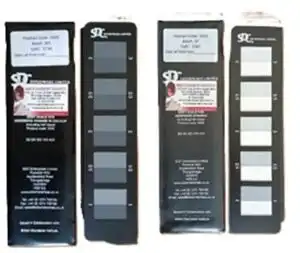
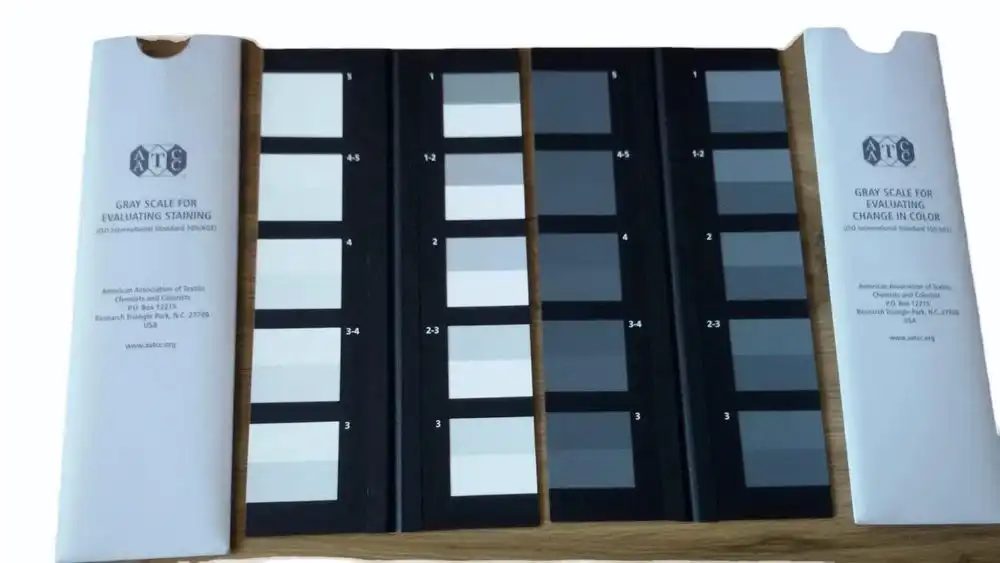
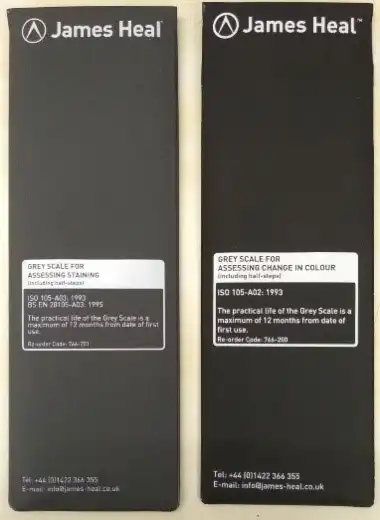
Grey Scales for Colour Fastness and Staining Assessment
Grey Scales are standardised visual assessment tools used in textile testing laboratories to evaluate colour change and staining after wet processing, washing, rubbing, and light exposure tests. Each scale consists of a set of grey and white chips arranged to represent defined contrast steps, allowing technicians to compare a tested fabric sample against a reference and assign a numerical rating.
There are two main types: the Grey Scale for Colour Change, which measures how much a fabric’s original shade has faded, and the Grey Scale for Staining, which measures how much colour has transferred onto an adjacent white fabric. Both are essential for colour fastness testing under ISO 105 and AATCC test methods.
Textile mills, garment exporters, fabric testing laboratories, quality control departments, and academic research institutes rely on Grey Scales to ensure consistent, buyer-compliant fastness ratings before shipment. Using a calibrated, standard-compliant Grey Scale reduces subjective judgement errors and helps labs deliver repeatable results that overseas buyers trust.
Amith Garment Services supplies genuine, standard-compliant Grey Scales sourced from recognised textile testing consumable brands, backed by over 25 years of experience serving Indian textile laboratories. Every scale is supplied with proper documentation for traceability.
-
Major Advantages :
- Stringent quality control, including colour-difference measurement tests undertaken by independent assessors.
- Ease of use, with sliding scale in a cardboard sleeve and having a protective plastic envelope.
- Each scale can be independently used, minimising handling and possible soiling in use.
- Each scale has a nine-point gradation to provide more accurate assessment.
- Comes in ISO standard (from S.D.C UK) and American standard from AATCC – USA.
- Helps grading the tested specimen after conducting the rubbing test (grey scale for staining) and wash fastness test (grey scale for colour change).
- Also used for colour matching with original specimen (grey scale for colour change ).
- Grading of 1 up to 5 can be done.
- For assessing staining that occurs during fastness testing. Consisting of nine pairs of non-glossy grey or white and grey colour chips, which illustrate the perceived colour difference corresponding to fastness ratings 5, 4, 3, 2 and 1, with intermediate half steps in accordance with the requirements of ISO105.
Get in touch with Amith Garment Services for pricing and availability.
Frequently Asked Questions:
What is a Grey Scale used for in textile testing?
A Grey Scale is used to visually evaluate colour change or staining after textile colour fastness tests such as washing, rubbing, perspiration, or light exposure. Technicians compare the tested sample with the grey and white reference chips to assign a fastness rating from 1 (poor) to 5 (excellent) according to ISO standards.
What is the difference between a Grey Scale for Colour Change and a Grey Scale for Staining?
A Grey Scale for Colour Change measures how much the original fabric shade has faded after testing, while a Grey Scale for Staining measures the amount of colour transferred onto an adjacent undyed fabric. Both scales are commonly used together during textile colour fastness evaluations.
Which standards govern Grey Scale usage in textile laboratories?
Grey Scales are used according to internationally recognized standards, including ISO 105-A02, ISO 105-A03, and AATCC Evaluation Procedures 1 and 2. These standards specify the rating method, viewing conditions, and lighting requirements to ensure accurate and repeatable results accepted worldwide.
What is a Grey Scale in textile testing?
A Grey Scale is a standardized visual reference tool containing grey and white chip pairs used to assess colour fading or staining after textile testing. It helps laboratories assign a colour fastness rating from 1 to 5 in accordance with ISO or AATCC testing methods.
How does a Grey Scale measure colour fastness?
A Grey Scale measures colour fastness through visual comparison. The technician places the tested fabric beside the Grey Scale under standard lighting conditions and matches the level of contrast to the closest reference chip pair, which determines the fastness rating.
Why should textile laboratories use a certified Grey Scale?
A certified Grey Scale provides accurate, repeatable, and internationally accepted colour fastness ratings. Using certified reference scales helps laboratories maintain compliance with ISO and AATCC standards, minimize testing errors, reduce shipment rejections, and meet buyer quality requirements.