
Conditioning Chamber — Standard Atmosphere Equipment for Accurate Textile Testing
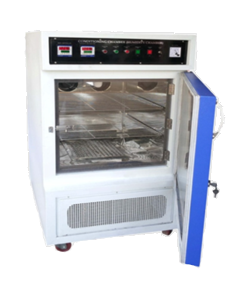
A Conditioning Chamber is a laboratory instrument that holds textile and garment samples at a fixed temperature and relative humidity before physical testing begins. Fabrics and yarns absorb or release moisture depending on their surroundings, and this changes their weight, strength, and dimensions. A Conditioning Chamber removes that variability by bringing every sample to the same standard atmosphere before it goes through tensile, tear, bursting strength, or GSM testing.
Amith Garment Services has supplied textile testing instruments across India since 1999, backing every Conditioning Chamber with calibration support and technical guidance. Contact our team for product specifications and a quote suited to your lab’s testing volume.
Purpose
Used to condition the test samples at specified temperature and humidity for specified time.
Features
- Microprocessor based control for accurate & consistent performance.
- Perforated Stainless Steel tray for conditioning sample.
- Inner chamber consists of anodized aluminium or S.S. and outer wall of M.S. Sheet duly painted.
- Working under constant rate of increasing Hydraulic pressure
- The gap of 75 mm between the outer and inner wall id filled with special grade glass wool to prevent thermal losses.
- Air circulation fan is fitted to maintain uniform temperature and humidity condition throughout the chamber.
- Digital display of Humidity & Temperature.
- Humidity is controlled through an imported humidistat.
- Steam flow is maintained for humidity.
Related Standards
- ASTM D 1776, ISO 139, ERT 60-1, DIN 50015, BS EN 20139/ 20187
Frequently Asked Questions:
What is a Conditioning Chamber used for in textile testing?
A Conditioning Chamber maintains fabric and yarn samples at a controlled temperature and humidity before physical testing. It ensures that ambient moisture does not affect test results and is commonly used before tensile strength, tear strength, GSM, bursting strength, and other textile performance tests.
Why is conditioning required before textile testing?
Textile fibres naturally absorb or release moisture depending on the surrounding environment, which can alter their weight, strength, and dimensions. Conditioning every sample to a standard atmosphere ensures test results accurately represent the material's true properties rather than temporary moisture variations.
What temperature and humidity does a Conditioning Chamber maintain?
Most textile laboratories condition samples at approximately 20–27°C with 65% relative humidity (RH), following internationally recognised standard atmospheric conditions for textile testing. The exact settings can be adjusted to meet specific test methods or buyer requirements.
What is a Conditioning Chamber?
A Conditioning Chamber is a laboratory instrument that keeps fabric, yarn, and textile samples at a controlled temperature and humidity before testing. This prevents moisture in the air from influencing test results and improves overall testing accuracy.
How does a Conditioning Chamber improve testing accuracy?
By bringing every sample to the same standard atmospheric conditions before testing, a Conditioning Chamber eliminates moisture-related variations. This allows strength, weight, dimensional stability, and other test results to remain consistent, repeatable, and comparable across different batches.
Why should labs use a Conditioning Chamber before physical testing?
Without proper conditioning, humidity differences can cause identical fabric samples to produce different results on different days. A Conditioning Chamber ensures reliable, repeatable, and audit-ready test reports while helping laboratories comply with international textile testing standards.