
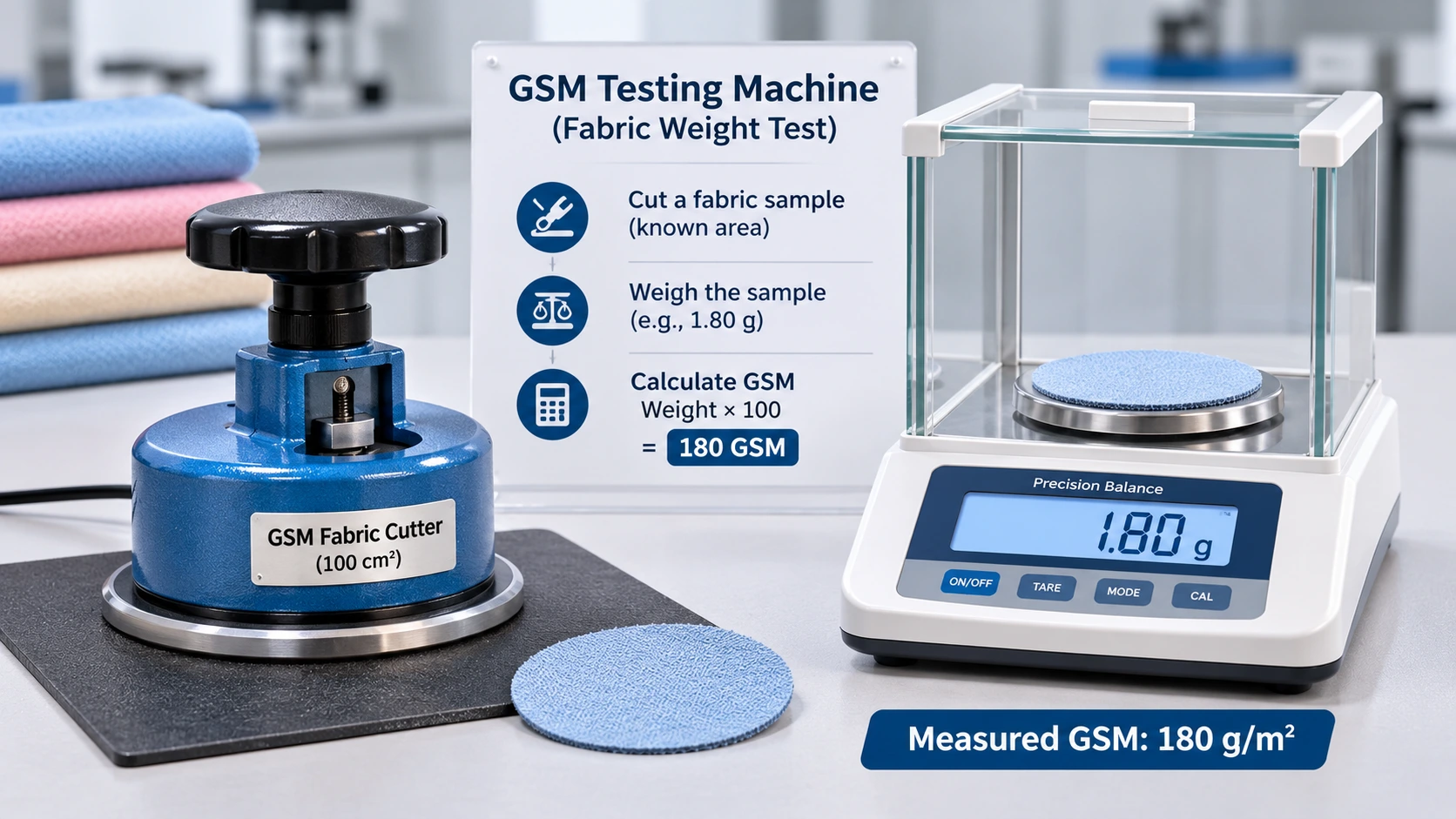
Walk into a fabric testing lab in Tiruppur or Bangalore and you will usually find the same setup on the bench: a circular cutter, a precision balance and a stack of round fabric swatches. That setup is what most people mean by a GSM testing machine. It tells you how many grams one square metre of fabric weighs. That figure affects cost, drape, durability and buyer approval.
This guide explains how a GSM testing machine works, which methods and standards apply, and how to get results you can trust.
What Is a GSM Testing Machine?
GSM stands for grams per square metre. It is the standard way to express fabric weight and compare one fabric with another.
A GSM testing machine is textile testing equipment used to measure fabric weight in grams per square metre. In most labs, a GSM cutter machine cuts a sample of fixed area, and a precision balance weighs it. The result helps verify fabric quality, specification compliance and consistency before production or shipment.
In everyday use, the term covers a GSM cutter machine plus a digital GSM balance for fabric testing. Some suppliers use it for the cutter alone, so always check what is included.
Why Is GSM Testing Important in the Textile Industry?
Fabric weight is linked to fabric construction. Yarn count, thread density (or stitch density in knits), fibre type and finishing all change GSM. If the GSM drifts, something in the construction or process has usually changed.
Fabric GSM testing matters because fabric weight affects cost, feel, drape, strength and performance. A fabric that drifts from its specified GSM can cause buyer rejections, inconsistent garments and yield problems. Regular testing on a GSM testing machine lets mills, exporters and labs confirm that each lot matches the approved standard.
In practice, a merchandiser may receive a 180 GSM jersey order that measures 165 GSM on arrival. That 8% gap changes handfeel, opacity and shrinkage behaviour. A quick check at goods-in catches it before cutting begins.
For garment exporters and fabric manufacturers in India, GSM is also a standard line on buyer specifications and inspection reports.
How Does a GSM Testing Machine Work?
The working principle is simple: known area, measured mass, calculated density.
A GSM cutter machine uses a sharp circular blade to cut a fabric specimen of fixed area, commonly 100 cm². The specimen is then weighed on a precision balance. Because the area is known, the weight converts directly into grams per square metre, making results quick and repeatable.
The balance matters as much as the cutter. A specimen of 100 cm² from a light fabric may weigh under 1.5 g, so a balance with fine readability is essential.
Fabric GSM equals specimen mass in grams divided by specimen area in square metres. With a 100 cm² cutter, area is 0.01 m², so you multiply the specimen weight in grams by 100. A 1.6 g specimen therefore gives 160 GSM. Average several specimens for a reliable result.
Formula: GSM = specimen weight (g) ÷ specimen area (m²)
To convert, 1 oz/yd² is roughly 33.9 GSM.
Different GSM Testing Methods
The applicable method depends on the standard you follow and the buyer’s requirement. Sample size, conditioning and specimen count are not identical across methods, so do not assume one procedure fits all.
| Method | How it works | Typical use |
| Cutter and balance | Fixed-area circular specimens are cut and weighed | Routine QC, incoming fabric checks |
| Larger or full-width sample | A measured piece is weighed on a laboratory scale | Standard-driven lab testing |
| Mass per length, then area | Fabric mass over a measured length is converted using width | Woven fabric, mill-level checks |
ISO 3801 covers mass per unit length and mass per unit area of woven fabrics. ASTM D3776/D3776M covers mass per unit area (weight) of fabric and describes more than one option. Read the current edition of whichever standard your buyer names before setting your procedure.
Fabric GSM Testing Process Step by Step
The standard fabric GSM testing process is: condition the fabric, select representative areas, cut specimens with a GSM cutter, weigh each on a calibrated balance, calculate GSM and average the results. The exact specimen size and number depend on the chosen standard, such as ISO or ASTM methods.
- Condition the fabric. Many labs follow a standard atmosphere, commonly 20 ± 2 °C and 65 ± 4% RH under ISO 139.
- Select the sample. Avoid selvedges and creases. Take specimens from different positions across the width and length.
- Cut specimens. Press the cutter firmly on a cutting pad for clean edges.
- Weigh each specimen. Use a calibrated balance with the draught shield closed.
- Calculate and average. Record each GSM value and report the mean.
Types of GSM Testing Equipment
Fabric GSM testing equipment ranges from basic to well-equipped:
- Manual GSM cutter machine: hand-operated circular blade, widely used for routine testing.
- Digital GSM balance for fabric testing: high-readability electronic balance, sometimes with GSM display functions.
- Measuring table, ruler and laboratory scale: for larger sample methods.
A fabric weight testing machine is only as accurate as its weakest part. A good cutter with a poor balance still gives poor data.
Industries That Use GSM Testing Machines
GSM testing equipment for the textile industry appears across the supply chain:
- Fabric manufacturing: verifying knit, woven and nonwoven output against specification.
- Garment manufacturing: checking fabric before cutting, especially in knitwear clusters like Tiruppur.
- Textile exporters: confirming shipments match buyer-approved weights.
- Textile testing laboratories: running third-party and in-house tests for brands and buying houses.
- Textile education: teaching students how construction affects fabric weight.
Factors Affecting Fabric GSM Measurement
Several practical issues change the number you read:
- Moisture content: unconditioned fabric can read heavier.
- Fabric relaxation: knits may behave differently before and after relaxation.
- Finishing: sizing, softeners and coatings add mass.
- Sampling position: weight can vary across width and length.
- Cutter condition: a dull blade distorts edges and changes the true area.
- Balance accuracy: poor calibration or air movement skews small specimens.
How to Improve Accuracy in Fabric GSM Testing
- Test at least several specimens per sample and report the average.
- Calibrate the balance regularly with certified weights.
- Replace or sharpen cutter blades when edges look frayed.
- Handle specimens with clean, dry hands or tweezers.
- Keep conditions consistent from one test session to the next.
- Document the standard, specimen size and conditioning used.
Consistent procedure matters more than any single reading. Two labs using different methods will not always agree, even on the same fabric.
How to Choose the Right GSM Testing Machine?
Start with your test method, then match the equipment.
| Check | Why it matters |
| Cutter area | Must suit your standard or buyer requirement |
| Blade quality and replacement | Affects edge quality and area accuracy |
| Balance capacity and readability | Light fabrics need finer resolution |
| Build and cutting pad | Influences repeatability and blade life |
| Support and spares | Keeps the lab running |
A reliable GSM testing machine manufacturer will state these details clearly and explain which methods the equipment supports. Be cautious of vague claims.
Why Choose Amith Garment Services?
Amith Garment Services supplies textile testing equipment for fabric and garment quality control, including a GSM cutter machine alongside related instruments such as the crock meter, light booth, colour matching cabinet, washing fastness tester, bursting strength tester, fabric inspection machine and fabric rolling machine. This allows a lab to build a consistent testing setup from one source.
When you enquire, ask for the exact specifications of the model you are considering and confirm they match your test method.
Conclusion
A GSM testing machine is a small piece of equipment with a big job. It links fabric construction, material quality and buyer specifications through one simple number. Whether you run a mill, a garment unit, a buying house or a testing laboratory in India, consistent GSM testing helps you catch problems early and keep production predictable. Choose equipment that suits your test method, follow the same procedure each time, and keep your balance calibrated.
Frequently Asked Questions:
1. Is a GSM cutter machine the same as a GSM testing machine?
In everyday textile usage, the two terms often overlap. A GSM cutter machine is the tool that cuts a fixed-area specimen, while a complete GSM testing machine setup also includes a digital GSM balance for weighing it. Some labs use the term for the cutter alone. When ordering, confirm exactly what is supplied, including cutter area, blade type and balance resolution, so the equipment matches your chosen test method.
2. Which standards apply to textile fabric GSM testing?
Commonly referenced methods include ISO 3801 for woven fabrics and ASTM D3776/D3776M for fabric mass per unit area. Sample size, conditioning and specimen count differ between standards, so do not assume one procedure fits all. Always follow the method named in your buyer's specification or your lab's quality manual, and check the current edition. Consistent use of one method also keeps results comparable over time.
3. Why do GSM results vary between two labs?
Differences usually come from conditioning, sampling position, balance accuracy and cutter condition rather than the fabric itself. Moisture regain can shift the weight noticeably, and knit fabrics may be measured before or after relaxation. Dull blades can distort edges and change the specimen area. Using the same standard, controlled atmosphere, calibrated balance and several specimens from different positions narrows the gap between labs considerably.
4. What should I look for in a GSM testing machine manufacturer?
Look for a supplier that clearly states cutter area, blade type, balance capacity and readability, and explains which test methods the equipment supports. Ask about calibration support, spare blades and after-sales service. Request a demonstration or sample test if possible. A manufacturer who understands textile laboratory practice in India, from Tiruppur garment units to export testing labs, can also advise on setup and routine checks.
5. What is a GSM testing machine used for?
A GSM testing machine measures fabric weight in grams per square metre. Mills, garment exporters and labs use it to check that fabric matches its specification, compare lots, and catch weight variation before cutting, stitching or shipment.
6. How do you perform a fabric GSM test?
Condition the fabric, cut specimens of known area with a GSM cutter, weigh each on a calibrated balance, then divide weight by area in square metres. Average several specimens for the final fabric GSM result.
7. How does a GSM cutter machine work?
You press the circular blade through the fabric on a cutting pad, producing a specimen of fixed area, often 100 square centimetres. Weigh it, then multiply the grams by 100 to get GSM.
8. Why is fabric GSM important in garment manufacturing?
GSM affects how a garment feels, drapes, wears and costs. Consistent fabric weight keeps sizing, shrinkage behaviour and buyer approvals on track, and helps merchandisers confirm they received the fabric they ordered.