
color matching cabinet

What Is a Color Matching Cabinet and How Does It Work?

Anyone who has compared a fabric swatch near a window in the morning and then again under office tube lights knows the shade never looks quite the same twice. That shift isn’t imagination — it’s a real optical phenomenon, and it’s one of the biggest headaches in textile production. A color matching cabinet solves this by giving quality teams one fixed, repeatable lighting setup so a colour decision made today matches the decision made next week, whether it’s checked in Bengaluru, Dhaka, or a buyer’s office in Europe.

Colour looks different under different light because light sources emit different wavelengths. A dye recipe that appears identical to a buyer’s standard under daylight can look slightly greenish under fluorescent light and slightly reddish under incandescent light. This effect, known as metamerism, is one of the most common causes of rejected fabric lots, reprocessing costs, and disputes between mills and buying houses. Since no factory or lab can control the weather or the time of day, textile manufacturers rely on artificial, standardized lighting instead — and that’s exactly what this equipment provides.

What Is a Color Matching Cabinet?

A color matching cabinet is a controlled-lighting viewing booth used in textile and garment quality control to evaluate and compare fabric colour under standardized artificial light sources instead of variable daylight or room lighting. It houses multiple lamp types — such as daylight, TL84, and UV — so that inspectors can view a sample under the exact same conditions every time, anywhere in the world.

Put simply, it’s a shading cabinet: an enclosed, neutral-grey interior lined with specific light sources, built so that stray light, wall colour, and ambient reflections don’t interfere with the assessment. Fabric swatches, lab dips, garment panels, and approved standards are placed side by side inside, and the inspector switches between light sources to check whether the shade holds up consistently. This is why the equipment is also referred to as a color matching box, color matching light box, or simply a textile color matching cabinet — the terms are used interchangeably across mills and labs.

Viewing fabric under uncontrolled room lighting is unreliable because ordinary tube lights, LED panels, and daylight through a window all have different colour temperatures and spectral compositions. A shade that passes inspection under one type of light might fail under another, which is exactly the kind of inconsistency a fabric color matching cabinet is designed to eliminate.

Why Is a Color Matching Cabinet Important in Textile Testing?

Colour is often the first thing a buyer notices, and it’s also one of the most common reasons for rejection at the inspection stage. A color assessment cabinet matters in textile testing because it removes guesswork from decisions that directly affect production cost and buyer relationships. Here’s where it plays a role:

  • Fabric colour approval – Lab dips and bulk production samples are checked against an approved standard before dyeing continues at scale.
  • Shade matching – Panels cut from different rolls or dye lots are compared to confirm they fall within an acceptable tolerance.
  • Production consistency – Repeated checks across shifts and batches use the same lighting, so results aren’t influenced by the time of day.
  • Buyer approvals – Many international buyers specify the exact light source (often D65) their vendors must use, and a textile color matching cabinet ensures the factory can meet that requirement precisely.
  • Garment quality testing – Finished garment panels, trims, and accessories are checked together to confirm they match as a set.
  • Dyeing quality control – Dye house teams use it to catch shade variation early, before an entire lot is processed incorrectly.
  • Fabric color assessment across suppliers – When fabric arrives from multiple vendors, the cabinet gives a common reference point for comparison.
  • Textile color inspection at multiple production stages – from greige to finished fabric to cut panels.

Without this kind of controlled environment, two equally experienced inspectors could reach different conclusions about the same fabric simply because one checked it near a window and the other under a ceiling light.

Color Matching Cabinet Working Principle

The color matching cabinet working principle is straightforward once you understand what it’s trying to solve. The cabinet houses several individually switchable light sources, each simulating a specific real-world lighting condition:

  • D65 – Simulates average daylight; the most commonly specified reference for international buyers.
  • TL84 – Simulates fluorescent lighting typically found in European retail stores.
  • CWF (Cool White Fluorescent) – Common in North American retail environments.
  • UV (Ultraviolet) – Detects optical brighteners or whitening agents used in fabric finishing.
  • Incandescent (A) – Simulates warm household lighting.
  • Horizon light / TL83 in some models, for additional retail simulation.

The interior walls are typically finished in a neutral grey to avoid any colour bias reflecting onto the sample. The inspector places the fabric or garment sample alongside the approved standard, closes the cabinet to block external light, and switches between light sources one at a time. If the shade matches consistently across all the specified lights, it’s considered a stable match. If the colour shifts noticeably under one or more sources, that’s metamerism showing up — and it flags a real risk that the same fabric could look mismatched once it reaches the buyer’s store under different lighting.

This is the basic operating logic behind every textile color matching machine on the market, regardless of brand or cabinet size, and it’s the same principle taught in most textile quality control training programs.

Standard Light Sources Used for Color Matching

Every reputable standard light source for color matching used in these cabinets follows internationally recognized illuminant standards, largely based on CIE (International Commission on Illumination) definitions. Buyers and certification bodies usually specify which combination of lights a supplier must check against — commonly D65 plus TL84, with UV used separately to detect brightening agents. Using the correct, calibrated light source matters just as much as using the cabinet itself; a poorly calibrated or aging lamp can quietly throw off every assessment made under it, which is why periodic lamp replacement and calibration checks are part of standard lab maintenance.

Where Color Matching Cabinets Are Used in the Textile Industry

The use of a color matching cabinet in textile industry settings spans the entire supply chain:

  • Textile mills and dye houses – checking lab dips against approved standards before bulk dyeing
  • Garment manufacturing units – matching fabric, thread, buttons, zippers, and trims as a complete set
  • Buying houses and merchandising offices – verifying supplier samples before forwarding approval to the buyer
  • Textile testing laboratories – running formal colour fastness and shade comparison tests
  • Quality control departments – conducting routine inline and end-line inspections
  • Export houses – confirming shipment-ready goods meet the buyer’s specified colour tolerance

This wide range of use is one reason visual color matching remains a standard practice even in facilities that also use spectrophotometers for numerical colour measurement — the human eye, under correct lighting, is still the final check before goods are approved.

Visual Color Matching vs. Instrumental Color Measurement

It’s worth noting that a color matching cabinet supports visual assessment, while a spectrophotometer provides numerical, instrument-based colour data (values like L*, a*, b*, and Delta E). The two methods complement each other rather than replace one another. Instrumental measurement is useful for objective, repeatable data, but many buyers still require final sign-off through visual inspection under standardized light, since that reflects how the product will actually be judged by end customers in a retail setting. A well-run quality department typically uses both: instrumental data to catch deviations early, and the cabinet for final human approval.

Choosing the Right Color Matching Equipment

When selecting color matching equipment for a lab or production floor, a few practical factors matter more than brand names:

  • Number and type of light sources included, matched to your buyers’ requirements
  • Cabinet size, based on whether you’re checking swatches, full garment panels, or large fabric rolls
  • Build quality of the interior lining, since colour-neutral walls are essential for accurate results
  • Lamp availability for replacement, since consistent recalibration keeps results reliable over time
  • Ease of switching between light sources during inspection

Getting this right the first time avoids the common problem of a factory investing in a cabinet that doesn’t match the light sources its buyers actually specify.

Conclusion

A color matching cabinet isn’t a luxury item in a textile lab — it’s the equipment that keeps colour decisions consistent across shifts, teams, and continents. By replacing unpredictable daylight and mixed room lighting with standardized artificial sources, it takes the guesswork out of shade approval and helps catch metamerism before it becomes an expensive rejection at the buyer’s end. Whether it’s called a color matching box, a color matching light cabinet, or a fabric color matching cabinet, its job stays the same: give inspectors one reliable, repeatable way to judge colour, every single time.

Frequently Asked Questions

A color matching cabinet is used to evaluate and compare fabric or garment colour under standardized artificial light sources, helping textile professionals confirm shade accuracy before production or shipment approval.

D65, which simulates average daylight, is the most widely specified standard light source for color matching, often used alongside TL84 and UV depending on the buyer's requirements.

This happens due to metamerism, where two colours that appear to match under one light source look different under another because of differences in their spectral reflectance.

No. A color matching cabinet supports visual color matching under controlled lighting, while a spectrophotometer measures colour numerically. Many textile labs use both together for complete quality control.

Lamps degrade with use and should be checked and replaced periodically, typically as recommended by the manufacturer, since an aging lamp can distort colour assessment results even if it still lights up normally.

It ensures fabric color assessment, textile color inspection, and shade approvals are done consistently, reducing disputes between mills, garment manufacturers, and buyers over colour mismatches.
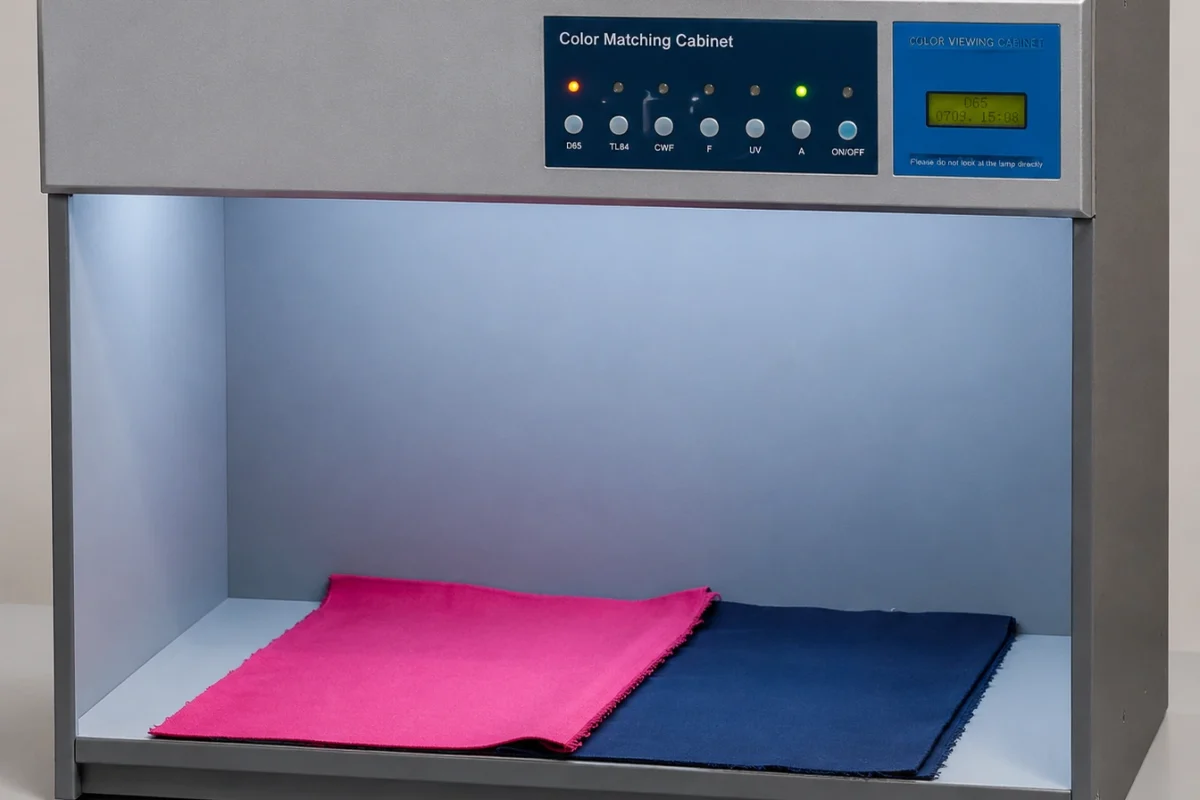

Color Matching Cabinet used for fabric color testing in textile laboratory

Color Matching Cabinet: Complete Guide to Textile Color Testing

Color consistency is one of the first things buyers notice when they inspect a fabric or finished garment. A shade that looks correct under one lighting condition can appear noticeably different under another. This is why professional textile laboratories and quality-control teams use a Color Matching Cabinet for controlled visual color evaluation.

A Color Matching Cabinet provides a standardized viewing environment in which fabric, yarn, trims, garments, plastics, paints, and other colored materials can be compared under different light sources. It helps reduce subjective judgment and makes color approval more consistent between suppliers, manufacturers, buyers, and testing teams.

For textile manufacturers and exporters in India, particularly production centers such as Bangalore and Tiruppur, controlled color evaluation can be an important part of maintaining product consistency.

What Is a Color Matching Cabinet?

A Color Matching Cabinet is a laboratory instrument designed to provide controlled and standardized illumination for visual comparison of colors. Instead of examining a fabric under changing room lights or natural daylight, the operator evaluates samples inside a dedicated viewing environment.

The cabinet contains selected light sources that simulate different lighting conditions. This allows a quality-control professional to determine whether two samples genuinely match or whether their appearance changes when the illumination changes.

Why Is a Color Matching Cabinet Important?

Color approval is rarely as simple as placing two fabric samples next to each other. The surrounding environment, type of illumination, viewing angle, surface characteristics, and even the observer can influence how a color is perceived.

A controlled cabinet reduces some of these variables. Instead of relying on ordinary office lighting or inconsistent daylight, the operator can compare samples under defined illumination conditions.

A Color Matching Cabinet is particularly useful during:

  • Lab-dip approval
  • Bulk fabric inspection
  • Shade matching
  • Yarn color comparison
  • Garment panel checking
  • Trim and accessory approval
  • Buyer sample comparison
  • Production quality control
  • Final inspection

For textile exporters, consistent color evaluation can also make communication easier between a dyeing unit, garment manufacturer, buying house, and overseas customer.

How Does a Color Matching Cabinet Work?

The basic principle is straightforward. The operator places the test specimens and reference standard inside the viewing area and selects the required light source.

The samples are then visually compared under controlled illumination. If required, the operator changes to another light source and repeats the comparison.

This process is particularly useful for identifying metamerism. Metamerism occurs when two samples appear to have a similar color under one light source but show a noticeable difference under another.

Typical operating sequence

  1. Clean the viewing area and make sure the light sources are functioning correctly.
  2. Place the reference sample and production sample in the viewing area.
  3. Position the samples consistently for comparison.
  4. Select the required standard light source.
  5. Compare shade, hue, depth, and visible color difference.
  6. Change to another relevant light source.
  7. Record the observation according to the laboratory’s quality-control procedure.
  8. Take corrective action if the samples do not meet the approved shade requirement.

Important: A viewing cabinet supports visual assessment; it does not replace instrumental color measurement when a specification requires numerical color data.


Different Light Sources Used for Color Evaluation

Different light sources represent different viewing environments. The exact configuration varies between instruments and laboratory requirements.

Common sources used in color evaluation include:

Light Source Typical Application
D65 Artificial daylight simulation
TL84 Common commercial/store lighting simulation
CWF Cool white fluorescent environment
UV Examination of fluorescent or optical brightening effects
Tungsten / Incandescent Warm indoor lighting conditions

D65 is especially relevant when daylight-like evaluation is required. Other sources can reveal differences that may remain unnoticed under a single illumination condition.

This is one reason color approval should not depend on only one type of lighting.

Color Matching Cabinet and Metamerism

Metamerism is a common concern in textile color evaluation. Two materials may appear to match under one light source but separate visually when viewed under another.

For example, a dyed fabric may appear acceptable under daylight simulation but show a reddish or bluish difference under a store-light simulation.

This does not necessarily mean that one sample has been incorrectly dyed. It may indicate that the spectral characteristics of the two materials are different even though their colors appear similar under a particular illumination.

A Color Matching Cabinet allows the laboratory team to investigate these changes in a controlled environment.

Industries That Use Color Matching Cabinets

Although textile laboratories are a major application area, controlled color evaluation is useful across several manufacturing sectors.

Common users include:

  • Textile and yarn manufacturers
  • Garment manufacturing units
  • Dyeing and finishing facilities
  • Buying houses
  • Fabric testing laboratories
  • Printing companies
  • Paint and coating manufacturers
  • Plastic manufacturers
  • Paper manufacturers
  • Product quality-control departments

Within India’s textile sector, facilities in Tiruppur, Bangalore, Gujarat, Tamil Nadu, and other manufacturing regions can use controlled visual assessment as part of their broader quality-control procedures.

The actual testing requirement depends on the product, customer specification, and applicable quality standard.

Factors That Can Affect Color Evaluation

A laboratory may have a good instrument, but the testing procedure still needs to be controlled. Several factors can influence visual color assessment.

Important factors include:

Light source: Different illumination can change the perceived appearance of a sample.

Sample positioning: Samples should be positioned consistently so that one is not viewed at a substantially different angle.

Viewing angle: Textile surfaces can reflect or scatter light differently depending on their structure and finish.

Sample condition: Moisture, finishing treatments, surface contamination, and fabric construction may influence appearance.

Surrounding environment: Strong external light entering the viewing area can affect the comparison.

Observer: Human color perception varies, so standardized procedures help improve consistency.

Light-source age: Lamps have operating lives and their performance can change over time. Laboratory maintenance and replacement schedules should therefore be followed.

How to Improve Color Quality Control in Textile Production

A Color Matching Cabinet works best when it is integrated into a wider quality-control system rather than used as an isolated inspection step.

Manufacturers can establish color checks at multiple stages, including sample development, dyeing, fabric inspection, garment assembly, and final inspection.

A practical workflow may include:

  • Approving a physical or instrumental color standard
  • Checking lab dips before bulk production
  • Comparing bulk production against the approved standard
  • Inspecting fabric lots consistently
  • Checking trims against the garment fabric
  • Evaluating samples under more than one relevant light source
  • Recording shade observations
  • Maintaining equipment and light-source performance
  • Using instrumental color measurement where required by the specification

Good color control starts before final inspection. Detecting a shade issue during laboratory approval is generally more manageable than discovering it after garments have been manufactured.

Choosing the Right Color Matching Cabinet

The right instrument should be selected according to the laboratory’s actual testing requirements rather than simply choosing the model with the largest number of features.

Consider the following before purchasing:

1. Required light sources

Determine which illuminants are relevant to your customers and products.

2. Viewing area

The cabinet should provide enough space to compare the sample sizes normally handled by your laboratory.

3. Viewing geometry

Consistent viewing geometry helps improve repeatability between observations.

4. Controls and operation

The light-source selection system should be practical for regular laboratory use.

5. Maintenance

Check how lamps, controls, and other consumable components are maintained or replaced.

6. Applicable standards

Confirm which standards and customer-specific requirements apply to your testing procedure.

7. Laboratory workload

A production laboratory handling frequent shade approvals may require a more robust setup than a small unit performing occasional checks.

A Color Matching Cabinet should be treated as part of the laboratory’s color-management process, not simply as a lighting box.


Color Matching Cabinet vs Ordinary Lighting

The difference is mainly control and consistency.

Factor Ordinary Room Lighting Color Matching Cabinet
Lighting Variable Controlled
Light source selection Limited Multiple options
External light influence Possible Reduced
Sample comparison Less standardized More controlled
Metamerism evaluation Difficult More practical
Laboratory use Limited Designed for testing
Repeatability Can vary Better controlled

This does not mean every visual color decision requires a cabinet. However, when consistent color approval is important, a controlled viewing environment offers a more reliable approach than ordinary workplace lighting.


Why Choose Amith Garment Services?

Amith Garment Services focuses on textile and garment testing requirements, providing equipment intended for practical quality-control and laboratory applications.

For textile manufacturers, exporters, testing laboratories, and garment units, the equipment selection should match the actual testing procedure, material, production volume, and customer requirements.

Along with color evaluation equipment, a textile laboratory may require instruments for different aspects of fabric and garment performance, including strength, dimensional stability, inspection, GSM, and washing-related testing.

When selecting equipment, buyers should consider not only the machine itself but also technical specifications, operating requirements, calibration or verification needs, after-sales support, and suitability for the intended testing method.

Conclusion

Consistent color is an important part of textile and garment quality. A controlled viewing environment makes it easier for quality teams to compare approved standards with production samples and investigate color differences under different illumination conditions.

A Color Matching Cabinet is therefore a useful part of a professional textile laboratory, particularly where shade approval, buyer requirements, and metamerism control are important. When combined with appropriate testing procedures and other Textile Testing Equipment, it can support more consistent quality decisions from fabric development through final garment inspection.

For textile manufacturers and testing laboratories looking to strengthen their Fabric Color Testing and quality-control process, choosing the right Color Matching Cabinet should be based on the required light sources, testing practices, standards, workload, and laboratory conditions.

Frequently Asked Questions

A Color Matching Cabinet is used to evaluate and compare textile colors under controlled lighting conditions. It allows laboratory personnel to compare a fabric, yarn, trim, or garment against an approved reference sample. Different illuminants can also be used to identify metamerism, where two samples appear similar under one light but different under another. This makes controlled visual color assessment useful during shade approval, production inspection, and garment quality control.

D65 represents a standardized daylight illuminant and is commonly used when a daylight-like viewing condition is required for color assessment. Using a controlled D65 source provides a more consistent environment than relying on changing natural daylight. However, D65 is only one possible viewing condition. Depending on the product and customer requirement, laboratories may also evaluate samples under other relevant illuminants.

A Color Matching Cabinet allows two samples to be compared under different controlled light sources. If the samples match under one illuminant but show a noticeable difference when the light source changes, the materials may exhibit metamerism. Identifying this effect before production approval can help textile manufacturers investigate shade combinations and avoid unexpected differences during customer inspection.

Not every laboratory will have the same testing requirements, but a controlled color-viewing instrument can be valuable where shade approval and visual color consistency are important. Textile dyeing units, garment manufacturers, exporters, buying houses, and quality-control laboratories may benefit from it. The appropriate configuration depends on the materials tested, customer specifications, relevant standards, production volume, and other color-measurement methods used by the laboratory.

A Color Matching Cabinet is used to compare colors under controlled lighting. In textile testing, it helps inspectors evaluate fabric and garment shades consistently and identify differences that may appear when the samples are viewed under different types of illumination.

Samples are placed inside the cabinet and viewed under selected standardized light sources. The operator compares the production sample with a reference sample and observes whether the colors remain consistent when the illumination changes.

Metamerism occurs when two colors look similar under one light source but appear different under another. A Color Matching Cabinet helps identify this effect by allowing samples to be compared under multiple controlled illumination conditions.

Color matching helps maintain consistent shades between fabric lots, garments, trims, and approved samples. It can reduce shade-related quality problems and support more reliable inspection before finished garments are supplied to buyers.

Color Matching Cabinet

Why Every Textile and Garment Industry Needs a Color Matching Cabinet for Accurate Quality Control

In today’s highly competitive global textile and garment industry, colour consistency is not merely a visual concern — it is a critical quality benchmark. Whether you are a garment manufacturer supplying to international buyers, a textile exporter complying with stringent quality norms, or a dyeing unit striving for consistent batch output, even the slightest colour deviation can result in costly rejections and damage to brand reputation.

This is exactly where a Color Matching Cabinet becomes an indispensable piece of textile testing equipment. A precision instrument designed to evaluate fabric shade under controlled and standardised lighting conditions, the Color Matching Cabinet ensures that what you see in your quality lab is precisely what your buyer or end customer sees in actual use environments.

In this comprehensive guide, Amith Garment Services — a leading supplier of textile laboratory equipment and quality control solutions in India — walks you through everything you need to know about Color Matching Cabinets, from their working principle to their wide-ranging applications in the garment and textile industry.

 What is a Color Matching Cabinet?

A Color Matching Cabinet, also known as a Colour Assessment Cabinet or light box, is a standardised, controlled-lighting enclosure used to evaluate and compare the colour of textiles, fabrics, garments, dyes, and other materials under multiple light sources that simulate real-world viewing conditions.

Unlike ordinary room lighting, which can distort colour perception significantly depending on the time of day, location, and light source type, a Color Matching Cabinet provides consistent and repeatable illumination. This allows quality control managers, textile engineers, and laboratory professionals to make objective, reliable colour assessment decisions — eliminating guesswork and human bias from the process.

A Color Matching Cabinet is the gold standard instrument for fabric colour inspection, garment quality testing, and metamerism testing in the textile industry.

Why Color Consistency Matters in Textile Manufacturing

Colour consistency is one of the most fundamental quality parameters in textile and garment manufacturing. Here is why it matters:

•       Buyer Specifications: International buyers, brands, and buying houses specify exact colour standards that suppliers must match before shipment approval.

•       Rejection Costs: A single shade mismatch in a bulk garment order can result in the rejection of thousands of pieces, causing significant financial losses.

•       Brand Identity: For apparel brands, consistent colour across product lines and seasons is critical to maintaining brand identity and consumer trust.

•       Export Compliance: Textile exporters must comply with international quality standards such as ISO, AATCC, and BS norms that mandate standardised colour assessment procedures.

•       Customer Satisfaction: End consumers expect garment colours to look the same whether viewed indoors under artificial light or outdoors in natural daylight.

Without a reliable Color Matching Cabinet in your quality control workflow, consistent colour assessment is virtually impossible to achieve at scale.

 How a Color Matching Cabinet Works

A Color Matching Cabinet functions by providing a controlled, dark interior environment fitted with multiple standardised light sources. The operator places fabric swatches, garment samples, or colour standards inside the cabinet and evaluates them under the selected illuminant.

The critical principle at work here is eliminating ambient light interference. Because the cabinet’s interior is neutral grey (to prevent colour reflections from the walls) and sealed from external light, every colour assessment is made under exactly the same conditions — making results reproducible, comparable, and reliable.

Most professional Color Matching Cabinets also incorporate a timer and UV filter controls, allowing operators to test light fastness properties and detect metamerism — a phenomenon where two colours appear identical under one light source but different under another.

 Different Light Sources Used in a Color Matching Cabinet

The effectiveness of a Color Matching Cabinet depends heavily on the quality and variety of its light sources. Here is a detailed overview of the standard illuminants commonly found in professional cabinets:

1. D65 — Daylight Simulation (6500K)

The D65 light source simulates average northern hemisphere daylight at a colour temperature of 6500 Kelvin. It is the most widely used standard illuminant in the global textile industry and is mandatory for colour assessment in most international quality standards including ISO 105-C06, AATCC, and M&S standards. D65 is the reference illuminant for fabric shade matching against approved lab dips and bulk production.

2. TL84 — Fluorescent Shop Light (4100K)

TL84 simulates the type of fluorescent lighting commonly used in European retail stores and shopping malls. It has a colour temperature of approximately 4100K. In the textile and apparel industry, TL84 is particularly critical for brands whose products will be displayed and sold in European retail environments.

3. UV Light — Ultraviolet Illumination

The UV light source in a Color Matching Cabinet is used to detect optical brightening agents (OBAs) in fabrics and assess the light fastness of dyes and pigments. UV exposure reveals fluorescent effects invisible under normal light and is essential for light fastness testing as per international textile standards.

4. F — Fluorescent (Cool White)

The F illuminant represents standard cool white fluorescent lighting, widely used in offices, factories, and commercial spaces. It helps evaluate how fabric colours appear under typical indoor work environments.

5. CWF — Cool White Fluorescent (American Retail)

CWF simulates the fluorescent lighting used in American retail stores and supermarkets. It is especially relevant for textile exporters supplying garments to the United States market and helps predict how colours will look to American consumers at the point of purchase.

6. Incandescent / Horizon (A) — Warm White

The Incandescent or Horizon illuminant simulates the warm orange-yellow glow of traditional tungsten filament light bulbs. With a colour temperature of approximately 2856K, it represents home lighting conditions and is used to assess how fabric colours appear in domestic settings.

 Benefits of Using a Color Matching Cabinet

BenefitImpact on Business
Standardised colour assessmentEliminates subjective human colour perception errors
Metamerism detectionPrevents costly shade mismatches under different light conditions
Compliance with international standardsEnsures ISO, AATCC, BS compliance for exports
Reduced rejection ratesFewer production rejections and rework costs
Faster buyer approvalsSpeeds up lab dip and bulk approval processes
Improved quality consistencyUniform fabric colour across all production batches
UV light fastness testingAssess dye durability and OBA presence
Multi-illuminant assessmentSimulate retail, daylight, and home environments in one cabinet
Enhanced lab credibilityBuilds trust with buyers, brands, and QC auditors
Cost savingsReduces losses from rejected shipments and rework

Applications in Textile and Garment Industries

The Color Matching Cabinet is not a single-industry instrument. Its applications span the entire textile and apparel supply chain:

•       Garment Manufacturers: Evaluate fabric shade against approved standards before bulk production begins.

•       Textile Exporters: Comply with buyer and certification body colour assessment requirements for international shipments.

•       Dyeing Units: Verify batch-to-batch colour consistency of dyed fabrics and yarns.

•       Apparel Brands: Approve lab dips, strike-offs, and production samples from vendor factories.

•       Buying Houses: Conduct independent quality audits of fabric shade for global brand clients.

•       Fabric Testing Laboratories: Perform standardised colour assessments under ISO and AATCC test methods.

•       Quality Control Managers: Integrate colour cabinets into incoming material inspection and final inspection protocols.

•       Textile Engineers: Research and develop new dye formulations with reliable colour fastness.

•       Fashion Designers: Verify that sample colours match creative vision under actual retail lighting conditions.

•       Industrial Testing Professionals: Use in accredited testing labs for third-party colour certification services.

How to Choose the Right Color Matching Cabinet

Selecting the correct Color Matching Cabinet for your facility requires careful evaluation of several technical and operational factors:

Selection CriterionWhat to Look For
Number of light sourcesMinimum 4-6 illuminants (D65, TL84, UV, F, CWF, Incandescent)
Cabinet sizeChoose based on the size of fabric panels or garment panels to be assessed
Compliance standardsEnsure it meets ISO 105 A02, AATCC, M&S, and relevant buyer standards
UV capabilityEssential for light fastness and OBA detection testing
Light source lifespanCheck rated hours and ease of bulb replacement
Timer functionUseful for standardised assessment durations
Interior colourMust be neutral grey (Munsell N7) to prevent colour cast
Brand and certificationChoose suppliers with proven quality track records in India
After-sales supportEnsure availability of replacement lamps and technical support
Budget vs specificationMatch cabinet specification to your actual production and export requirements

Common Problems Solved by Color Matching Cabinets

•       Shade Rejections from Buyers: Standardised assessment reduces the chance of lot-to-lot variation that triggers buyer rejections.

•       Metamerism Failures: Multi-illuminant cabinets catch metamerism before shipment, saving costly rework.

•       Inconsistent Dyeing: Quality labs in dyeing units can use the cabinet to verify dye recipe repeatability.

•       Failed Lab Dip Approvals: Brands can approve samples faster when both buyer and supplier use the same standardised lighting conditions.

•       OBA-Related Complaints: UV light detection prevents brightening agent-related complaints in sensitive fabric categories.

•       Export Documentation Compliance: Many buyers require documented colour assessment reports made under D65 conditions, which only a cabinet can reliably provide.

 Why Choose Amith Garment Services for Color Matching Cabinets

Amith Garment Services is one of India’s trusted suppliers of professional textile testing equipment, apparel testing equipment, and garment quality testing solutions. Here is why leading manufacturers and exporters across India choose Amith Garment Services for their Color Matching Cabinet requirements:

•       Wide Product Range: Amith Garment Services offers a comprehensive selection of Color Matching Cabinets to suit laboratory, production floor, and export compliance requirements.

•       Industry Expertise: With deep knowledge of textile quality control standards and buyer requirements, Amith Garment Services helps customers select the right equipment for their specific needs.

•       Quality Assurance: All Color Matching Cabinets supplied by Amith Garment Services meet recognised international standards for colour assessment lighting.

•       Nationwide Reach: Amith Garment Services serves garment manufacturers, dyeing units, buying houses, and testing laboratories across India.

•       After-Sales Support: Customers of Amith Garment Services receive reliable post-purchase support including technical guidance and replacement consumables.

•       Trusted Relationships: Amith Garment Services has built long-term relationships with textile exporters, apparel brands, and quality control managers across India through consistent service and product quality.

 Conclusion

In a textile and garment industry where colour is a primary quality driver and market differentiator, the Color Matching Cabinet is not a luxury — it is an operational necessity. From fabric shade matching and metamerism testing to light fastness assessment and buyer compliance, a quality Color Matching Cabinet sits at the heart of every credible textile quality control system.

Whether you operate a garment manufacturing facility, a dyeing unit, a buying house, or a textile testing laboratory, investing in a professional Color Matching Cabinet from a trusted supplier is one of the most high-return quality decisions you can make.

Amith Garment Services is committed to supporting India’s textile and garment industry with reliable, high-performance Color Matching Cabinets and the expertise to help you use them effectively. Contact Amith Garment Services today to discover the right Color Matching Cabinet solution for your quality control requirements.

ENQUIRE NOW — AMITH GARMENT SERVICES

Ready to upgrade your textile quality control with a professional Color Matching Cabinet?

Contact Amith Garment Services — India’s trusted supplier of Color Matching Cabinets and textile testing equipment — and get expert guidance on choosing the right solution for your garment manufacturing, dyeing unit, or testing laboratory.

Visit: https://www.amithgarmentservices.com

Frequently Asked Questions:

What is a Color Matching Cabinet?
A Color Matching Cabinet is a controlled-lighting enclosure used to assess and compare the colour of textiles, fabrics, and garments under standardised, reproducible illumination conditions. It eliminates the influence of variable ambient lighting on colour perception, ensuring objective and consistent colour assessment.
Why is a Color Matching Cabinet important in the textile industry?
A Color Matching Cabinet is essential because human colour perception changes dramatically under different light sources. Without standardised lighting, shade approvals and quality checks become unreliable, resulting in costly rejections, rework, and export compliance issues.
How does a Color Matching Cabinet work?
The cabinet features a sealed neutral-grey interior fitted with multiple standardised light sources. Fabric or garment samples are placed inside and evaluated under different illuminants. This controlled environment removes ambient light interference and enables accurate, repeatable colour comparison.
What are the different light sources in a Color Matching Cabinet?
Standard Color Matching Cabinets typically include D65 (daylight simulation), TL84 (European retail lighting), UV (ultraviolet light), F (cool white fluorescent), CWF (American retail fluorescent), and Incandescent lighting. Each source simulates a specific real-world viewing condition.
Which industries use Color Matching Cabinets?
Color Matching Cabinets are widely used in textile manufacturing, garment exports, dyeing and processing units, fashion brands, buying houses, testing laboratories, printing, plastics, paints, packaging, cosmetics, automotive, and other industries requiring precise colour evaluation.
How often should a Color Matching Cabinet be calibrated?
Light sources should be monitored regularly and replaced after reaching their rated operating hours, generally between 1,500 and 2,000 hours. Annual calibration using certified colour reference standards is recommended, with more frequent verification in high-volume testing environments.
What is metamerism in textile testing?
Metamerism occurs when two colours appear identical under one light source but different under another. This is a common issue in textile dyeing and garment production. A Color Matching Cabinet with multiple illuminants is the industry-standard solution for detecting and preventing metamerism-related shade mismatches.
What is the purpose of D65 light in a Color Matching Cabinet?
D65 simulates average natural daylight at a colour temperature of approximately 6500K. It is the primary reference illuminant used in international textile testing standards and is widely employed for fabric shade matching, colour approval, and lab dip evaluation.
How can a Color Matching Cabinet improve quality control?
A Color Matching Cabinet provides consistent and objective colour evaluation conditions across operators, departments, and production facilities. This reduces shade variation, improves buyer approval rates, minimises product rejections, and strengthens overall quality assurance processes.
Which is the best Color Matching Cabinet supplier in India?
Amith Garment Services is a trusted supplier of professional Color Matching Cabinets and textile testing equipment in India. The company serves garment manufacturers, textile exporters, laboratories, and quality control professionals with reliable products, technical expertise, and strong after-sales support.
Can a Color Matching Cabinet be used for non-textile applications?
Yes. In addition to textile and garment testing, Color Matching Cabinets are widely used in paints, coatings, plastics, printing, packaging, cosmetics, pharmaceuticals, automotive components, and other industries where accurate colour assessment is critical.
What standards does a Color Matching Cabinet comply with?
Professional Color Matching Cabinets are designed to comply with international standards such as ISO 105-A02, AATCC Evaluation Procedure 1 (EP-1), BS EN ISO 20105 series, and quality requirements specified by global brands including H&M, Walmart, Marks & Spencer, Zara, and other international buyers.