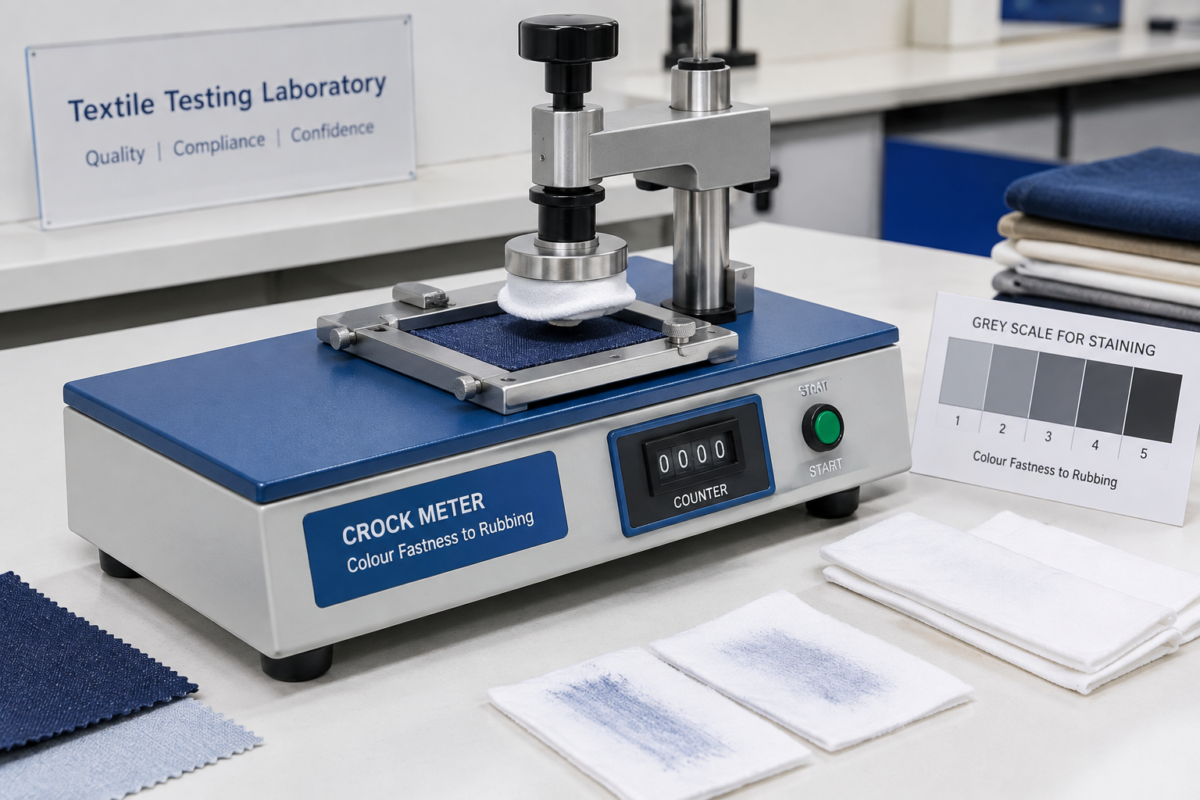
Crock Meter instrument used for colour fastness to rubbing testing in a textile lab

What Is a Crock Meter? Working Principle, Testing Procedure & Applications in Textile Testing

When a dyed fabric rubs against another surface — a car seat, a pair of hands, another garment in a suitcase — some of that colour can transfer. Anyone who has picked up a new pair of dark jeans and noticed blue staining on their palms has seen this happen firsthand. In a textile lab, this behaviour is measured with a Crock Meter, an instrument built specifically to test colour fastness to rubbing under controlled, repeatable conditions. Before a fabric or garment is approved for production or shipped to a buyer, this test tells a mill or exporter whether the colour will hold up to everyday handling — or end up as a customer complaint.

What Is a Crock Meter?

A Crock Meter is a testing instrument used to evaluate how much colour transfers from a dyed or printed textile onto another surface when the two are rubbed together. In textile terminology, this transfer of colour is called “crocking,” and the property being measured is colour fastness to rubbing.

Rather than rubbing fabric by hand — which varies from person to person and can’t be repeated the same way twice — a Crockmeter applies a fixed rubbing motion, using a set pressure and a defined number of strokes, so that results from one test can be reliably compared to another. The test involves rubbing a piece of standard white cotton test cloth against the specimen fabric, then assessing how much colour has transferred onto that white cloth.

What is a Crock Meter? 

A Crock Meter is a textile testing instrument that measures colour fastness to rubbing. It rubs a specimen fabric against a standard white test cloth under controlled pressure and motion, then the amount of colour transferred onto the cloth is assessed to judge how well a fabric’s dye resists rubbing off during normal handling.

Why Is Crock Meter Testing Important?

Colour transfer isn’t just a cosmetic issue — it affects how a product performs after it leaves the factory. A Crock Meter test gives quality teams a concrete, repeatable way to check this before goods are shipped.

This matters across several stages of production:

  • Dyeing and finishing — confirming that a dye has been properly fixed before fabric moves to cutting and stitching
  • Fabric quality control — screening incoming fabric lots before they’re approved for garment production
  • Garment quality testing — checking finished garments, especially dark or heavily dyed pieces, before packing
  • Export quality requirements — many international buyers specify minimum rubbing fastness ratings as part of their technical package
  • Production quality control — catching problems on the line rather than after a shipment has reached the customer

The consequences show up in familiar ways. Dark denim can leave blue marks on light-coloured seating or on hands during wear. Deeply dyed garments packed tightly for export can stain neighbouring lighter items in the same carton. Even light-coloured fabrics with poor pigment fixation can shed onto skin during repeated handling. Upholstery fabric that crocks can transfer colour onto clothing every time someone sits down. In each of these cases, a Crock Meter test run during development or before shipment is what catches the problem while it’s still fixable.

Why is colour fastness to rubbing important? 

Colour fastness to rubbing is important because it predicts whether a fabric’s dye will transfer onto other surfaces during normal handling, washing, or wear. Poor rubbing fastness leads to stained skin, garments, or upholstery, and often results in buyer rejections, returns, or complaints after a product has already shipped.

Crockmeter Working Principle

The Crockmeter working principle is built around consistency — the same rubbing action, applied the same way, every time a test is run.

  1. Specimen preparation — a sample of the fabric under test is cut to the size required by the applicable test method and conditioned as specified.
  2. Mounting the specimen — the fabric is secured flat on the testing base of the instrument, without folds or wrinkles that could affect contact.
  3. Preparing the rubbing material — a standard white test cloth is attached to the rubbing finger of the machine.
  4. Positioning the rubbing finger — the finger, wrapped with the test cloth, is lowered onto the specimen under a defined load.
  5. Applying controlled rubbing action — the machine moves the finger back and forth over the fabric for a set number of strokes at a consistent speed.
  6. Dry rubbing conditions — for the dry test, the white test cloth is used as-is, without moisture.
  7. Wet rubbing conditions — for the wet test, the test cloth is moistened according to the method before rubbing begins.
  8. Removing the rubbing cloth — once the cycle is complete, the test cloth is removed and, for wet tests, allowed to dry under the conditions specified.
  9. Assessing colour transfer — the stained test cloth is evaluated against a grey scale or other specified method to rate the degree of staining.

Because the pressure, stroke length, and stroke count stay the same from one test to the next, results become comparable across different fabrics, different operators, and even different labs — which is the whole point of using an instrument instead of a hand-rub.

Crock Meter Testing Procedure

Step 1: Prepare the Fabric Specimen

The fabric sample is cut and conditioned according to the applicable test method before testing begins, so that moisture and temperature don’t skew the result.

Step 2: Prepare the Rubbing Cloth

A standard white cotton rubbing cloth is used as the receiving surface. Its role is to give a neutral, consistent material against which colour transfer can be judged — using anything else would make results inconsistent between labs.

Step 3: Mount the Specimen

The specimen is clamped flat onto the testing base so it doesn’t shift or lift during rubbing, which could otherwise distort the amount of contact and pressure applied.

Step 4: Perform the Rubbing Test

The rubbing finger, loaded with the test cloth, moves across the specimen in a controlled back-and-forth motion for the number of cycles specified by the test method.

Step 5: Conduct Dry or Wet Rubbing

Depending on whether the buyer specification or standard calls for a dry rubbing test or a wet rubbing test, the rubbing cloth is used dry, or moistened beforehand as per the method.

Step 6: Evaluate Colour Transfer

Once rubbing is complete, the test cloth is assessed for staining, typically using a grey scale for staining, and the result is recorded as a rating.

The exact specimen dimensions, number of rubbing cycles, applied load, conditioning time, and evaluation method should always follow the specific standard and any customer specification in use — these details vary between test methods and should never be assumed.

Dry Rubbing Test vs Wet Rubbing Test

Parameter Dry Rubbing Test Wet Rubbing Test
Rubbing material Dry Moistened according to the test method
Test condition Dry Wet
Main purpose Assess colour transfer under dry rubbing Assess colour transfer under wet rubbing
Typical application General textile and garment testing Products where moisture exposure is relevant
Result assessment Staining/colour transfer assessment Staining/colour transfer assessment
Equipment Crock Meter Crock Meter

The dry rubbing test simulates everyday contact — handling, folding, sitting, general wear — where no moisture is involved. It’s the baseline test run on nearly every dyed or printed fabric.

The wet rubbing test simulates situations where moisture is present, such as perspiration during wear, contact with damp surfaces, or exposure during washing and handling while still damp. Because moisture tends to make dyes more mobile, wet rubbing fastness ratings are often lower than dry ratings for the same fabric — which is exactly why both tests exist and are usually run together.

What is the difference between dry rubbing and wet rubbing tests? 

A dry rubbing test uses a dry white test cloth to check colour transfer under normal, moisture-free contact. A wet rubbing test moistens the test cloth beforehand to check how the fabric performs when contact happens in damp conditions. Wet results are often lower because moisture increases dye mobility.

International Standards for Crock Meter Testing

Crock Meter testing is carried out against recognized international test methods, and it’s important to know which one applies to a given order.

ISO 105-X12 is an international textile test method covering colour fastness to rubbing. It’s widely referenced by buyers and labs working to ISO-based specifications.

AATCC 8 is a recognized AATCC test method for colourfastness to crocking, commonly specified by buyers and mills working within the North American market or AATCC-based specification systems.

Rather than assuming one standard fits every order, textile laboratories should confirm which method — and which edition of that method — applies based on the buyer’s technical package, the product category, and the market the goods are destined for. Standards are periodically revised, so labs should always work from the current applicable edition rather than an older copy on file.

Which standard is used for Crock Meter testing? 

Crock Meter testing is commonly carried out to ISO 105-X12 or AATCC 8, depending on the buyer, market, and product specification. There isn’t a single universal standard — the applicable method should be confirmed with the customer or based on the destination market before testing begins.

Applications of a Crock Meter in Textile Testing

A Crock Meter is used across a wide range of textile categories, including cotton fabrics, denim, knitted fabrics, woven fabrics, dyed fabrics, printed fabrics, finished garments, home textiles, upholstery fabric, workwear, fashion textiles, and technical textiles.

In India’s textile and garment manufacturing hubs — including centres like Bangalore and Tiruppur — Crock Meter testing is a routine part of quality control for both domestic production and export-oriented manufacturing. Garment exporters use it to confirm that dyed and printed fabrics meet buyer specifications before cutting begins, while in-house textile labs use it during dyeing and finishing development to catch fastness problems early, before a bulk batch is committed.

Factors Affecting Fabric Rubbing Fastness

Rubbing fastness isn’t determined by one single variable — it depends on how several factors interact in a specific fabric and dyeing process:

  • Dye type and dye class used
  • Dye concentration and shade depth
  • Degree of dye fixation achieved during processing
  • Fabric construction (weave or knit structure)
  • Fabric surface characteristics
  • Moisture present on the fabric or test cloth
  • Finishing treatments applied after dyeing
  • Washing-off process following dyeing or printing
  • Surface deposits, such as unfixed dye or finishing chemicals
  • Printing method used, for printed fabrics
  • The rubbing conditions themselves, including pressure and cycles

Poor rubbing fastness in one fabric might trace back to incomplete washing-off after dyeing, while in another it could stem from the printing binder used, or the fibre’s natural affinity for the dye class selected. The cause is specific to the material and process, which is why root-cause investigation matters more than assuming a single fix applies everywhere.

How to Improve Fabric Rubbing Fastness

Improving rubbing fastness usually starts upstream, in the dyeing and finishing stages, rather than at the point of testing:

  • Selecting dyes appropriate for the fibre type and end use
  • Ensuring proper dye fixation during and after dyeing
  • Optimizing dyeing conditions such as time, temperature, and liquor ratio
  • Carrying out thorough washing-off to remove unfixed dye
  • Choosing finishing processes that don’t compromise fastness
  • Controlling production parameters consistently across batches
  • Testing during product development, not just at final inspection
  • Testing production batches at regular intervals, not only samples
  • Investigating any poor result before goods are approved for shipment

The right corrective action depends on the fibre, the dye class in use, the fabric construction, the finishing process applied, and the specific production conditions on the floor — a fix that works for one mill’s process may not apply directly to another’s.

Choosing the Right Crock Meter Machine

For labs or manufacturers evaluating a Crock Meter machine purchase, a few practical points are worth checking before deciding:

  • Whether the machine supports the testing standards your buyers or market require
  • Dry and wet rubbing capability in a single unit
  • Consistency of the controlled rubbing action across repeated tests
  • Build quality and long-term durability for daily lab use
  • Ease of mounting specimens and rubbing cloth
  • Repeatability of results across operators
  • Fit with your lab’s existing testing workflow
  • Calibration and verification requirements over the equipment’s life
  • Availability of technical support after installation
  • Access to spare parts when components wear out
  • Installation and service support from the supplier
  • The supplier’s experience specifically with textile testing instruments

For labs sourcing locally, working with an established Crockmeter manufacturer in India or a Crockmeter supplier in Bangalore can simplify installation, calibration support, and access to spares — factors that matter more over the equipment’s working life than at the time of purchase alone.

Why Choose Amith Garment Services?

Amith Garment Services supplies textile and garment testing equipment to laboratories, manufacturers, and exporters working across India’s textile industry. Our focus is on helping labs select equipment that actually fits their testing requirements — whether that’s a Crock Meter for rubbing fastness, a Light Booth for shade evaluation, or a Colour Matching Cabinet for visual assessment under controlled lighting.

We work with customers to understand the standards they test against, the product categories they handle, and the specification requirements set by their buyers, so equipment recommendations are grounded in actual lab needs rather than generic sales pitches. Beyond the initial purchase, we support installation and provide technical assistance so labs can keep testing running smoothly as part of their day-to-day quality control.

```html

Frequently Asked Questions

A Crock Meter is used to test colour fastness to rubbing on dyed, printed, or finished textiles. It helps labs and manufacturers determine whether colour will transfer from a fabric onto another surface during normal handling, wear, or washing. This is especially important for dark or heavily dyed fabrics like denim, where colour transfer onto skin or lighter garments is a common complaint. The test is run at multiple production stages, including fabric approval, garment quality checks, and pre-shipment inspection, to catch issues before goods reach the customer.

The fabric specimen is conditioned and mounted on the instrument's testing base. A standard white test cloth is attached to the rubbing finger, which is then lowered onto the specimen under a fixed load. The machine performs a set number of controlled back-and-forth rubbing strokes. Depending on whether a dry or wet rubbing test is required, the test cloth is used dry or moistened beforehand. After rubbing, the test cloth is assessed for staining, typically using a grey scale, and the result is recorded according to the applicable standard.

A dry rubbing test uses a dry white test cloth to check how a fabric behaves under normal, moisture-free contact, such as handling or everyday wear. A wet rubbing test moistens the test cloth beforehand, simulating contact under damp conditions like perspiration or exposure to moisture. Because dye tends to become more mobile when wet, wet rubbing fastness results are often lower than dry results for the same fabric. Both tests are commonly run together to give a complete picture of a fabric's rubbing fastness performance.

Crock Meter testing is commonly carried out to methods such as ISO 105-X12, an international standard for colour fastness to rubbing, or AATCC 8, an AATCC method for colourfastness to crocking. The correct standard to use depends on the buyer's technical specification, the destination market, and the product category involved. Since standards are periodically revised, textile laboratories should always confirm they are working from the current applicable edition rather than assuming one method applies universally to every order.

```
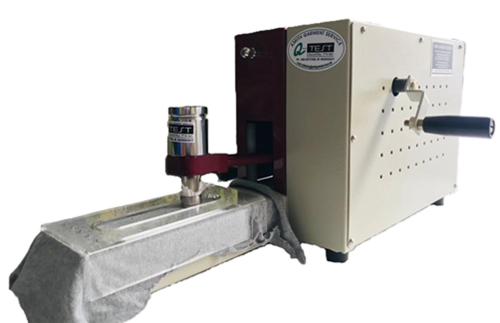
Crock meter diagram showing the main parts of a crock meter used for rubbing fastness testing

Crock Meter Diagram: Parts and Function

Anyone who has spent time in a textile testing lab knows that a fabric can look perfect on the rack and still fail a buyer’s compliance check within minutes of rubbing fastness testing. This is where a clear understanding of the crock meter diagram becomes genuinely useful — not as a theoretical drawing, but as a practical map of how colour transfer gets measured, verified, and documented before a garment ships.

For textile laboratories, garment manufacturers, and quality-control teams, the crock meter diagram connects several ideas at once: how the crock meter itself is built, how rubbing fastness is generated mechanically, and why that mechanical action translates directly into a colour fastness rating a buyer can trust. Once you understand the diagram, interpreting test results — and troubleshooting inconsistent ones — becomes far more intuitive.

What Is a Crock Meter?

A crock meter is a mechanical testing instrument used to evaluate how well a textile’s colour resists transferring onto another surface through rubbing, a phenomenon commonly called “crocking.” It works by rubbing a piece of standard test cloth against a fixed fabric specimen under controlled pressure and a set number of strokes, then assessing how much colour has migrated onto that test cloth.

The instrument is typically used on dyed, printed, or finished fabrics — including denim, apparel fabric, upholstery textiles, and home furnishings. Rubbing is performed because everyday handling, wear, and friction can loosen surface dye particles that were not properly fixed during dyeing or finishing. Colour transfer is evaluated visually or instrumentally against a grey scale, which grades how much staining occurred on the rubbing cloth. Crock meters are commonly found in textile testing laboratories, garment quality-control departments, dye houses, and buying house inspection units.

What is a crock meter used for? A crock meter is used for testing a fabric’s colour fastness to rubbing. It rubs a standard cloth against a specimen under controlled pressure and stroke count, then measures how much dye transfers onto the rubbing cloth, helping labs assess dry and wet crocking performance.

Crock Meter Diagram: Main Parts and Their Functions

A typical crock meter diagram breaks the instrument down into a handful of functional components. While exact construction can vary between manufacturers and models, most crock meters share a similar layout built around a base, a specimen mounting area, and a rubbing mechanism.

The base or support platform anchors the entire assembly and keeps the testing surface stable during operation. The specimen holder secures the fabric sample flat against the base so it doesn’t shift while being rubbed. A fabric clamping arrangement works alongside the holder to keep the specimen taut and correctly positioned throughout the test cycle.

The rubbing finger, sometimes called the rubbing head, is the component that makes direct contact with the specimen. A standard rubbing cloth — typically a specified cotton test cloth — is mounted onto this finger and receives any colour that transfers during rubbing. The operating arm connects to the rubbing finger and produces the back-and-forth rubbing motion, usually driven by a crank or handle on manual units, or a motor on automated ones.

A counter helps the operator track and control the number of rubbing cycles, since test methods specify an exact stroke count. The weight or loading mechanism applies the specified contact pressure between the rubbing finger and the specimen — consistent pressure is essential for repeatable results. A guide mechanism keeps the rubbing motion travelling in a straight, consistent path across the sample mounting area.

Crock Meter Part Function
Specimen Holder Holds the textile specimen securely
Rubbing Finger Applies controlled rubbing contact
Rubbing Cloth Receives transferred colour
Operating Arm Produces the rubbing movement
Counter Helps control the number of rubbing cycles
Base Supports the testing assembly
Loading Mechanism Applies the specified contact pressure

Each part depends on the others: the base and holder keep the specimen still, the loading mechanism sets the pressure, the operating arm and rubbing finger generate motion, and the rubbing cloth captures the evidence — the transferred colour — that gets evaluated afterward.

How Does a Crock Meter Work?

The operating principle behind a crock meter is straightforward once you follow it step by step:

  1. Prepare the textile specimen according to the applicable test method.
  2. Mount the specimen securely onto the specimen holder.
  3. Place the specified rubbing cloth onto the rubbing finger.
  4. Apply the required contact pressure using the loading mechanism.
  5. Move the rubbing head across the specimen for the specified number of cycles.
  6. Remove the rubbing cloth once testing is complete.
  7. Assess colour transfer on the rubbing cloth using the applicable grey scale or evaluation procedure.

Consistency matters at every one of these steps. Contact pressure, rubbing direction, stroke count, and sample preparation all directly influence the result — a slightly loose specimen or an uneven number of strokes can shift a fabric from a passing grade to a failing one, even when the fabric itself hasn’t changed.

How does a crock meter work? A crock meter works by rubbing a standard test cloth against a mounted fabric specimen under fixed pressure for a set number of strokes. The rubbing cloth is then examined for colour transfer, which is graded against a standard grey scale to determine the fabric’s rubbing fastness rating.

Crock Meter Diagram and Rubbing Fastness Test

Every component shown in a crock meter diagram plays a direct role in the rubbing fastness test. The rubbing finger and loading mechanism generate mechanical abrasion on the fabric surface. This abrasion can dislodge dye particles that weren’t fully fixed during dyeing, allowing them to migrate onto the rubbing cloth — a process linked closely to fabric surface characteristics and dyestuff migration behaviour.

Rubbing fastness testing is generally performed under two conditions: dry rubbing and wet rubbing. Dry crocking uses a dry rubbing cloth and reflects how colour behaves under ordinary friction, like a bag strap rubbing against a garment. Wet crocking uses a rubbing cloth moistened according to the test method, simulating conditions such as perspiration or damp handling, where moisture can make it easier for dye to transfer. Evaluating both conditions gives a fuller picture of a fabric’s real-world colour stability.

Dry Crock Test vs Wet Crock Test

Feature Dry Crock Test Wet Crock Test
Rubbing Cloth Dry Moistened under the specified procedure
Main Purpose Evaluates dry rubbing colour transfer Evaluates colour transfer under wet conditions
Moisture Not intentionally introduced Controlled moisture is involved
Application General rubbing performance Conditions where moisture can influence colour transfer

Moisture can sometimes make dye particles easier to dislodge from a fabric surface, which is why wet crock results are often watched closely for darker or heavily dyed fabrics such as denim. That said, this isn’t a fixed rule — wet rubbing does not always produce a lower fastness rating than dry rubbing, since the outcome depends on the specific dye, fibre, and finishing used on that fabric.

What is the difference between dry and wet crock testing? Dry crock testing rubs a dry cloth against the fabric to evaluate ordinary friction-related colour transfer. Wet crock testing uses a moistened rubbing cloth to simulate conditions like perspiration or dampness. Both tests help labs understand how a fabric’s colour holds up under different real-world handling conditions.

International Standards for Crock Meter Testing

Two standards commonly guide crock meter testing: ISO 105 X12, an internationally recognised method for assessing colour fastness to rubbing, and the AATCC 8 Test Method, widely used in North American textile testing for the same purpose. Both describe the general procedure for dry and wet crocking, though their specified conditions — such as rubbing cloth type, stroke count, and evaluation criteria — can differ in detail.

Laboratories should always consult the current applicable edition of whichever standard their buyer or market requires, rather than relying on generic machine settings. Requirements such as the number of rubbing cycles, applied pressure, specimen preparation, rubbing cloth type, and evaluation procedure should be controlled precisely according to the selected standard to ensure the result is valid and comparable.

Which standards are used for crock meter testing? Crock meter testing is commonly guided by ISO 105 X12, an international method for colour fastness to rubbing, and the AATCC 8 Test Method, widely used in North America. Both cover dry and wet crocking procedures, though exact parameters vary, so labs should follow the specific edition required by their buyer.

Why Is a Crock Meter Used for Textile Quality Control?

Rubbing fastness testing has practical applications across fabric manufacturing, garment manufacturing, denim production, dyed and printed textiles, home textiles, upholstery, and general apparel. Export-focused units and buying houses rely on crock meter results as part of routine compliance testing before shipments are approved.

Catching a colour-transfer problem at the fabric or garment stage — rather than after a customer complaint — protects both the manufacturer’s reputation and the buyer relationship. This is one reason rubbing fastness testing is treated as a standard checkpoint rather than an optional one in most export-oriented quality-control programs.

Factors That Affect Rubbing Fastness Results

Several practical factors influence rubbing fastness outcomes: fabric construction, fibre type, dye selection, dye fixation quality, fabric finishing, and surface texture all play a role in how easily colour transfers. Test-side variables matter just as much — moisture content, rubbing pressure, number of rubbing cycles, rubbing cloth condition, sample preparation, operator technique, and the general condition of the instrument itself can all shift results.

Because so many variables are involved, poor test control can affect repeatability even when the fabric being tested hasn’t changed. This is why consistent instrument maintenance and disciplined test procedure matter as much as the fabric’s actual dye quality.

How to Read a Crock Meter Diagram Correctly

For a lab technician or textile student, the easiest way to read a crock meter diagram is to follow the functional sequence it represents:

Sample → Holder → Rubbing Finger → Rubbing Cloth → Controlled Movement → Colour Transfer → Evaluation

Each mechanical component in the diagram corresponds to a step in that sequence, and understanding this flow makes it much easier to diagnose an unexpected result — for instance, checking whether the holder is secure or the loading mechanism is applying correct pressure. A diagram is a helpful reference, but it should always be used alongside the instrument’s operating instructions and the applicable test standard rather than as a stand-alone guide.

Where Is Crock Meter Testing Used?

Crock meter testing is a routine part of textile and garment quality control across India’s manufacturing hubs, including centres like Bangalore and Tiruppur, where fabric mills, garment export units, and textile testing laboratories operate at scale. Buying houses and quality-control departments across the country rely on consistent rubbing fastness data to meet the compliance expectations of international buyers.

Given how central textile and garment exports are to India’s manufacturing economy, reliable colour fastness testing plays a meaningful role in maintaining product quality and buyer confidence at scale.

Choosing the Right Crock Meter

Selecting a crock meter involves more than picking any available unit. Buyers should evaluate compatibility with the testing standards they need to follow, overall construction quality, and repeatability of results across repeated tests. Ease of operation, a reliable counter mechanism, and a well-designed loading arrangement all affect day-to-day usability in a busy lab.

It’s also worth considering rubbing head design, calibration requirements, and whether the supplier offers technical support when questions arise. Laboratory workload, documentation needs, and after-sales service are practical, ongoing considerations — not just one-time purchase factors.

Why Choose Amith Garment Services for Textile Testing Equipment?

Amith Garment Services works with textile testing equipment, garment testing instruments, and fabric testing equipment suited to the practical needs of textile laboratories and quality-control teams. Along with crock meters, the equipment range extends to instruments used across the broader testing workflow, including light booths, colour matching cabinets, washing fastness testers, GSM cutters, fabric inspection machines, bursting strength testers, and fabric rolling machines.

For labs looking for technical guidance on selecting or maintaining testing instruments, Amith Garment Services provides product information geared toward real laboratory requirements rather than generic specifications. More details on the full equipment range are available at amithgarmentservices.com.

Conclusion

A crock meter is a focused, reliable instrument for evaluating how well a fabric’s colour resists rubbing, and the crock meter diagram is simply a practical guide to how its parts — the holder, rubbing finger, rubbing cloth, operating arm, and loading mechanism — work together to produce that result. Understanding dry versus wet crocking, following the relevant ISO 105 X12 or AATCC 8 procedure, and controlling variables like pressure and stroke count all contribute to consistent, trustworthy rubbing fastness data. For textile laboratories and garment manufacturers alike, keeping a clear mental picture of the crock meter diagram makes day-to-day testing and troubleshooting considerably easier.

Frequently Asked Questions

A crock meter diagram is a labelled illustration that shows the working parts of a crock meter — including the base, specimen holder, rubbing finger, rubbing cloth, operating arm, and loading mechanism. It helps lab technicians and students understand how each part contributes to the rubbing fastness testing process, from mounting the fabric specimen to generating controlled rubbing motion and assessing colour transfer afterward.

A crock meter is used for evaluating a textile's colour fastness to rubbing, also known as crocking. It works by rubbing a standard test cloth against a fabric specimen under fixed pressure for a specified number of strokes, then assessing how much colour transferred onto the rubbing cloth. It's commonly used on dyed, printed, and finished fabrics across garment and textile manufacturing.

The main parts of a crock meter typically include the base, specimen holder, fabric clamping arrangement, rubbing finger, standard rubbing cloth, operating arm, crank or handle, counter, and loading mechanism. Exact construction can vary between manufacturers and models, but these components generally work together to hold the specimen, apply controlled pressure, and generate consistent rubbing motion during testing.

Dry crock testing uses a dry rubbing cloth to evaluate how a fabric's colour transfers under ordinary friction, while wet crock testing uses a rubbing cloth moistened according to the applicable test method, simulating conditions like perspiration or dampness. Both tests are important because moisture can influence how easily dye particles dislodge from certain fabrics, giving labs a fuller picture of real-world colour stability.

A crock meter is used to test how well a fabric's colour resists rubbing off onto other surfaces, which helps labs check for colour fastness before garments go to buyers.

It rubs a standard test cloth against a fabric sample under set pressure and stroke count, then checks how much colour transferred using a grey scale.

It shows the crock meter's parts, like the rubbing finger, specimen holder, and operating arm, and how they work together during testing.

It helps manufacturers catch colour-transfer problems before garments reach customers, protecting product quality and buyer trust.