
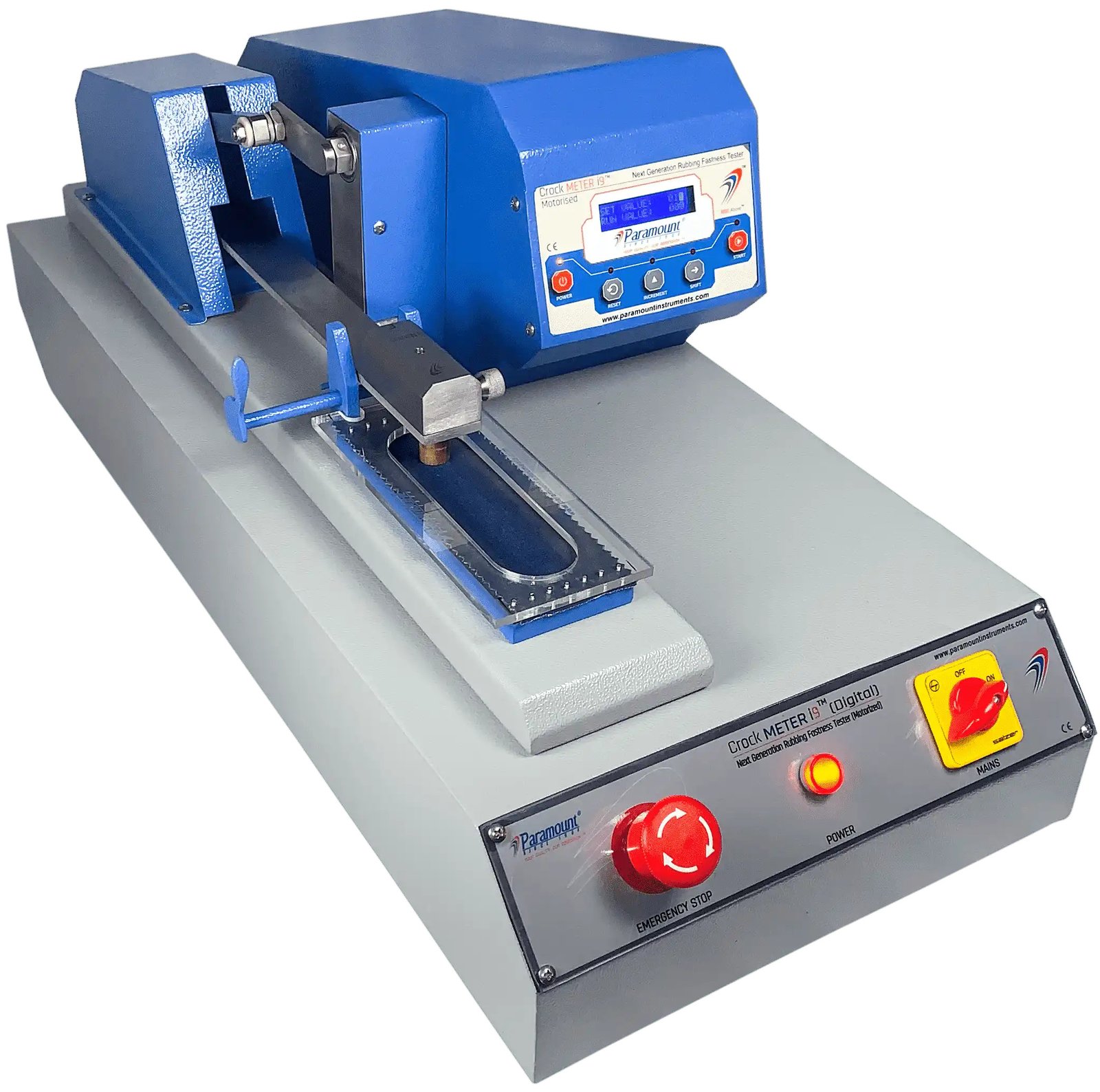
If you have ever pulled a new pair of jeans out of the wash and found blue dye on your white sofa, you have seen a rubbing fastness failure in real life. In a testing lab, this exact problem is measured using a crock meter test — one of the most routine yet most important checks in a textile quality control programme. For manufacturers, exporters, and buying houses across India’s garment hubs, a crock meter test is often the first line of defence against colour-related customer complaints and shipment rejections.
This article walks through what the test actually measures, how the equipment works, the difference between dry and wet crocking, the standards labs follow, and how to improve a fabric’s rubbing fastness rating before it ever reaches a buyer’s inspection table.
A crock meter test measures how much colour transfers from a dyed or printed fabric onto another surface when rubbed under controlled pressure. It is used worldwide to check a fabric’s rubbing fastness, which affects both appearance retention and consumer safety.
What Is a Crock Meter Test?
A crock meter test is a standardised method for evaluating colour fastness to rubbing — in other words, how well a dyed, printed, or finished fabric resists transferring its colour onto another material through friction. The instrument used for this, called a crock meter, rubs a piece of white testing cloth against the fabric sample in a fixed back-and-forth motion, under a specified weight and number of strokes.
Once the rubbing cycle is complete, the white cloth is examined and rated against a grey scale, which runs from 1 (severe staining) to 5 (no staining at all). This rating tells a quality manager, merchandiser, or buyer exactly how stable the fabric’s colour is under everyday friction — the kind that happens when a shirt rubs against skin, a car seat, or another garment in a wardrobe.
In practical terms, this test answers a very simple question: will this fabric’s colour rub off onto something else? It is a question every garment exporter needs answered before a shipment leaves the factory.
Why Is the Crock Meter Test Important?
Colour transfer is not just a cosmetic issue. It can lead to returned shipments, damaged brand reputation, and in some cases, safety concerns if unfixed dyes come into contact with skin repeatedly.
Rubbing fastness testing matters because it predicts whether a fabric’s dye will stain other surfaces or garments during normal wear, washing, or storage — a common cause of buyer rejections and customer complaints in the garment industry.
For buying houses and quality managers, the crock meter test is usually a mandatory checkpoint before bulk production is approved. A few reasons it carries so much weight:
- Buyer compliance: Most international retailers specify a minimum crock rating (commonly 3.5–4) before accepting a shipment.
- Consumer safety: Excess dye transfer onto skin, especially for children’s wear, is flagged in several compliance audits.
- Brand reputation: Colour bleeding onto other clothes during storage or transit is one of the most visible and complained-about defects in retail.
- Cost control: Catching poor rubbing fastness at the fabric stage is far cheaper than a full shipment rejection after cutting and stitching.
This is why fabric colour testing is built into pre-production, in-process, and final inspection stages at most reputable garment units.
How Does a Crock Meter Work?
A crock meter is a fairly simple mechanical instrument, but its precision lies in consistency. The core components include a flat testing base where the fabric sample is clamped, a weighted finger or peg fitted with a piece of standard crocking cloth, and a crank or motor mechanism that moves the finger back and forth over a fixed 100 mm stroke length.
How the test typically runs:
- The fabric sample is mounted flat and taut on the base plate.
- A square of standard white crocking cloth is attached to the rubbing finger.
- The finger applies a fixed downward force (usually around 9 N, per standard specification).
- The machine performs a set number of rub cycles — 10 strokes for dry testing is common under AATCC methods.
- The crocking cloth is removed and assessed for staining using a grey scale or, in some labs, an instrumental colour transfer test with a spectrophotometer.
Manual crock meters are still widely used in smaller labs, while larger textile testing equipment setups increasingly use motorised, programmable units for repeatability across large sample volumes.
Dry Crock Test vs Wet Crock Test
One of the most common questions from students and new quality executives is how dry and wet crocking differ. The mechanics of the machine are identical — what changes is the condition of the crocking cloth.
The difference between dry and wet crock testing is simple: dry crocking uses a completely dry testing cloth, while wet crocking uses a cloth moistened to a specified water content. Wet crocking is generally more demanding and tends to produce lower fastness ratings than dry crocking.
| Parameter | Dry Crock Test | Wet Crock Test |
| Cloth condition | Completely dry | Moistened to standard water pickup |
| Severity | Less severe | More severe, exposes weaker dye fixation |
| Typical use | General fabric checks | Simulates sweat, rain, damp storage |
| Common pass rating | 4–5 | 3.5–4 |
| Relevance | All fabrics | Especially activewear, denim, dark shades |
Wet crock testing is particularly important for dark, heavily dyed fabrics such as indigo denim, where moisture can loosen unfixed dye particles that a dry rub would not disturb. Many fabric testing labs run both tests together as a standard pair, since a fabric can pass dry crocking comfortably and still fail wet crocking.
International Testing Standards (ISO 105 X12 & AATCC 8)
Crock meter testing is not an arbitrary in-house procedure — it follows internationally recognised protocols so that results from a lab in Tiruppur, Bangalore, or anywhere else in the world are comparable to a buyer’s own lab.
The two most widely used standards for crock meter testing are ISO 105-X12, common in European and global buyer specifications, and the AATCC 8 test method, widely used in the United States. Both measure colour fastness to rubbing but differ slightly in stroke count and cloth handling.
- ISO 105-X12: Specifies rubbing cloth type, stroke length, applied force, and evaluation using the grey scale for staining. It is the reference method for most European and multinational buyer requirements.
- AATCC 8 Test Method: The American counterpart, widely referenced by US retailers, with its own defined stroke count and crocking cloth specifications.
Labs serving export-oriented clients typically run both standards side by side, since a single shipment may be destined for buyers who reference either specification in their technical packs. Understanding which standard a buyer expects is one of the first things a merchandiser should confirm before samples are sent for testing.
Industries That Use Crock Meter Testing
While garments are the most visible application, rubbing fastness testing extends well beyond apparel.
- Apparel and garment manufacturing — shirts, trousers, denim, kidswear
- Home textiles — bedsheets, curtains, upholstery fabric
- Automotive textiles — car seat covers and interior trims
- Footwear and leather goods — dyed uppers and linings
- Technical and industrial textiles — where colour transfer onto adjoining materials must be controlled
India’s textile industry, with major garment manufacturing and export clusters in cities like Tiruppur and Bangalore, relies heavily on this kind of in-house textile quality control to meet the specifications of international buyers before goods are even shipped for third-party inspection.
Factors Affecting Rubbing Fastness
A fabric’s crock rating is influenced by more than just the dye colour. Several production-stage variables come into play:
- Dye class and fixation — reactive, direct, sulphur, and pigment dyes all behave differently under friction
- Dyeing and finishing process — inadequate washing-off after dyeing leaves loose surface dye
- Fabric construction — tightly woven or knitted fabrics tend to hold dye more securely
- Finishing chemicals — some softeners and coatings can improve or worsen rubbing fastness
- Colour depth — darker, heavier shades are statistically more prone to poor crock ratings
- Humidity and moisture exposure — directly affects wet crock performance
A quality manager reviewing a failed crock meter test should look upstream at the dyeing process rather than treating the test result as an isolated data point.
How to Improve Fabric Rubbing Fastness
Improving rubbing fastness is largely a dyeing and finishing exercise rather than a testing exercise, but there are proven, practical steps manufacturers commonly apply:
- Thorough soaping and washing-off after dyeing to remove unfixed surface dye
- Correct dye selection for the fibre type and end use
- Use of fixing agents appropriate to the dye class, applied at the correct dosage
- Controlled dyeing temperature and time to ensure proper dye penetration, not just surface adhesion
- Regular in-process crock checks, rather than testing only at the final stage
- Avoiding over-application of pigment finishes, which sit on the surface and rub off easily
Consistent, early-stage testing using a reliable colour fastness tester helps catch issues before they become expensive end-of-line rejections.
Choosing the Right Crock Meter
Not every fabric testing lab needs the same rubbing fastness machine. The right choice depends on sample volume, standards followed, and budget.
Points worth evaluating before purchase:
- Manual vs motorised operation — motorised units offer better repeatability for high sample volumes
- Standards compliance — confirm the unit supports both ISO 105-X12 and AATCC 8 requirements
- Build quality and calibration support — accurate stroke length and applied force are critical to valid results
- Ease of clamping and cloth mounting — reduces operator error across shifts
- After-sales calibration and service support — especially important for export-focused labs running continuous testing
A crock meter is a long-term lab investment, and getting the specification right the first time avoids costly recalibration or replacement later.
Why Choose Amith Garment Services
Amith Garment Services supplies textile testing equipment and garment testing instruments to manufacturers, exporters, and testing labs, with a focus on equipment that holds up to daily production-floor use. From crock meters to light booths, colour matching cabinets, washing fastness testers, GSM cutters, fabric inspection machines, bursting strength testers, and fabric rolling machines, the equipment range is built around the practical needs of Indian textile and garment quality control teams — not just laboratory showpieces.
For manufacturers and exporters who need dependable rubbing fastness machines that meet ISO 105-X12 and AATCC 8 requirements, Amith Garment Services provides equipment suited to both small quality labs and high-volume export units.
Conclusion
A crock meter test may look like a small, routine check, but it plays an outsized role in preventing colour-related complaints, returns, and compliance failures across the textile and garment supply chain. Understanding how dry and wet crock testing differ, which standards apply, and what affects rubbing fastness gives manufacturers, merchandisers, and quality teams a real head start in avoiding costly surprises. Whether you are setting up a new fabric testing lab or upgrading existing textile testing equipment, investing in a reliable crock meter test process pays for itself many times over in avoided rejections and stronger buyer trust.
Frequently Asked Questions:
1. What is a crock meter test used for in the textile industry?
A crock meter test measures a fabric's colour fastness to rubbing, determining whether dye transfers from the fabric to another surface through friction. It is an essential quality control test performed before production approval and shipment to prevent colour bleeding complaints and buyer rejections.
2. What is the difference between dry crock and wet crock testing?
Dry crock testing uses a completely dry rubbing cloth, while wet crock testing uses a cloth moistened to the specified water pickup level. Wet crock testing is generally more demanding because moisture can release unfixed dyes that may not transfer during dry rubbing.
3. Which standards are followed for crock meter testing?
The most widely accepted standards are ISO 105-X12 and AATCC 8. Both evaluate colour fastness to rubbing using controlled rubbing cycles followed by grey-scale staining assessment, ensuring results are accepted by international buyers and testing laboratories.
4. Can a fabric pass dry crock testing but fail wet crock testing?
Yes. This commonly occurs with dark shades such as indigo denim and heavily dyed fabrics. While the fabric may perform well under dry rubbing, moisture can loosen unfixed dye, resulting in lower wet crock fastness ratings. That's why both tests are recommended.
5. What is a crock meter test used for?
A crock meter test checks whether a fabric's dye transfers onto another surface when rubbed. It helps textile manufacturers identify colour transfer issues before garments reach buyers or consumers.
6. How do you perform a crock meter test?
A standard white rubbing cloth is mounted on the crock meter finger and rubbed against the fabric under a specified pressure and number of strokes. The rubbing cloth is then evaluated using a Grey Scale for Staining to determine the colour fastness rating.
7. What's the difference between dry and wet crocking?
Dry crocking uses a dry rubbing cloth, while wet crocking uses a dampened cloth. Wet crocking is generally more challenging because moisture increases the likelihood of dye transfer from the fabric.
8. Is crock meter testing mandatory for garment exporters?
Yes. Most international buyers require minimum rubbing fastness ratings based on ISO 105-X12 or AATCC 8, making crock meter testing a standard quality assurance requirement before export shipments.