
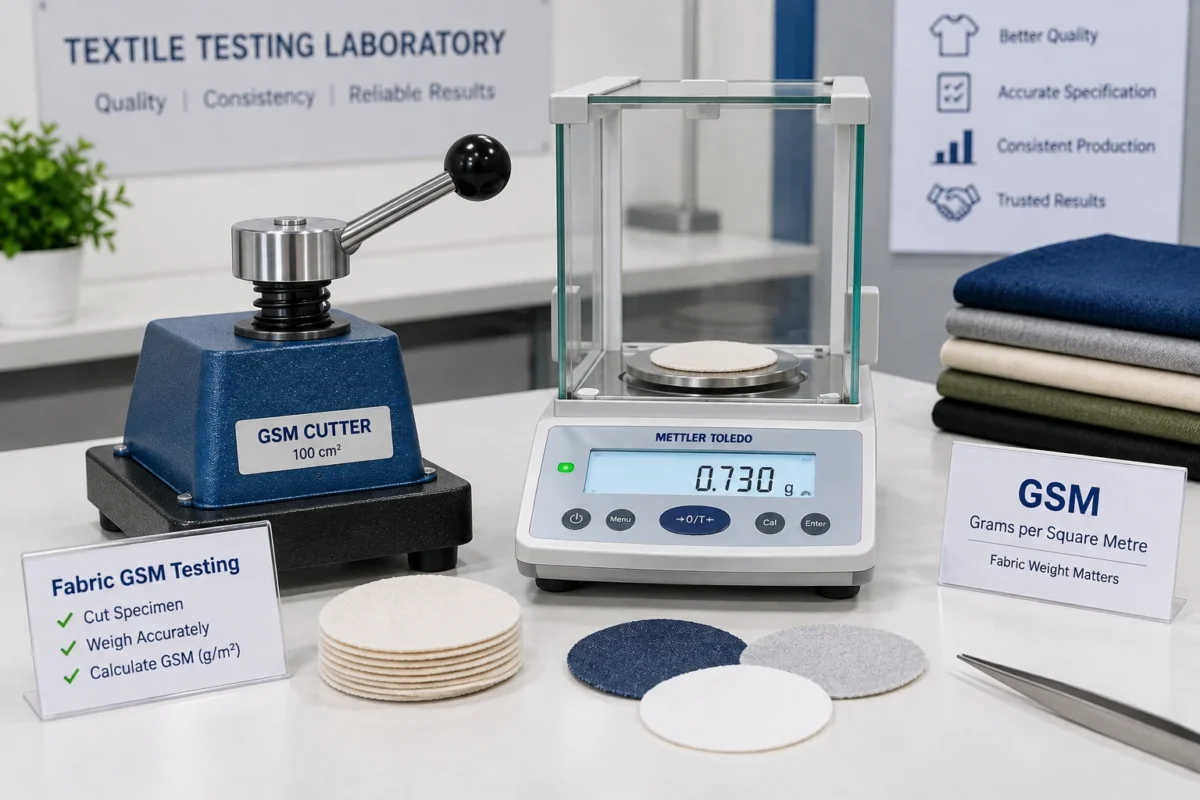
If you have spent any time in a fabric mill, a garment factory, or a buying house quality lab, you have probably heard someone ask, “What’s the GSM on this fabric?” It’s one of the first questions raised when a new fabric lot arrives, and for good reason. Fabric weight tells you a lot about how a material will behave — how it drapes, how it feels, how much yarn goes into it, and whether it meets the specification a buyer signed off on.
This is where a GSM Machine comes in. It’s a simple but essential piece of textile testing equipment used to determine how many grams a square metre of fabric weighs. Whether you’re running a spinning mill, managing quality at a garment export unit, or studying textile engineering, understanding how this instrument works will help you read fabric specification sheets with more confidence and catch quality issues before they become costly.
In this article, we’ll walk through what GSM actually means, how a GSM testing machine works step by step, and why this small but important test plays such a big role in textile manufacturing and garment exports.
What Is a GSM Machine?
GSM stands for Grams per Square Metre — a standard unit used across the textile industry to express fabric weight. A GSM Machine, sometimes called a GSM tester or fabric weight tester, is a laboratory instrument used to measure this value on a fabric sample.
In simple terms, fabric weight is the raw physical weight of a piece of cloth, while GSM is that weight expressed per unit area. Two fabrics can look similar but have very different GSM values depending on yarn thickness, weave density, or knitting structure. That’s why relying on “how heavy it feels” isn’t enough — a proper GSM test gives you a measurable, comparable number.
GSM matters because it directly affects cost, performance, and buyer acceptance. A shirt fabric specified at 120 GSM will behave very differently from one at 200 GSM, even if both are cotton. Getting this number right helps mills, exporters, and quality teams stay aligned on what’s actually being produced.
What is a GSM Machine? A GSM Machine is a textile testing instrument used to measure fabric weight in grams per square metre. It typically works with a precision cutter and a weighing balance to calculate how much a specific fabric area weighs, helping determine fabric quality and consistency.
How Does a GSM Machine Work?
The working principle behind a GSM testing machine is straightforward, even though the process requires care and consistency. Here’s how it typically works in a textile lab:
- Fabric sample selection – A representative piece of fabric is chosen, avoiding folds, selvedges, or visibly damaged areas.
- Conditioning where required – Depending on the applicable testing procedure, samples may be conditioned at standard temperature and humidity before testing.
- Cutting the test specimen – A GSM cutter is used to cut a fabric circle or square of a known, fixed area.
- Using a standard specimen size – Round cutters of a defined diameter are common in many labs, since they simplify area calculation.
- Weighing the sample – The cut specimen is placed on a precision weighing balance to record its weight in grams.
- Calculating fabric GSM – The weight is converted mathematically to represent one full square metre.
- Recording and interpreting the result – The final GSM value is logged and compared against the buyer’s specification or internal quality standard.
A simplified GSM calculation example: if a fabric specimen cut to a known area weighs a certain number of grams, that weight is scaled up proportionally to represent a full square metre. For instance, a small circular sample represents a known fraction of a square metre, so the recorded weight is multiplied accordingly to arrive at the final GSM figure. Many GSM testing machines and cutters are designed around standard specimen sizes specifically to make this calculation simple and repeatable.
How does a GSM Machine work? A GSM Machine works by cutting a fabric sample of known area using a GSM cutter, weighing it on a precision balance, and mathematically converting that weight into grams per square metre. This gives a standardized, comparable fabric weight value.
GSM Machine and GSM Cutter – What Is the Difference?
People often use “GSM Machine,” “GSM Tester,” and “GSM Cutter” interchangeably, but each refers to a slightly different part of the testing process.
| Component | Function |
| GSM Machine / GSM Tester | General term for the overall testing setup used to determine fabric GSM |
| GSM Cutter | Precision tool used to cut a fabric specimen of a fixed, known area |
| Weighing Balance | Precise scale used to record the weight of the cut specimen in grams |
In practice, GSM testing usually involves a cutting tool paired with an accurate weighing instrument. Some labs use a combined setup, while others use a dedicated GSM cutter alongside a separate analytical balance. Both components need to work together reliably — an inaccurate cutter or an uncalibrated balance can lead to misleading GSM results, regardless of how good the rest of the process is.
Why Is GSM Testing Important in Textile Manufacturing?
GSM testing isn’t just a lab formality — it has real, practical consequences across the production chain.
- Maintaining fabric specifications as agreed with buyers or brands
- Batch-to-batch consistency, especially across large production runs
- Cost estimation and material consumption planning, since GSM affects how much fabric is needed per garment
- Production planning, particularly for cutting and sewing operations
- Garment construction quality, since fabric weight influences drape, structure, and finish
- Export quality requirements, where buyers often specify acceptable GSM tolerance
- Detecting variation between different rolls or lots of the same fabric order
Incorrect GSM can affect how a garment hangs, how it feels to the wearer, its durability, and even how it performs in downstream processes like cutting and stitching. A fabric that’s lighter than specified might feel flimsy or transparent, while one that’s heavier than ordered could throw off costing and shipping weight calculations.
Why is GSM testing important? GSM testing is important because it verifies whether fabric meets the specified weight, ensuring consistency across production batches, accurate costing, and compliance with buyer requirements. Incorrect GSM can affect fabric drape, durability, garment appearance, and overall production quality.
GSM Testing Procedure for Fabric
While exact steps can vary depending on the applicable standard or buyer specification, a typical GSM testing procedure in a textile laboratory follows this general workflow:
- Select a representative area of the fabric roll
- Avoid creases, stains, torn edges, or visibly defective sections
- Cut the specimen using a GSM cutter at the chosen location
- Weigh the specimen accurately on a calibrated balance
- Record the result along with sample details
- Repeat the test at multiple points across the fabric where required
- Calculate the average GSM from multiple readings
Representative sampling matters because fabric weight can vary slightly across a roll due to tension, finishing, or manufacturing inconsistencies. A single reading from one spot doesn’t always reflect the true average GSM of the entire batch, which is why many labs test multiple points rather than relying on just one specimen. It’s worth noting that not every laboratory or buyer follows an identical procedure — the applicable standard or in-house testing protocol should always guide the exact steps taken.
GSM Machine vs Manual GSM Testing
| Feature | GSM Machine/Tester | Manual GSM Testing |
| Testing process | Standardized cutting and weighing setup | Estimated or improvised measurement |
| Accuracy | Generally higher, based on calibrated instruments | Depends heavily on operator skill and tools used |
| Speed | Faster, especially with dedicated cutters | Slower and more labor-intensive |
| Operator involvement | Moderate, with defined steps | High, with more room for inconsistency |
| Repeatability | Good, when equipment is calibrated | Variable between operators |
| Laboratory suitability | Suitable for regular quality control testing | Suitable only for rough, non-critical checks |
| Quality control use | Widely used in structured QC programs | Rarely sufficient for buyer compliance |
The right setup ultimately depends on your laboratory’s testing volume, accuracy requirements, and the standards you need to comply with. A high-volume export unit will likely need dedicated GSM testing equipment, while a smaller operation might start with basic tools and scale up over time.
Types of Fabrics Tested Using a GSM Machine
GSM testing applies across a wide range of fabric types, including:
- Cotton fabrics
- Polyester and synthetic fabrics
- Blended fabrics (cotton-poly, viscose blends, etc.)
- Knitted fabrics
- Woven fabrics
- Nonwoven materials, where applicable
- Garment-specific fabrics
- Home textile materials like bedsheets and curtains
GSM ranges vary significantly depending on fabric construction, fiber type, and intended end use. A lightweight shirting fabric will naturally sit at a very different GSM than a heavy denim or upholstery fabric, so there’s no single “ideal” number — it’s always relative to what the fabric is designed for.
Factors That Can Affect Fabric GSM
Several variables can influence the final GSM reading, including:
- Fibre composition and yarn count
- Fabric construction (knit vs woven)
- Ends and picks per inch in woven fabrics
- Knitting structure and stitch density
- Finishing processes like calendering or coating
- Moisture content in the fabric
- Fabric shrinkage after washing or processing
- Location on the fabric roll where the sample was taken
- Conditioning of the sample before testing
- Overall measurement accuracy of the equipment used
Because so many factors can shift the result, testing conditions and sampling consistency matter just as much as the equipment itself. A well-calibrated GSM machine used with poor sampling practices will still produce unreliable results.
GSM Machine in Textile Quality Control
GSM testing plays a role at multiple checkpoints in the quality control process:
- Incoming fabric inspection from suppliers
- In-process quality checks during production
- Final fabric inspection before cutting
- Buyer compliance verification
- Supplier performance evaluation
- Batch-to-batch comparison
- Ongoing production monitoring
- Garment quality testing before shipment
Rather than relying on a single GSM reading, experienced quality teams track variation across multiple samples and batches over time. This helps identify whether a supplier is consistently within tolerance or whether a particular lot needs closer inspection.
How is GSM used in textile quality control? In textile quality control, GSM testing helps verify incoming fabric against specifications, monitor consistency across production batches, and confirm buyer compliance. Quality teams often track GSM trends across multiple samples rather than depending on a single test result.
How to Choose the Right GSM Machine
Selecting suitable GSM testing equipment depends on several practical factors:
- Required measurement accuracy for your testing needs
- Testing range suitable for your fabric types
- Sample size requirements based on your standard procedure
- Ease of operation for lab staff
- Build quality and durability of the cutter and balance
- Laboratory environment and available space
- Calibration requirements and frequency
- Repeatability of results over repeated use
- Compatibility with your applicable testing standard
- Availability of technical support and replacement parts
- Expected testing volume in your facility
Rather than choosing based on price alone, it’s worth evaluating equipment against your actual testing requirements and the standards your buyers expect you to follow.
GSM Testing Standards and Laboratory Practices
GSM testing is typically carried out based on applicable international, national, or buyer-specific procedures. Different laboratories and buyers may reference different standards depending on the region, product category, or contractual requirement. Rather than assuming one procedure applies universally, it’s good laboratory practice to confirm which standard or buyer specification applies to a given order and to follow its current official version.
If your lab works with multiple buyers, it’s common to maintain records of which testing procedure was used for each order, since requirements can differ from one buyer to another.
Industries That Use GSM Testing
GSM testing is used widely across:
- Textile manufacturing units
- Garment manufacturing and export houses
- Buying houses and sourcing agents
- Fabric processing and finishing units
- Independent textile testing laboratories
- Home textile producers
- Technical textile manufacturers
- Quality inspection agencies
India has a strong and diverse textile manufacturing base, with clusters like Tiruppur known for knitwear and garment exports, and cities like Bangalore hosting a mix of textile manufacturers, buying houses, and testing laboratories. Across the broader textile industry — both in India and internationally — GSM testing remains one of the most routinely performed quality checks in fabric and garment production.
Common GSM Testing Mistakes
Even experienced labs can run into avoidable errors, such as:
- Taking a sample that isn’t representative of the fabric roll
- Cutting the specimen inaccurately or off-center
- Using a weighing balance that isn’t properly calibrated
- Skipping moisture or conditioning requirements when applicable
- Not checking equipment condition before testing
- Relying on only one reading instead of an average
- Poor sample labeling and identification
- Mixing different testing procedures within the same batch
- Failing to maintain proper testing records
Consistent laboratory practices — calibrated equipment, trained staff, and clear documentation — go a long way toward improving the reliability of GSM results over time.
Why Choose Amith Garment Services
At Amith Garment Services, we supply GSM Machines, GSM Cutters, and a wider range of textile testing equipment designed to support fabric and garment quality workflows. Our product range includes GSM testing tools, Color Matching Cabinets, Crock Meters, Washing Fastness Testers, Fabric Inspection Machines, Bursting Strength Testers, and Fabric Rolling Machines, among other garment testing instruments.
We work with textile manufacturers, garment exporters, and testing laboratories to help them identify equipment suited to their specific testing requirements, lab environment, and applicable standards. Rather than pushing a one-size-fits-all solution, our approach is to understand what you’re testing, how often, and to what specification — and help you choose accordingly.
If you’re setting up a new fabric testing lab or upgrading existing GSM testing equipment, our team can walk you through the practical considerations involved.
Frequently Asked Questions
A GSM Machine is used to measure the weight of a fabric sample per square metre, helping textile manufacturers and quality teams verify whether fabric matches the required specification. It's commonly used during incoming fabric inspection, in-process quality checks, and final inspection before garments are cut and sewn. By providing a standardized, comparable weight value, a GSM Machine helps reduce guesswork and supports consistent decision-making across fabric batches, suppliers, and production orders.
A GSM Machine typically works by cutting a fabric specimen of a fixed, known area using a GSM cutter, then weighing that specimen on a precision balance. The recorded weight is then mathematically scaled up to represent a full square metre of fabric. This process gives a standardized GSM value that can be compared against buyer specifications or internal quality benchmarks, regardless of the actual size of the fabric roll being tested.
A GSM Cutter is a precision tool used specifically to cut a fabric specimen of a known, fixed area, while a GSM Machine or GSM Tester refers more broadly to the overall testing setup, which includes both the cutting tool and a weighing balance. In practice, both components work together — the cutter ensures a consistent sample size, and the balance provides an accurate weight reading needed to calculate the final GSM value.
Textile manufacturers test fabric GSM to confirm that production output matches agreed specifications, maintain consistency across batches, and avoid costly quality disputes with buyers. GSM directly influences fabric drape, durability, and garment appearance, so even small deviations can affect how a finished product performs. Regular GSM testing also supports better cost estimation, material planning, and long-term supplier evaluation within a textile quality control program.
A GSM Machine is used to measure fabric weight per square metre, helping textile labs check whether fabric meets buyer specifications and stays consistent across production batches.
You test fabric GSM by cutting a sample of known area, weighing it on a precise scale, and calculating the equivalent weight for one full square metre.
Fabric GSM matters because it affects cost, drape, durability, and how a garment feels and performs, making it a key quality check in textile production.
Choose a GSM testing machine based on your accuracy needs, testing volume, applicable standards, and how easily it fits into your existing lab workflow and calibration routine.