
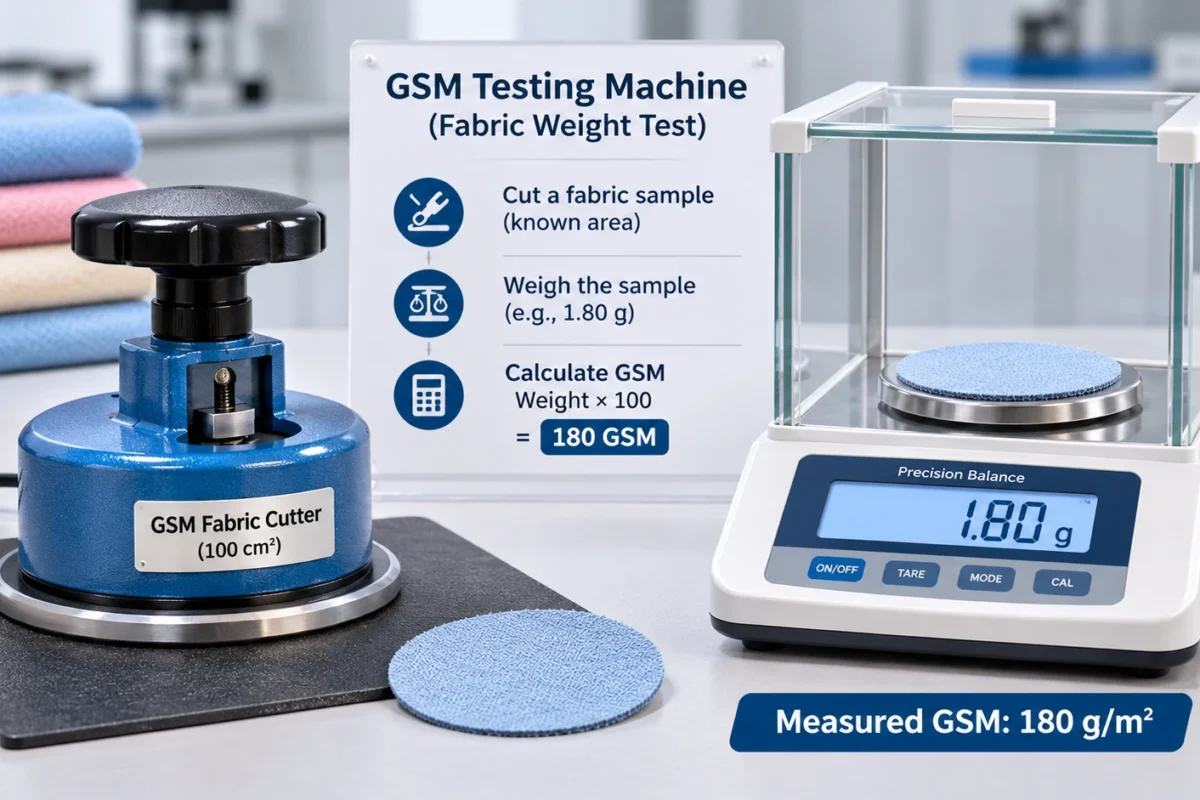
GSM testing machine with cutter and digital balance measuring fabric weight

What Is a GSM Testing Machine? Working Principle, Applications, and Importance in Textile Quality Control

Walk into a fabric testing lab in Tiruppur or Bangalore and you will usually find the same setup on the bench: a circular cutter, a precision balance and a stack of round fabric swatches. That setup is what most people mean by a GSM testing machine. It tells you how many grams one square metre of fabric weighs. That figure affects cost, drape, durability and buyer approval.

This guide explains how a GSM testing machine works, which methods and standards apply, and how to get results you can trust.

What Is a GSM Testing Machine?

GSM stands for grams per square metre. It is the standard way to express fabric weight and compare one fabric with another.

A GSM testing machine is textile testing equipment used to measure fabric weight in grams per square metre. In most labs, a GSM cutter machine cuts a sample of fixed area, and a precision balance weighs it. The result helps verify fabric quality, specification compliance and consistency before production or shipment.

In everyday use, the term covers a GSM cutter machine plus a digital GSM balance for fabric testing. Some suppliers use it for the cutter alone, so always check what is included.

Why Is GSM Testing Important in the Textile Industry?

Fabric weight is linked to fabric construction. Yarn count, thread density (or stitch density in knits), fibre type and finishing all change GSM. If the GSM drifts, something in the construction or process has usually changed.

Fabric GSM testing matters because fabric weight affects cost, feel, drape, strength and performance. A fabric that drifts from its specified GSM can cause buyer rejections, inconsistent garments and yield problems. Regular testing on a GSM testing machine lets mills, exporters and labs confirm that each lot matches the approved standard.

In practice, a merchandiser may receive a 180 GSM jersey order that measures 165 GSM on arrival. That 8% gap changes handfeel, opacity and shrinkage behaviour. A quick check at goods-in catches it before cutting begins.

For garment exporters and fabric manufacturers in India, GSM is also a standard line on buyer specifications and inspection reports.

How Does a GSM Testing Machine Work?

The working principle is simple: known area, measured mass, calculated density.

A GSM cutter machine uses a sharp circular blade to cut a fabric specimen of fixed area, commonly 100 cm². The specimen is then weighed on a precision balance. Because the area is known, the weight converts directly into grams per square metre, making results quick and repeatable.

The balance matters as much as the cutter. A specimen of 100 cm² from a light fabric may weigh under 1.5 g, so a balance with fine readability is essential.

Fabric GSM equals specimen mass in grams divided by specimen area in square metres. With a 100 cm² cutter, area is 0.01 m², so you multiply the specimen weight in grams by 100. A 1.6 g specimen therefore gives 160 GSM. Average several specimens for a reliable result.

Formula: GSM = specimen weight (g) ÷ specimen area (m²)

To convert, 1 oz/yd² is roughly 33.9 GSM.

Different GSM Testing Methods

The applicable method depends on the standard you follow and the buyer’s requirement. Sample size, conditioning and specimen count are not identical across methods, so do not assume one procedure fits all.

Method How it works Typical use
Cutter and balance Fixed-area circular specimens are cut and weighed Routine QC, incoming fabric checks
Larger or full-width sample A measured piece is weighed on a laboratory scale Standard-driven lab testing
Mass per length, then area Fabric mass over a measured length is converted using width Woven fabric, mill-level checks

ISO 3801 covers mass per unit length and mass per unit area of woven fabrics. ASTM D3776/D3776M covers mass per unit area (weight) of fabric and describes more than one option. Read the current edition of whichever standard your buyer names before setting your procedure.

Fabric GSM Testing Process Step by Step

The standard fabric GSM testing process is: condition the fabric, select representative areas, cut specimens with a GSM cutter, weigh each on a calibrated balance, calculate GSM and average the results. The exact specimen size and number depend on the chosen standard, such as ISO or ASTM methods.

  1. Condition the fabric. Many labs follow a standard atmosphere, commonly 20 ± 2 °C and 65 ± 4% RH under ISO 139.
  2. Select the sample. Avoid selvedges and creases. Take specimens from different positions across the width and length.
  3. Cut specimens. Press the cutter firmly on a cutting pad for clean edges.
  4. Weigh each specimen. Use a calibrated balance with the draught shield closed.
  5. Calculate and average. Record each GSM value and report the mean.

Types of GSM Testing Equipment

Fabric GSM testing equipment ranges from basic to well-equipped:

  • Manual GSM cutter machine: hand-operated circular blade, widely used for routine testing.
  • Digital GSM balance for fabric testing: high-readability electronic balance, sometimes with GSM display functions.
  • Measuring table, ruler and laboratory scale: for larger sample methods.

A fabric weight testing machine is only as accurate as its weakest part. A good cutter with a poor balance still gives poor data.

Industries That Use GSM Testing Machines

GSM testing equipment for the textile industry appears across the supply chain:

  • Fabric manufacturing: verifying knit, woven and nonwoven output against specification.
  • Garment manufacturing: checking fabric before cutting, especially in knitwear clusters like Tiruppur.
  • Textile exporters: confirming shipments match buyer-approved weights.
  • Textile testing laboratories: running third-party and in-house tests for brands and buying houses.
  • Textile education: teaching students how construction affects fabric weight.

Factors Affecting Fabric GSM Measurement

Several practical issues change the number you read:

  • Moisture content: unconditioned fabric can read heavier.
  • Fabric relaxation: knits may behave differently before and after relaxation.
  • Finishing: sizing, softeners and coatings add mass.
  • Sampling position: weight can vary across width and length.
  • Cutter condition: a dull blade distorts edges and changes the true area.
  • Balance accuracy: poor calibration or air movement skews small specimens.

How to Improve Accuracy in Fabric GSM Testing

  • Test at least several specimens per sample and report the average.
  • Calibrate the balance regularly with certified weights.
  • Replace or sharpen cutter blades when edges look frayed.
  • Handle specimens with clean, dry hands or tweezers.
  • Keep conditions consistent from one test session to the next.
  • Document the standard, specimen size and conditioning used.

Consistent procedure matters more than any single reading. Two labs using different methods will not always agree, even on the same fabric.

How to Choose the Right GSM Testing Machine?

Start with your test method, then match the equipment.

Check Why it matters
Cutter area Must suit your standard or buyer requirement
Blade quality and replacement Affects edge quality and area accuracy
Balance capacity and readability Light fabrics need finer resolution
Build and cutting pad Influences repeatability and blade life
Support and spares Keeps the lab running

A reliable GSM testing machine manufacturer will state these details clearly and explain which methods the equipment supports. Be cautious of vague claims.

Why Choose Amith Garment Services?

Amith Garment Services supplies textile testing equipment for fabric and garment quality control, including a GSM cutter machine alongside related instruments such as the crock meter, light booth, colour matching cabinet, washing fastness tester, bursting strength tester, fabric inspection machine and fabric rolling machine. This allows a lab to build a consistent testing setup from one source.

When you enquire, ask for the exact specifications of the model you are considering and confirm they match your test method.

Conclusion

A GSM testing machine is a small piece of equipment with a big job. It links fabric construction, material quality and buyer specifications through one simple number. Whether you run a mill, a garment unit, a buying house or a testing laboratory in India, consistent GSM testing helps you catch problems early and keep production predictable. Choose equipment that suits your test method, follow the same procedure each time, and keep your balance calibrated.

Frequently Asked Questions:

1. Is a GSM cutter machine the same as a GSM testing machine?

In everyday textile usage, the two terms often overlap. A GSM cutter machine is the tool that cuts a fixed-area specimen, while a complete GSM testing machine setup also includes a digital GSM balance for weighing it. Some labs use the term for the cutter alone. When ordering, confirm exactly what is supplied, including cutter area, blade type and balance resolution, so the equipment matches your chosen test method.

2. Which standards apply to textile fabric GSM testing?

Commonly referenced methods include ISO 3801 for woven fabrics and ASTM D3776/D3776M for fabric mass per unit area. Sample size, conditioning and specimen count differ between standards, so do not assume one procedure fits all. Always follow the method named in your buyer's specification or your lab's quality manual, and check the current edition. Consistent use of one method also keeps results comparable over time.

3. Why do GSM results vary between two labs?

Differences usually come from conditioning, sampling position, balance accuracy and cutter condition rather than the fabric itself. Moisture regain can shift the weight noticeably, and knit fabrics may be measured before or after relaxation. Dull blades can distort edges and change the specimen area. Using the same standard, controlled atmosphere, calibrated balance and several specimens from different positions narrows the gap between labs considerably.

4. What should I look for in a GSM testing machine manufacturer?

Look for a supplier that clearly states cutter area, blade type, balance capacity and readability, and explains which test methods the equipment supports. Ask about calibration support, spare blades and after-sales service. Request a demonstration or sample test if possible. A manufacturer who understands textile laboratory practice in India, from Tiruppur garment units to export testing labs, can also advise on setup and routine checks.

5. What is a GSM testing machine used for?

A GSM testing machine measures fabric weight in grams per square metre. Mills, garment exporters and labs use it to check that fabric matches its specification, compare lots, and catch weight variation before cutting, stitching or shipment.

6. How do you perform a fabric GSM test?

Condition the fabric, cut specimens of known area with a GSM cutter, weigh each on a calibrated balance, then divide weight by area in square metres. Average several specimens for the final fabric GSM result.

7. How does a GSM cutter machine work?

You press the circular blade through the fabric on a cutting pad, producing a specimen of fixed area, often 100 square centimetres. Weigh it, then multiply the grams by 100 to get GSM.

8. Why is fabric GSM important in garment manufacturing?

GSM affects how a garment feels, drapes, wears and costs. Consistent fabric weight keeps sizing, shrinkage behaviour and buyer approvals on track, and helps merchandisers confirm they received the fabric they ordered.
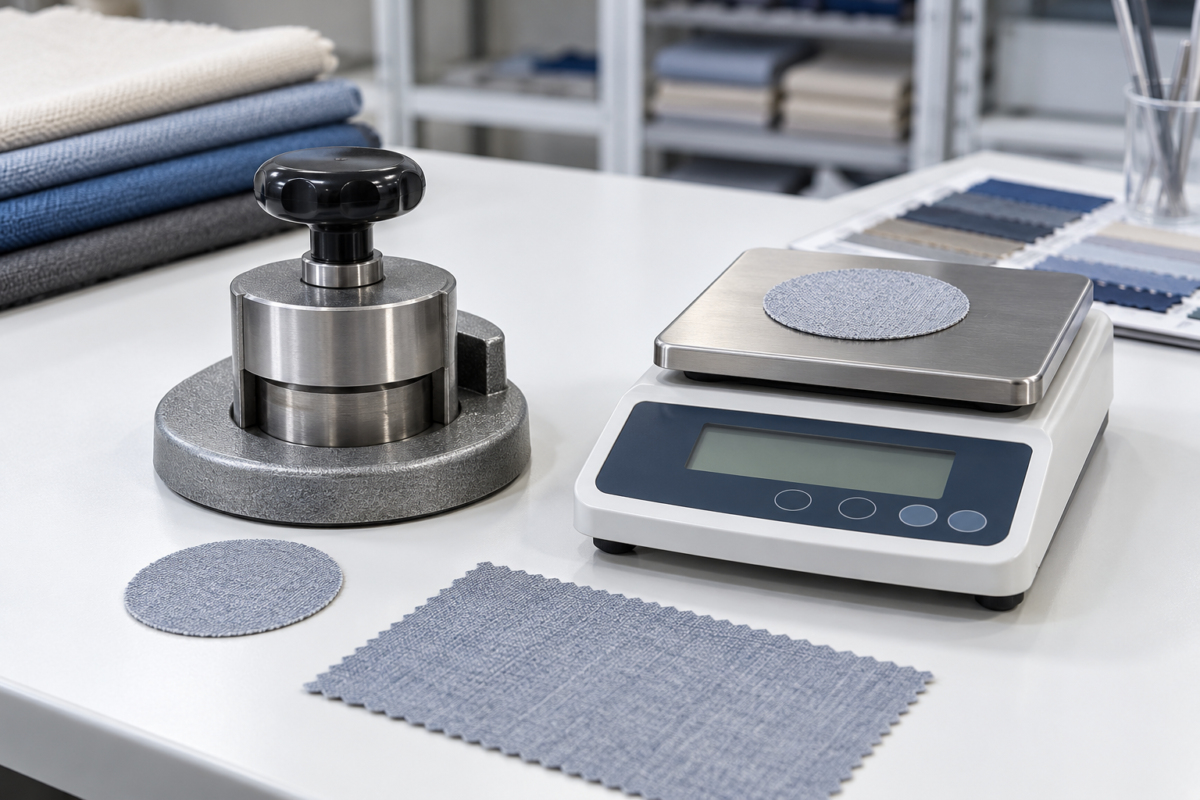
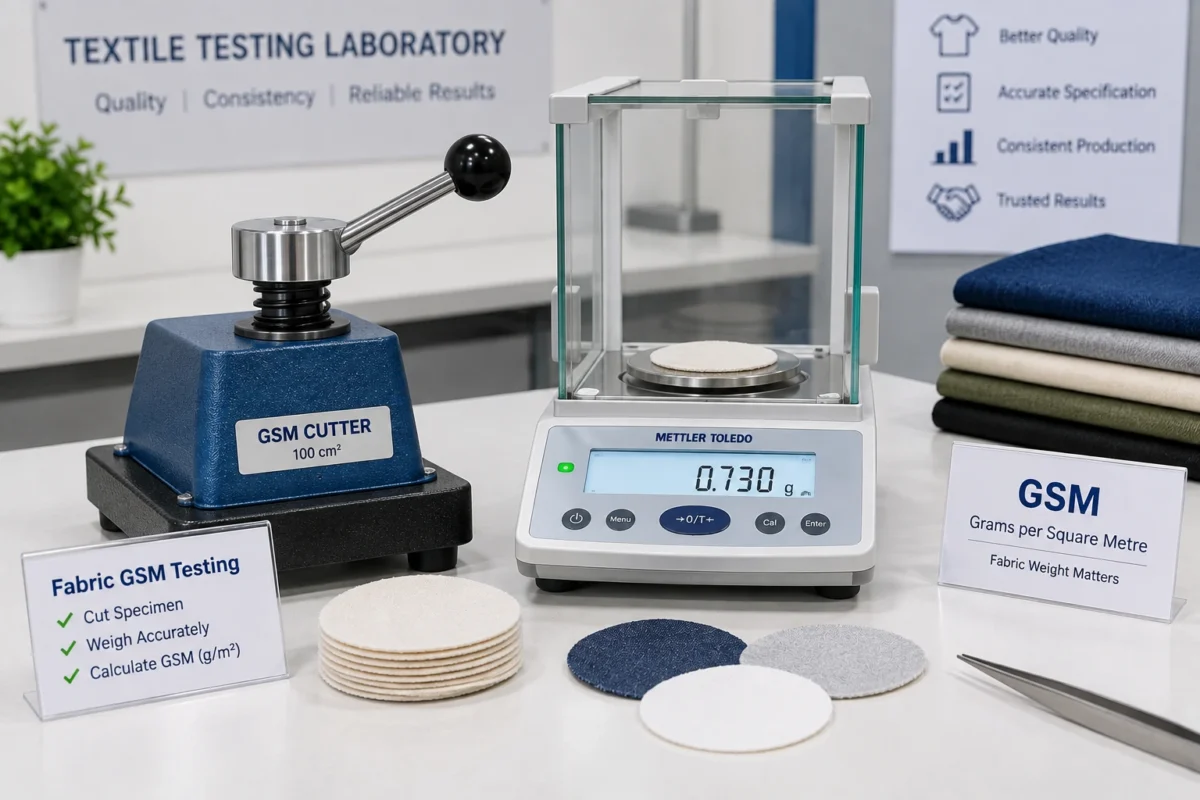
Fabric GSM testing setup with a round GSM cutter and precision weighing balance

How to Measure Fabric GSM Accurately

Fabric GSM, or grams per square metre, is the mass of a fabric in one square metre of area. It influences handfeel, durability, cost and specification matching. For mills, garment manufacturing units and textile exporters, a dependable GSM Machine in Tirupur or anywhere else in India only helps when it is paired with correct sampling, cutting, weighing and calculation.

What Is Fabric GSM and Why Does It Matter?

Fabric GSM means grams per square metre. It states how much a fabric weighs for each square metre of area, helping buyers and quality teams compare fabrics, confirm specifications and check consistency between lots. A higher GSM generally means a heavier fabric, although construction and fibre also decide how it performs.

GSM is not the same as thickness or density. Thickness is the distance through the fabric, usually in millimetres. Density in textile work usually refers to how closely yarns are packed, such as ends and picks in woven fabric or wales and courses in knits. Two fabrics can share the same GSM and still differ in thickness.

Why is GSM important in garment manufacturing? It ties the fabric to the garment specification. GSM affects handfeel, drape, warmth, durability and fabric cost, and measuring it helps teams catch lot-to-lot variation before cutting begins.

How to Measure Fabric GSM Accurately

Take a representative sample, condition it as the test method requires, and cut a specimen of known area. Weigh it on a calibrated balance, divide the weight in grams by the area in square metres, and compare the result with the specification. Repeat on several specimens and record the average.

  1. Select a representative sample. Avoid the outer layers of a roll, creases and selvedge edges.
  2. Condition the sample. Follow the applicable test method, because moisture changes weight.
  3. Use a GSM cutter or an accurately measured specimen. A round cutter gives a fixed area with clean edges.
  4. Confirm the specimen area. Do not assume it; check the cutter’s stated area.
  5. Weigh on a calibrated balance. Readability should suit the specimen’s weight.
  6. Calculate GSM using the formula below.
  7. Compare with the specification and any tolerance agreed with the buyer.
  8. Record the result with units, and repeat measurements where needed.

Each of these factors feeds directly into the final number. The exact procedure depends on the applicable test method and laboratory requirements.

How Does a GSM Machine in Tirupur Help Measure Fabric Weight?

Fabric GSM testing normally needs a GSM round cutter, a precision weighing balance and a way to calculate the result. Some products combine these steps, while others supply only one. Choose the configuration according to your fabric type, testing volume and workflow.

A typical setup includes a cutter and a balance, but “GSM testing machine” covers different configurations, and not every product sold under that name does both jobs.

  • GSM cutters produce specimens of a defined area, commonly 100 cm².
  • Precision balances record specimen weight; readability and calibration drive accuracy.
  • GSM calculator machines or digital calculators speed up the arithmetic.

How can a GSM Machine in Tirupur support fabric quality control? A well-chosen GSM setup in a Tiruppur unit makes incoming fabric checks quick and repeatable. Consistent specimen areas and calibrated weighing let teams compare lots, spot deviations early and keep records for buyer discussions. Regular calibration and correct operation remain essential.

GSM Calculation Formula With a Practical Example

GSM = specimen weight in grams ÷ specimen area in square metres. If a 100 cm² specimen weighs 1.8 g, convert the area to 0.01 m² and divide: 1.8 ÷ 0.01 = 180 GSM.

Item Value
Specimen weight 1.8 g
Specimen area 100 cm² = 0.01 m²
Calculation 1.8 g ÷ 0.01 m²
Final result 180 GSM

Since 1 m² equals 10,000 cm², 100 cm² is 0.01 m². For a 100 cm² specimen, you can multiply the weight in grams by 100 as a shortcut.

This result is only as good as the specimen area and the weighing. A GSM calculator machine or calculator automates the arithmetic, but it cannot fix inaccurate cutting, weighing or sampling.

Common Mistakes to Avoid When Measuring Fabric GSM

  • Wrong specimen area: a worn or mismatched cutter shifts every result.
  • Irregular or damaged specimens: frayed or distorted edges change weight and area.
  • Uncalibrated balance: drift produces consistently wrong values.
  • Ignoring conditioning: moisture can raise or lower weight.
  • Testing one unrepresentative piece: a single cut rarely reflects a roll.
  • Confusing thickness with GSM: a thick fabric is not necessarily a heavy one.
  • Recording wrong units: mixing grams, milligrams, cm² and m² causes large errors.
  • Using unsuitable equipment: a cutter or balance mismatched to the material limits repeatability.

These errors can cause wrongly accepted or rejected lots and buyer disputes.

GSM Testing Machine vs GSM Calculator Machine

A GSM testing machine or setup prepares and weighs the specimen, usually through a cutter and balance. A GSM calculator machine only performs the arithmetic once weight and area are known. It cannot cut, weigh or correct sampling errors, so the two are not interchangeable.

Item Main purpose What it does not do
GSM testing machine / setup Specimen preparation and weighing (configuration varies) May not include calculation or calibration records
GSM cutter Cuts a specimen of fixed area Does not weigh
Weighing balance Measures specimen weight Does not cut or calculate GSM
GSM calculator machine / tool Converts weight and area to GSM Does not prepare or weigh specimens

The right configuration depends on whether you need specimen preparation, weighing, calculation or a complete laboratory workflow.

Factors That Affect Fabric GSM Results

  • Construction and yarn: yarn count, twist and structure change fabric mass.
  • Knitted vs woven: knits stretch easily, so cutting without distortion needs extra care.
  • Moisture and conditioning: absorbed moisture adds weight.
  • Sample location: weight can vary across width and along length.
  • Finishing treatments: softeners, coatings and compaction alter mass per area.
  • Specimen size: small specimens magnify errors.
  • Balance resolution and calibration: low resolution limits precision.

Genuine fabric variation shows up as differences between positions or rolls even when the method is controlled. Measurement error shows up as scatter between repeat tests on the same spot or as consistent bias across all results.

Which Standards Are Used for Fabric GSM Testing?

Laboratories should use a recognised method for mass per unit area. Two commonly referenced ones are ISO 3801, which covers mass per unit length and mass per unit area of woven fabrics, and ASTM D3776/D3776M, which covers mass per unit area (weight) of fabric.

The right choice depends on fabric construction, product requirements, customer specifications and laboratory procedures. For knitted fabrics, confirm which method the buyer specifies. Consult the latest official version of the standard, including its conditioning requirements, before formal compliance testing.

Industries That Use a GSM Machine in Tirupur and Across India

GSM measurement supports:

  • Garment manufacturing and knitted and woven fabric production, for matching fabric to specifications.
  • Textile exporters and buying houses, for checking lots against buyer requirements.
  • Fabric testing laboratories, for routine and comparative testing.
  • Home textile production, where fabric weight affects product feel and performance.

Across India’s textile industry, hubs such as Tiruppur and Bangalore combine manufacturing, sourcing and quality assurance activity.

How to Choose the Right GSM Machine in Tirupur

When evaluating a GSM Machine in Tirupur or any GSM testing equipment, consider:

  • Fabric type and specimen requirements
  • Measurement range and required accuracy
  • Cutter size and specimen area
  • Balance capacity and readability
  • Ease of use and maintenance
  • Calibration and documentation needs
  • Availability of accessories
  • Technical support and written product specifications
  • Compatibility with your test procedures

Ask for written specifications and match the equipment to your fabrics and testing volume.

Why Consider Amith Garment Services for Textile Testing Equipment?

Amith Garment Services is a Bangalore-based supplier of textile testing and quality control instruments. Its website states that it was established in 1999 and lists categories including fabric testing equipment, swatch and GSM cutting machines, fabric inspection machines, calibration and repair services, and consultation on choosing instruments.

Suitable equipment supports fabric inspection and garment quality control. Review product specifications and select equipment for your fabric type and testing requirements.

Conclusion

Accurate fabric GSM depends on representative sampling, a correct specimen area, reliable weighing, the right calculation and consistent testing conditions. If you are comparing a GSM Machine in Tirupur setup for your laboratory or production unit, review the GSM testing equipment from Amith Garment Services and match its specifications to your fabrics.

Frequently Asked Questions

1. How do you measure fabric GSM accurately?

Start with a representative fabric sample, free from creases, selvedge damage and distortion. Condition it as required by the applicable test method, then cut a specimen of known area, such as 100 cm² with a GSM round cutter. Weigh it on a calibrated balance, divide the weight in grams by the area in square metres, and compare the result with the specification. Repeat on several specimens from different positions and record the average, since one cut rarely represents a whole roll.

2. Which machine is used for fabric GSM testing?

Most laboratories use a GSM testing setup made of a GSM round cutter and a precision weighing balance. The cutter produces a specimen of fixed area, commonly 100 cm², and the balance records its weight. Some products sold as GSM testing machines bundle cutting and weighing, and others calculate GSM on a display. Because the term covers different configurations, check specimen area, balance readability and your fabric types before choosing. Amith Garment Services lists swatch and GSM cutting equipment on its website for review.

3. What is the difference between a GSM testing machine and a GSM calculator machine?

A GSM testing machine, or testing setup, prepares and weighs the specimen, usually through a cutter and a balance. A GSM calculator machine, or digital calculator, only performs the arithmetic once weight and area are known. It cannot cut a specimen or weigh it, so it cannot correct poor sampling or an uncalibrated balance. Laboratories needing specimen preparation, weighing and calculation in one workflow should confirm that the chosen product covers every step.

4. Where can I find a GSM Machine in Tirupur?

Textile testing equipment is usually sourced from specialist suppliers, so ask for specifications, calibration documents and support terms before ordering. Amith Garment Services is headquartered in Bangalore, and its website states that it supplies testing instruments across India, including Tirupur. This article does not confirm stock, pricing or a local branch, so contact the company directly through its website to check availability for your location.

5. What is a GSM machine used for?

A GSM machine helps determine fabric weight in grams per square metre. In practice, a cutter prepares a specimen of known area and a balance weighs it. Mills, garment exporters and testing labs use the result to check fabric against specifications.

6. How do I calculate the GSM of fabric at home or in a laboratory?

Cut a specimen of known area, weigh it in grams, and divide by the area in square metres. For a 100 cm² piece, multiply the weight in grams by 100. At home, results are only indicative without a calibrated balance.

7. Do I need a GSM cutter to measure fabric GSM?

Not strictly, but it helps. Any accurately measured specimen works, yet a GSM cutter gives a consistent area and clean edges, which improves repeatability. Hand-cut pieces can introduce area errors, especially on stretchy knits.

8. What should I check before buying a GSM testing machine?

Check specimen area, balance capacity and readability, calibration certificate, maintenance needs, available accessories, technical support and compatibility with your standard or buyer method. Ask for written specifications instead of relying on general descriptions.

GSM Machine for fabric weight testing in textile laboratory

What Is a GSM Machine and How Does It Work?

If you have spent any time in a fabric mill, a garment factory, or a buying house quality lab, you have probably heard someone ask, “What’s the GSM on this fabric?” It’s one of the first questions raised when a new fabric lot arrives, and for good reason. Fabric weight tells you a lot about how a material will behave — how it drapes, how it feels, how much yarn goes into it, and whether it meets the specification a buyer signed off on.

This is where a GSM Machine comes in. It’s a simple but essential piece of textile testing equipment used to determine how many grams a square metre of fabric weighs. Whether you’re running a spinning mill, managing quality at a garment export unit, or studying textile engineering, understanding how this instrument works will help you read fabric specification sheets with more confidence and catch quality issues before they become costly.

In this article, we’ll walk through what GSM actually means, how a GSM testing machine works step by step, and why this small but important test plays such a big role in textile manufacturing and garment exports.

What Is a GSM Machine?

GSM stands for Grams per Square Metre — a standard unit used across the textile industry to express fabric weight. A GSM Machine, sometimes called a GSM tester or fabric weight tester, is a laboratory instrument used to measure this value on a fabric sample.

In simple terms, fabric weight is the raw physical weight of a piece of cloth, while GSM is that weight expressed per unit area. Two fabrics can look similar but have very different GSM values depending on yarn thickness, weave density, or knitting structure. That’s why relying on “how heavy it feels” isn’t enough — a proper GSM test gives you a measurable, comparable number.

GSM matters because it directly affects cost, performance, and buyer acceptance. A shirt fabric specified at 120 GSM will behave very differently from one at 200 GSM, even if both are cotton. Getting this number right helps mills, exporters, and quality teams stay aligned on what’s actually being produced.

What is a GSM Machine? A GSM Machine is a textile testing instrument used to measure fabric weight in grams per square metre. It typically works with a precision cutter and a weighing balance to calculate how much a specific fabric area weighs, helping determine fabric quality and consistency.

How Does a GSM Machine Work?

The working principle behind a GSM testing machine is straightforward, even though the process requires care and consistency. Here’s how it typically works in a textile lab:

  1. Fabric sample selection – A representative piece of fabric is chosen, avoiding folds, selvedges, or visibly damaged areas.
  2. Conditioning where required – Depending on the applicable testing procedure, samples may be conditioned at standard temperature and humidity before testing.
  3. Cutting the test specimen – A GSM cutter is used to cut a fabric circle or square of a known, fixed area.
  4. Using a standard specimen size – Round cutters of a defined diameter are common in many labs, since they simplify area calculation.
  5. Weighing the sample – The cut specimen is placed on a precision weighing balance to record its weight in grams.
  6. Calculating fabric GSM – The weight is converted mathematically to represent one full square metre.
  7. Recording and interpreting the result – The final GSM value is logged and compared against the buyer’s specification or internal quality standard.

A simplified GSM calculation example: if a fabric specimen cut to a known area weighs a certain number of grams, that weight is scaled up proportionally to represent a full square metre. For instance, a small circular sample represents a known fraction of a square metre, so the recorded weight is multiplied accordingly to arrive at the final GSM figure. Many GSM testing machines and cutters are designed around standard specimen sizes specifically to make this calculation simple and repeatable.

How does a GSM Machine work? A GSM Machine works by cutting a fabric sample of known area using a GSM cutter, weighing it on a precision balance, and mathematically converting that weight into grams per square metre. This gives a standardized, comparable fabric weight value.

GSM Machine and GSM Cutter – What Is the Difference?

People often use “GSM Machine,” “GSM Tester,” and “GSM Cutter” interchangeably, but each refers to a slightly different part of the testing process.

Component Function
GSM Machine / GSM Tester General term for the overall testing setup used to determine fabric GSM
GSM Cutter Precision tool used to cut a fabric specimen of a fixed, known area
Weighing Balance Precise scale used to record the weight of the cut specimen in grams

In practice, GSM testing usually involves a cutting tool paired with an accurate weighing instrument. Some labs use a combined setup, while others use a dedicated GSM cutter alongside a separate analytical balance. Both components need to work together reliably — an inaccurate cutter or an uncalibrated balance can lead to misleading GSM results, regardless of how good the rest of the process is.

Why Is GSM Testing Important in Textile Manufacturing?

GSM testing isn’t just a lab formality — it has real, practical consequences across the production chain.

  • Maintaining fabric specifications as agreed with buyers or brands
  • Batch-to-batch consistency, especially across large production runs
  • Cost estimation and material consumption planning, since GSM affects how much fabric is needed per garment
  • Production planning, particularly for cutting and sewing operations
  • Garment construction quality, since fabric weight influences drape, structure, and finish
  • Export quality requirements, where buyers often specify acceptable GSM tolerance
  • Detecting variation between different rolls or lots of the same fabric order

Incorrect GSM can affect how a garment hangs, how it feels to the wearer, its durability, and even how it performs in downstream processes like cutting and stitching. A fabric that’s lighter than specified might feel flimsy or transparent, while one that’s heavier than ordered could throw off costing and shipping weight calculations.

Why is GSM testing important? GSM testing is important because it verifies whether fabric meets the specified weight, ensuring consistency across production batches, accurate costing, and compliance with buyer requirements. Incorrect GSM can affect fabric drape, durability, garment appearance, and overall production quality.

GSM Testing Procedure for Fabric

While exact steps can vary depending on the applicable standard or buyer specification, a typical GSM testing procedure in a textile laboratory follows this general workflow:

  • Select a representative area of the fabric roll
  • Avoid creases, stains, torn edges, or visibly defective sections
  • Cut the specimen using a GSM cutter at the chosen location
  • Weigh the specimen accurately on a calibrated balance
  • Record the result along with sample details
  • Repeat the test at multiple points across the fabric where required
  • Calculate the average GSM from multiple readings

Representative sampling matters because fabric weight can vary slightly across a roll due to tension, finishing, or manufacturing inconsistencies. A single reading from one spot doesn’t always reflect the true average GSM of the entire batch, which is why many labs test multiple points rather than relying on just one specimen. It’s worth noting that not every laboratory or buyer follows an identical procedure — the applicable standard or in-house testing protocol should always guide the exact steps taken.

GSM Machine vs Manual GSM Testing

Feature GSM Machine/Tester Manual GSM Testing
Testing process Standardized cutting and weighing setup Estimated or improvised measurement
Accuracy Generally higher, based on calibrated instruments Depends heavily on operator skill and tools used
Speed Faster, especially with dedicated cutters Slower and more labor-intensive
Operator involvement Moderate, with defined steps High, with more room for inconsistency
Repeatability Good, when equipment is calibrated Variable between operators
Laboratory suitability Suitable for regular quality control testing Suitable only for rough, non-critical checks
Quality control use Widely used in structured QC programs Rarely sufficient for buyer compliance

The right setup ultimately depends on your laboratory’s testing volume, accuracy requirements, and the standards you need to comply with. A high-volume export unit will likely need dedicated GSM testing equipment, while a smaller operation might start with basic tools and scale up over time.

Types of Fabrics Tested Using a GSM Machine

GSM testing applies across a wide range of fabric types, including:

  • Cotton fabrics
  • Polyester and synthetic fabrics
  • Blended fabrics (cotton-poly, viscose blends, etc.)
  • Knitted fabrics
  • Woven fabrics
  • Nonwoven materials, where applicable
  • Garment-specific fabrics
  • Home textile materials like bedsheets and curtains

GSM ranges vary significantly depending on fabric construction, fiber type, and intended end use. A lightweight shirting fabric will naturally sit at a very different GSM than a heavy denim or upholstery fabric, so there’s no single “ideal” number — it’s always relative to what the fabric is designed for.

Factors That Can Affect Fabric GSM

Several variables can influence the final GSM reading, including:

  • Fibre composition and yarn count
  • Fabric construction (knit vs woven)
  • Ends and picks per inch in woven fabrics
  • Knitting structure and stitch density
  • Finishing processes like calendering or coating
  • Moisture content in the fabric
  • Fabric shrinkage after washing or processing
  • Location on the fabric roll where the sample was taken
  • Conditioning of the sample before testing
  • Overall measurement accuracy of the equipment used

Because so many factors can shift the result, testing conditions and sampling consistency matter just as much as the equipment itself. A well-calibrated GSM machine used with poor sampling practices will still produce unreliable results.

GSM Machine in Textile Quality Control

GSM testing plays a role at multiple checkpoints in the quality control process:

  • Incoming fabric inspection from suppliers
  • In-process quality checks during production
  • Final fabric inspection before cutting
  • Buyer compliance verification
  • Supplier performance evaluation
  • Batch-to-batch comparison
  • Ongoing production monitoring
  • Garment quality testing before shipment

Rather than relying on a single GSM reading, experienced quality teams track variation across multiple samples and batches over time. This helps identify whether a supplier is consistently within tolerance or whether a particular lot needs closer inspection.

How is GSM used in textile quality control? In textile quality control, GSM testing helps verify incoming fabric against specifications, monitor consistency across production batches, and confirm buyer compliance. Quality teams often track GSM trends across multiple samples rather than depending on a single test result.

How to Choose the Right GSM Machine

Selecting suitable GSM testing equipment depends on several practical factors:

  • Required measurement accuracy for your testing needs
  • Testing range suitable for your fabric types
  • Sample size requirements based on your standard procedure
  • Ease of operation for lab staff
  • Build quality and durability of the cutter and balance
  • Laboratory environment and available space
  • Calibration requirements and frequency
  • Repeatability of results over repeated use
  • Compatibility with your applicable testing standard
  • Availability of technical support and replacement parts
  • Expected testing volume in your facility

Rather than choosing based on price alone, it’s worth evaluating equipment against your actual testing requirements and the standards your buyers expect you to follow.

GSM Testing Standards and Laboratory Practices

GSM testing is typically carried out based on applicable international, national, or buyer-specific procedures. Different laboratories and buyers may reference different standards depending on the region, product category, or contractual requirement. Rather than assuming one procedure applies universally, it’s good laboratory practice to confirm which standard or buyer specification applies to a given order and to follow its current official version.

If your lab works with multiple buyers, it’s common to maintain records of which testing procedure was used for each order, since requirements can differ from one buyer to another.

Industries That Use GSM Testing

GSM testing is used widely across:

  • Textile manufacturing units
  • Garment manufacturing and export houses
  • Buying houses and sourcing agents
  • Fabric processing and finishing units
  • Independent textile testing laboratories
  • Home textile producers
  • Technical textile manufacturers
  • Quality inspection agencies

India has a strong and diverse textile manufacturing base, with clusters like Tiruppur known for knitwear and garment exports, and cities like Bangalore hosting a mix of textile manufacturers, buying houses, and testing laboratories. Across the broader textile industry — both in India and internationally — GSM testing remains one of the most routinely performed quality checks in fabric and garment production.

Common GSM Testing Mistakes

Even experienced labs can run into avoidable errors, such as:

  • Taking a sample that isn’t representative of the fabric roll
  • Cutting the specimen inaccurately or off-center
  • Using a weighing balance that isn’t properly calibrated
  • Skipping moisture or conditioning requirements when applicable
  • Not checking equipment condition before testing
  • Relying on only one reading instead of an average
  • Poor sample labeling and identification
  • Mixing different testing procedures within the same batch
  • Failing to maintain proper testing records

Consistent laboratory practices — calibrated equipment, trained staff, and clear documentation — go a long way toward improving the reliability of GSM results over time.

Why Choose Amith Garment Services

At Amith Garment Services, we supply GSM Machines, GSM Cutters, and a wider range of textile testing equipment designed to support fabric and garment quality workflows. Our product range includes GSM testing tools, Color Matching Cabinets, Crock Meters, Washing Fastness Testers, Fabric Inspection Machines, Bursting Strength Testers, and Fabric Rolling Machines, among other garment testing instruments.

We work with textile manufacturers, garment exporters, and testing laboratories to help them identify equipment suited to their specific testing requirements, lab environment, and applicable standards. Rather than pushing a one-size-fits-all solution, our approach is to understand what you’re testing, how often, and to what specification — and help you choose accordingly.

If you’re setting up a new fabric testing lab or upgrading existing GSM testing equipment, our team can walk you through the practical considerations involved.

Frequently Asked Questions

A GSM Machine is used to measure the weight of a fabric sample per square metre, helping textile manufacturers and quality teams verify whether fabric matches the required specification. It's commonly used during incoming fabric inspection, in-process quality checks, and final inspection before garments are cut and sewn. By providing a standardized, comparable weight value, a GSM Machine helps reduce guesswork and supports consistent decision-making across fabric batches, suppliers, and production orders.

A GSM Machine typically works by cutting a fabric specimen of a fixed, known area using a GSM cutter, then weighing that specimen on a precision balance. The recorded weight is then mathematically scaled up to represent a full square metre of fabric. This process gives a standardized GSM value that can be compared against buyer specifications or internal quality benchmarks, regardless of the actual size of the fabric roll being tested.

A GSM Cutter is a precision tool used specifically to cut a fabric specimen of a known, fixed area, while a GSM Machine or GSM Tester refers more broadly to the overall testing setup, which includes both the cutting tool and a weighing balance. In practice, both components work together — the cutter ensures a consistent sample size, and the balance provides an accurate weight reading needed to calculate the final GSM value.

Textile manufacturers test fabric GSM to confirm that production output matches agreed specifications, maintain consistency across batches, and avoid costly quality disputes with buyers. GSM directly influences fabric drape, durability, and garment appearance, so even small deviations can affect how a finished product performs. Regular GSM testing also supports better cost estimation, material planning, and long-term supplier evaluation within a textile quality control program.

A GSM Machine is used to measure fabric weight per square metre, helping textile labs check whether fabric meets buyer specifications and stays consistent across production batches.

You test fabric GSM by cutting a sample of known area, weighing it on a precise scale, and calculating the equivalent weight for one full square metre.

Fabric GSM matters because it affects cost, drape, durability, and how a garment feels and performs, making it a key quality check in textile production.

Choose a GSM testing machine based on your accuracy needs, testing volume, applicable standards, and how easily it fits into your existing lab workflow and calibration routine.