
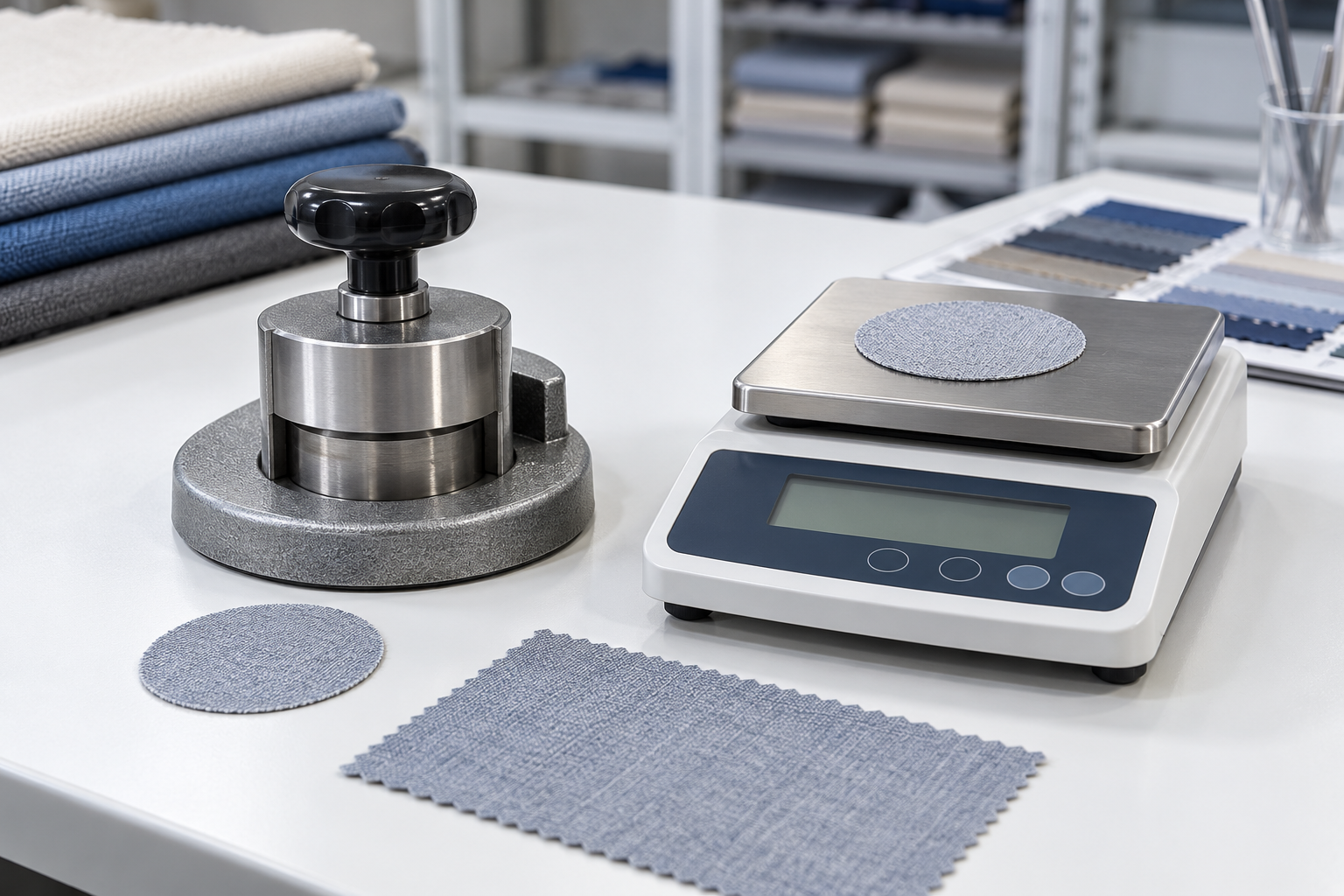
Fabric GSM, or grams per square metre, is the mass of a fabric in one square metre of area. It influences handfeel, durability, cost and specification matching. For mills, garment manufacturing units and textile exporters, a dependable GSM Machine in Tirupur or anywhere else in India only helps when it is paired with correct sampling, cutting, weighing and calculation.
What Is Fabric GSM and Why Does It Matter?
Fabric GSM means grams per square metre. It states how much a fabric weighs for each square metre of area, helping buyers and quality teams compare fabrics, confirm specifications and check consistency between lots. A higher GSM generally means a heavier fabric, although construction and fibre also decide how it performs.
GSM is not the same as thickness or density. Thickness is the distance through the fabric, usually in millimetres. Density in textile work usually refers to how closely yarns are packed, such as ends and picks in woven fabric or wales and courses in knits. Two fabrics can share the same GSM and still differ in thickness.
Why is GSM important in garment manufacturing? It ties the fabric to the garment specification. GSM affects handfeel, drape, warmth, durability and fabric cost, and measuring it helps teams catch lot-to-lot variation before cutting begins.
How to Measure Fabric GSM Accurately
Take a representative sample, condition it as the test method requires, and cut a specimen of known area. Weigh it on a calibrated balance, divide the weight in grams by the area in square metres, and compare the result with the specification. Repeat on several specimens and record the average.
- Select a representative sample. Avoid the outer layers of a roll, creases and selvedge edges.
- Condition the sample. Follow the applicable test method, because moisture changes weight.
- Use a GSM cutter or an accurately measured specimen. A round cutter gives a fixed area with clean edges.
- Confirm the specimen area. Do not assume it; check the cutter’s stated area.
- Weigh on a calibrated balance. Readability should suit the specimen’s weight.
- Calculate GSM using the formula below.
- Compare with the specification and any tolerance agreed with the buyer.
- Record the result with units, and repeat measurements where needed.
Each of these factors feeds directly into the final number. The exact procedure depends on the applicable test method and laboratory requirements.
How Does a GSM Machine in Tirupur Help Measure Fabric Weight?
Fabric GSM testing normally needs a GSM round cutter, a precision weighing balance and a way to calculate the result. Some products combine these steps, while others supply only one. Choose the configuration according to your fabric type, testing volume and workflow.
A typical setup includes a cutter and a balance, but “GSM testing machine” covers different configurations, and not every product sold under that name does both jobs.
- GSM cutters produce specimens of a defined area, commonly 100 cm².
- Precision balances record specimen weight; readability and calibration drive accuracy.
- GSM calculator machines or digital calculators speed up the arithmetic.
How can a GSM Machine in Tirupur support fabric quality control? A well-chosen GSM setup in a Tiruppur unit makes incoming fabric checks quick and repeatable. Consistent specimen areas and calibrated weighing let teams compare lots, spot deviations early and keep records for buyer discussions. Regular calibration and correct operation remain essential.
GSM Calculation Formula With a Practical Example
GSM = specimen weight in grams ÷ specimen area in square metres. If a 100 cm² specimen weighs 1.8 g, convert the area to 0.01 m² and divide: 1.8 ÷ 0.01 = 180 GSM.
| Item | Value |
| Specimen weight | 1.8 g |
| Specimen area | 100 cm² = 0.01 m² |
| Calculation | 1.8 g ÷ 0.01 m² |
| Final result | 180 GSM |
Since 1 m² equals 10,000 cm², 100 cm² is 0.01 m². For a 100 cm² specimen, you can multiply the weight in grams by 100 as a shortcut.
This result is only as good as the specimen area and the weighing. A GSM calculator machine or calculator automates the arithmetic, but it cannot fix inaccurate cutting, weighing or sampling.
Common Mistakes to Avoid When Measuring Fabric GSM
- Wrong specimen area: a worn or mismatched cutter shifts every result.
- Irregular or damaged specimens: frayed or distorted edges change weight and area.
- Uncalibrated balance: drift produces consistently wrong values.
- Ignoring conditioning: moisture can raise or lower weight.
- Testing one unrepresentative piece: a single cut rarely reflects a roll.
- Confusing thickness with GSM: a thick fabric is not necessarily a heavy one.
- Recording wrong units: mixing grams, milligrams, cm² and m² causes large errors.
- Using unsuitable equipment: a cutter or balance mismatched to the material limits repeatability.
These errors can cause wrongly accepted or rejected lots and buyer disputes.
GSM Testing Machine vs GSM Calculator Machine
A GSM testing machine or setup prepares and weighs the specimen, usually through a cutter and balance. A GSM calculator machine only performs the arithmetic once weight and area are known. It cannot cut, weigh or correct sampling errors, so the two are not interchangeable.
| Item | Main purpose | What it does not do |
| GSM testing machine / setup | Specimen preparation and weighing (configuration varies) | May not include calculation or calibration records |
| GSM cutter | Cuts a specimen of fixed area | Does not weigh |
| Weighing balance | Measures specimen weight | Does not cut or calculate GSM |
| GSM calculator machine / tool | Converts weight and area to GSM | Does not prepare or weigh specimens |
The right configuration depends on whether you need specimen preparation, weighing, calculation or a complete laboratory workflow.
Factors That Affect Fabric GSM Results
- Construction and yarn: yarn count, twist and structure change fabric mass.
- Knitted vs woven: knits stretch easily, so cutting without distortion needs extra care.
- Moisture and conditioning: absorbed moisture adds weight.
- Sample location: weight can vary across width and along length.
- Finishing treatments: softeners, coatings and compaction alter mass per area.
- Specimen size: small specimens magnify errors.
- Balance resolution and calibration: low resolution limits precision.
Genuine fabric variation shows up as differences between positions or rolls even when the method is controlled. Measurement error shows up as scatter between repeat tests on the same spot or as consistent bias across all results.
Which Standards Are Used for Fabric GSM Testing?
Laboratories should use a recognised method for mass per unit area. Two commonly referenced ones are ISO 3801, which covers mass per unit length and mass per unit area of woven fabrics, and ASTM D3776/D3776M, which covers mass per unit area (weight) of fabric.
The right choice depends on fabric construction, product requirements, customer specifications and laboratory procedures. For knitted fabrics, confirm which method the buyer specifies. Consult the latest official version of the standard, including its conditioning requirements, before formal compliance testing.
Industries That Use a GSM Machine in Tirupur and Across India
GSM measurement supports:
- Garment manufacturing and knitted and woven fabric production, for matching fabric to specifications.
- Textile exporters and buying houses, for checking lots against buyer requirements.
- Fabric testing laboratories, for routine and comparative testing.
- Home textile production, where fabric weight affects product feel and performance.
Across India’s textile industry, hubs such as Tiruppur and Bangalore combine manufacturing, sourcing and quality assurance activity.
How to Choose the Right GSM Machine in Tirupur
When evaluating a GSM Machine in Tirupur or any GSM testing equipment, consider:
- Fabric type and specimen requirements
- Measurement range and required accuracy
- Cutter size and specimen area
- Balance capacity and readability
- Ease of use and maintenance
- Calibration and documentation needs
- Availability of accessories
- Technical support and written product specifications
- Compatibility with your test procedures
Ask for written specifications and match the equipment to your fabrics and testing volume.
Why Consider Amith Garment Services for Textile Testing Equipment?
Amith Garment Services is a Bangalore-based supplier of textile testing and quality control instruments. Its website states that it was established in 1999 and lists categories including fabric testing equipment, swatch and GSM cutting machines, fabric inspection machines, calibration and repair services, and consultation on choosing instruments.
Suitable equipment supports fabric inspection and garment quality control. Review product specifications and select equipment for your fabric type and testing requirements.
Conclusion
Accurate fabric GSM depends on representative sampling, a correct specimen area, reliable weighing, the right calculation and consistent testing conditions. If you are comparing a GSM Machine in Tirupur setup for your laboratory or production unit, review the GSM testing equipment from Amith Garment Services and match its specifications to your fabrics.
Frequently Asked Questions
1. How do you measure fabric GSM accurately?
Start with a representative fabric sample, free from creases, selvedge damage and distortion. Condition it as required by the applicable test method, then cut a specimen of known area, such as 100 cm² with a GSM round cutter. Weigh it on a calibrated balance, divide the weight in grams by the area in square metres, and compare the result with the specification. Repeat on several specimens from different positions and record the average, since one cut rarely represents a whole roll.
2. Which machine is used for fabric GSM testing?
Most laboratories use a GSM testing setup made of a GSM round cutter and a precision weighing balance. The cutter produces a specimen of fixed area, commonly 100 cm², and the balance records its weight. Some products sold as GSM testing machines bundle cutting and weighing, and others calculate GSM on a display. Because the term covers different configurations, check specimen area, balance readability and your fabric types before choosing. Amith Garment Services lists swatch and GSM cutting equipment on its website for review.
3. What is the difference between a GSM testing machine and a GSM calculator machine?
A GSM testing machine, or testing setup, prepares and weighs the specimen, usually through a cutter and a balance. A GSM calculator machine, or digital calculator, only performs the arithmetic once weight and area are known. It cannot cut a specimen or weigh it, so it cannot correct poor sampling or an uncalibrated balance. Laboratories needing specimen preparation, weighing and calculation in one workflow should confirm that the chosen product covers every step.
4. Where can I find a GSM Machine in Tirupur?
Textile testing equipment is usually sourced from specialist suppliers, so ask for specifications, calibration documents and support terms before ordering. Amith Garment Services is headquartered in Bangalore, and its website states that it supplies testing instruments across India, including Tirupur. This article does not confirm stock, pricing or a local branch, so contact the company directly through its website to check availability for your location.
5. What is a GSM machine used for?
A GSM machine helps determine fabric weight in grams per square metre. In practice, a cutter prepares a specimen of known area and a balance weighs it. Mills, garment exporters and testing labs use the result to check fabric against specifications.
6. How do I calculate the GSM of fabric at home or in a laboratory?
Cut a specimen of known area, weigh it in grams, and divide by the area in square metres. For a 100 cm² piece, multiply the weight in grams by 100. At home, results are only indicative without a calibrated balance.
7. Do I need a GSM cutter to measure fabric GSM?
Not strictly, but it helps. Any accurately measured specimen works, yet a GSM cutter gives a consistent area and clean edges, which improves repeatability. Hand-cut pieces can introduce area errors, especially on stretchy knits.
8. What should I check before buying a GSM testing machine?
Check specimen area, balance capacity and readability, calibration certificate, maintenance needs, available accessories, technical support and compatibility with your standard or buyer method. Ask for written specifications instead of relying on general descriptions.