
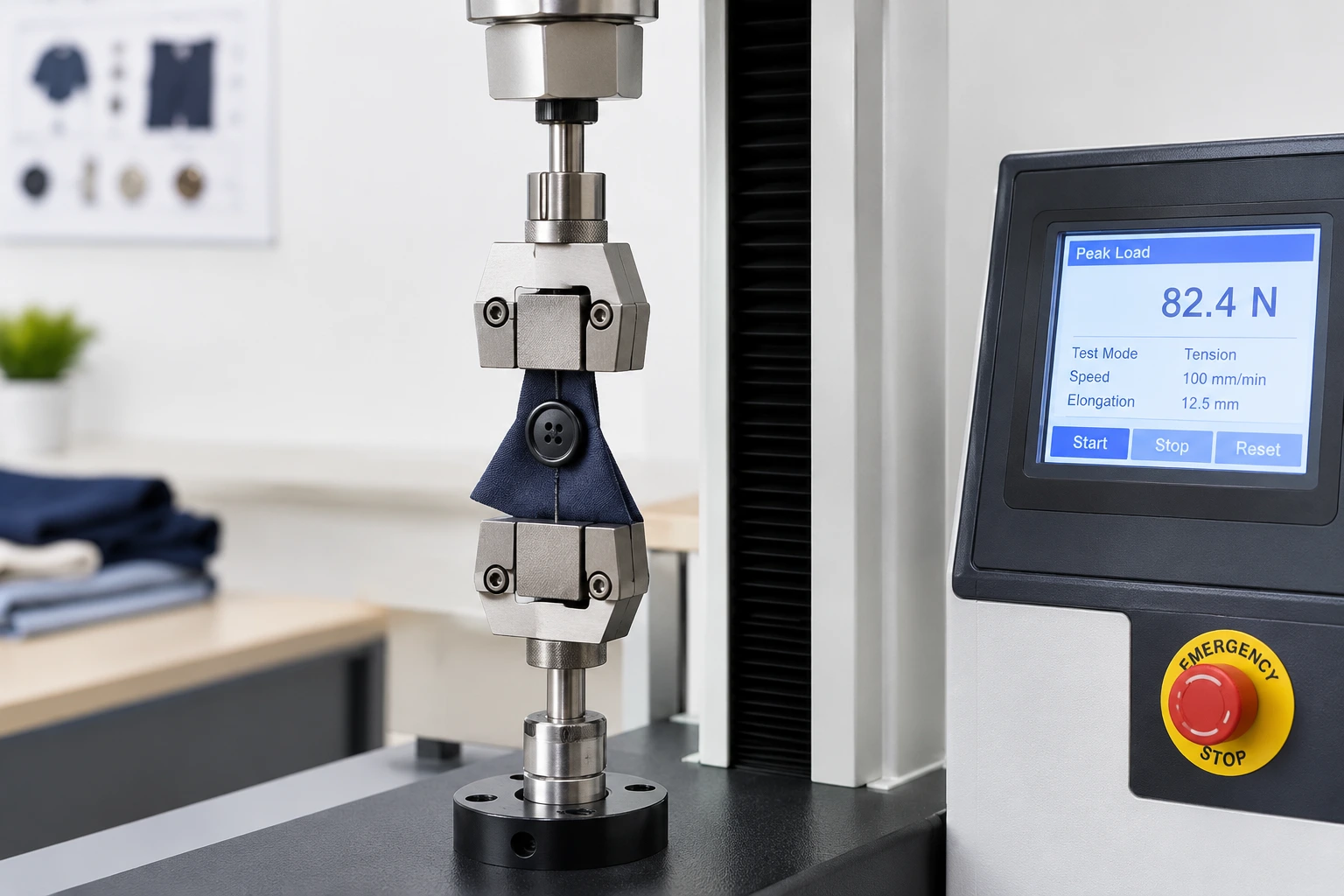
A button that comes off in a customer’s hands looks like a small defect, but it can lead to returns, buyer complaints and, in children’s wear, a safety concern. The practical question for any garment factory is simple: is this accessory attached securely enough? A Pull Test Machine answers it with a measured force instead of a quick tug by hand. It applies a controlled pull to a button, snap fastener, rivet or similar component and records the force at which it detaches or fails. For garment manufacturers, exporters and testing laboratories across India, this makes attachment strength testing a dependable part of daily quality control.
What Is a Pull Test Machine for Garments?
What is a Pull Test Machine?
A Pull Test Machine for garments is a force-measuring instrument that pulls on an attached accessory, such as a button, snap fastener or rivet, until it detaches or fails. It records the force involved, helping quality teams judge whether the attachment is strong enough for the garment and the applicable buyer or standard requirement.
Pull force is the pulling load, usually read in newtons or kilograms-force, needed to separate an accessory from the garment. A low reading can point to weak stitching, a poorly set fastener or fabric that cannot hold the attachment. Because every result is a number, trends are easy to track from lot to lot.
This is different from fabric tensile testing. A tensile test pulls a fabric strip until it breaks, to measure the material itself. A pull test focuses on one attached component and the way it is anchored to the cloth.
Why Is a Pull Test Machine Important in Garment Quality Testing?
Attachment failures are rarely random. They usually trace back to a process that can be measured and corrected. A Pull Test Machine helps in five ways:
- Prevents detachment: confirms that buttons, snaps and rivets can stay on through normal wear.
- Finds weak attachment points: exposes problem machines, operators or batches early.
- Supports production QA: gives floor teams a quick, objective check during stitching and finishing.
- Reduces avoidable cost: fewer reworked garments, rejects and customer complaints.
- Creates records: results can be written into test reports for buyers and audits.
Why is a Pull Test Machine used for garment accessories?
A Pull Test Machine is used to confirm that buttons, snaps, rivets and other accessories are attached firmly enough to stay on during normal use. It gives measurable, repeatable results that help identify weak attachments early and support quality records, buyer requirements and product safety checks.
The right test method depends on the accessory, the garment type, the buyer specification and any safety rules that apply.
How Does a Pull Test Machine Work?
The exact set-up varies, but the typical sequence is:
- Identify the accessory and the applicable test method.
- Prepare the garment or test specimen.
- Secure the accessory and specimen in suitable fixtures.
- Apply the specified pulling force using the machine.
- Record the force and observe the failure mode.
- Compare the result with the applicable acceptance criteria.
- Document everything in a test report.
Pulling direction, loading rate, test duration and acceptance limits must come from the selected standard or buyer specification. This guide deliberately does not quote universal loads or pass/fail values, because none exist across all products.
How do you perform a button pull test?
Select the applicable method, mount the garment or specimen so the button sits correctly in the fixture, and apply a controlled pull in the specified direction. Record the force at detachment, note how the attachment failed, and compare the result with the buyer or standard requirement.
Which Garment Accessories Can Be Tested Using a Pull Test Machine?
Depending on the machine and its fixtures, typical candidates include:
- Sewn buttons, including jeans buttons
- Snap buttons and snap fasteners
- Rivets and studs
- Hooks and other garment fasteners
- Attached decorative components
- Other sewn or mechanically attached accessories
Which garment accessories can be pull tested?
Buttons, snap fasteners, rivets, studs, jeans buttons, hooks and some attached decorative components can be pull tested, depending on the machine and fixtures. Each accessory type may need a different fixture, pulling direction and test method, so confirm these before testing.
Pull Test Procedure for Buttons and Garment Accessories
Start with specimen preparation. Note where the accessory sits on the garment, how many fabric layers and any interlining lie beneath it, and whether the sample is a finished garment or a prepared test piece, as your method requires. Choose jaws or fixtures that hold the accessory without crushing or slipping, then align the specimen so the pull follows the specified direction. Apply the force steadily, not with a jerk, and record the value together with what actually happened.
That last part matters. Five outcomes are commonly distinguished:
- Accessory detachment: the button or snap separates cleanly from its attachment.
- Thread breakage: the sewing thread snaps while the button stays intact.
- Fabric tearing: the cloth gives way around the attachment.
- Fastener deformation: a snap, rivet or prong bends or opens.
- Fixture slippage: the specimen or accessory slides in the jaws, so the reading is unreliable and the test should be repeated.
Recording the failure mode tells you where to look. Thread breakage suggests a stitching or thread-choice issue, deformation points to the accessory or how it was set, and fabric tearing may mean the base material needs reinforcement. A magnifier such as the Magnascope, which Amith lists for inspecting buttons and stitching, helps examine the failed area.
Garment Accessory Pull Testing Standards and Safety Requirements
Published standards and buyer protocols define how to test and what counts as acceptable. Not every standard applies to every button, fastener or garment, so check scope before you rely on one. Examples worth reviewing:
- ASTM D4846: a test method for resistance to unsnapping of snap fasteners, covering the force to disengage a snap by a pull perpendicular to, and parallel with, its plane. It is about snaps, not sewn buttons.
- ASTM D7142: a method for the holding strength of prong-ring attached snap fasteners, using either a tensile testing machine or a manual test stand with a force gauge.
- EN 17394 series: a European set of documents on security of attachment in children’s clothing. Part 2 covers buttons, Part 3 metal mechanically applied press fasteners and Part 4 other components, while Part 1 sets requirements for infants’ clothing.
- Buyer-specific protocols: many brands publish their own accessory pull requirements, which can differ from public standards.
Children’s garments need extra attention because a detached small part can be a choking hazard. Which rules apply depends on the destination market and product, so confirm requirements with the buyer or a qualified compliance adviser. Owning a machine that can apply force does not, by itself, mean a product complies with any standard.
Factors That Affect Garment Accessory Pull Test Results
Two identical-looking garments can give different readings. The usual influences are:
- Accessory design and material
- Attachment method
- Stitching quality and thread
- Fabric construction and thickness
- Specimen preparation
- Clamp selection and alignment
- Pulling direction and loading rate
- Equipment calibration and condition
- Operator technique
- Test method and acceptance criteria
What affects garment accessory pull test results?
Results are affected by accessory design and material, attachment method, stitching quality, fabric and interlining, specimen preparation, clamp alignment, pulling direction and rate, machine calibration, operator technique and the test method used. Controlling these keeps results repeatable and comparable.
Repeatability is the point of testing. If two operators cannot reproduce each other’s results, the numbers cannot support a decision, so write down the method, fixtures and conditions every time.
Pull Test Machine vs Fabric Tensile Testing Machine
Both instruments measure force, but they answer different questions.
| Aspect | Pull Test Machine | Fabric Tensile Testing Machine |
| Main purpose | Check how securely an accessory is attached | Measure the strength and stretch of the fabric |
| Specimen type | Garment or prepared piece with an attached accessory | Fabric strip, grab sample or seam specimen |
| What is measured | Force to detach or fail the attachment | Force at break and elongation |
| Typical applications | Buttons, snaps, rivets, studs, hooks | Fabric strength, seam slippage, yarn strength |
| Fixture requirements | Accessory-specific jaws and holders | Flat grips suited to fabric strips |
| How results are read | Force plus failure mode against method or buyer limit | Breaking force and elongation against a specification |
Some laboratories use a computerised tensile tester with an additional gripper for button pull strength; Amith’s computerised tensile strength tester listing mentions this as an extra-cost option. Confirm suitability for your method first.
How to Choose the Right Pull Test Machine
Before you buy, work through these points:
- Accessory types: buttons only, or also snaps, rivets and zippers?
- Force range: enough headroom for your highest expected value, with usable resolution at the low end.
- Accuracy and resolution: how precisely the force gauge reads.
- Clamps and fixtures: which jaws are included and whether custom ones can be made.
- Operation: manual or motorised.
- Display and data: analogue or digital readout, peak hold, data recording.
- Calibration and maintenance: certificates, recalibration routes and service access, such as calibration and repair of testing instruments.
- Method compatibility: the standards and buyer protocols you actually follow.
- Space and workload: bench area and how often you test.
- Support: manuals, training and technical help.
How do you choose a Pull Test Machine?
Choose by the accessories and standards you must test, the force range and accuracy needed, available jaws and fixtures, display and data recording, and calibration and service support. Confirm the specifications in writing with the supplier to ensure the machine suits your method before buying.
Industries That Use Pull Test Machines
In India, pull testing matters wherever garments are made or checked. Garment manufacturing units in Bangalore, Tiruppur and other production centres use it to verify buttons, snaps and rivets before shipment. Children’s clothing producers rely on it for small-part attachment checks, while denim and casualwear makers use it for jeans buttons, rivets and studs. Apparel export houses, buying houses and inspection agencies use the results to confirm buyer requirements, and textile testing laboratories run the tests as a service. Accessory manufacturers also test their products on sample fabrics to show how they perform once attached. Textile exporters and the wider textile industry benefit from the same discipline: measured results, kept on record.
Why Choose Amith Garment Services for Textile Testing Equipment?
Amith Garment Services is a Bangalore-based supplier of textile and garment testing instruments. According to its website, the company was established in 1999 and supplies garment and fabric testing equipment, textile lab consumables, and calibration and repair services, along with installation, demonstration and operator training.
The website lists a Button Snap Pull Tester, described as a way to determine the pulling strength needed to remove buttons or snaps once attached to garments. Listed features include a 30 kg IMADA push-pull scale with 250 g sensitivity, a 5 kg calibrated dead weight for internal calibration, three stainless steel jaws for buttons, eyelets, rivets and snaps, and special attachments for tests such as the bow test, wash care labels and zippers. The page also mentions custom jaws, a digital display model, availability as per specific buyer standards, and ASTM D 4846 as a related standard.
Specifications and availability can change, so review the Button Snap Pull Tester details or contact Amith Garment Services to confirm availability, specifications, accessories and suitability for your testing requirements.
Conclusion
A Pull Test Machine turns attachment security from a guess into a measurement. It shows how much force a button, snap or rivet can take, reveals whether the weak link is the accessory, the stitching or the fabric, and leaves a record that buyers and auditors can trust. Match the method to the product, calibrate regularly, and record failure modes along with the numbers. Used that way, a Pull Test Machine becomes a practical everyday tool for garment quality control.
Frequently Asked Questions:
A Pull Test Machine is a force-measuring instrument used to check how securely an accessory is attached to a garment. The accessory and specimen are held in suitable fixtures, a controlled pulling force is applied in the direction specified by the test method, and the force at detachment or failure is recorded. The operator also notes whether the button detached, the thread broke or the fabric tore. Results are then compared with the applicable standard or buyer requirement.
Depending on the machine and fixtures, a Pull Test Machine can evaluate sewn buttons, snap fasteners, rivets, studs, jeans buttons, hooks and some decorative attachments. Not every accessory uses the same fixture, pulling direction or method, so the choice of jaws and the test procedure matter. For example, snap fasteners and children's clothing components are covered by different published test methods. Always confirm the fixture and method with your supplier and buyer specification before testing.
Garment accessory pull testing checks how well a small component, such as a button or snap, stays attached to a finished garment or specimen. Fabric tensile testing pulls a strip or grab sample of fabric until it breaks to measure the fabric's own strength and elongation. One answers whether an attachment is secure; the other answers whether the material can withstand load. Both involve force measurement, but their specimens, fixtures and acceptance criteria are different.
Start with the accessories you test and the standards or buyer protocols you must follow. Then check the force range, measurement resolution, available jaws and fixtures, display and data-recording options, and how the instrument is calibrated and serviced. Also consider how often you test and how much bench space you have. Ask the supplier for written specifications, calibration documentation and operator training details before you buy a Pull Test Machine.
A Pull Test Machine is used to measure how much force it takes to pull a button, snap, rivet or similar accessory off a garment. It helps quality teams find weak attachments before the garment reaches the buyer.
Secure the garment so the button sits in the correct fixture, then apply a steady pulling force in the direction your test method specifies. Record the force at detachment and note how it failed. Compare the result with your buyer's or standard's requirement.
They test button strength to prevent buttons coming off during wear, avoid rejections and customer complaints, and meet buyer and safety requirements. It matters most for children's clothing, where detached small parts can be a choking hazard.
Check which accessories and standards you need to test, the force range and accuracy, the jaws and fixtures supplied, calibration and service support, and written specifications from the supplier. Confirm everything in writing before you order.