
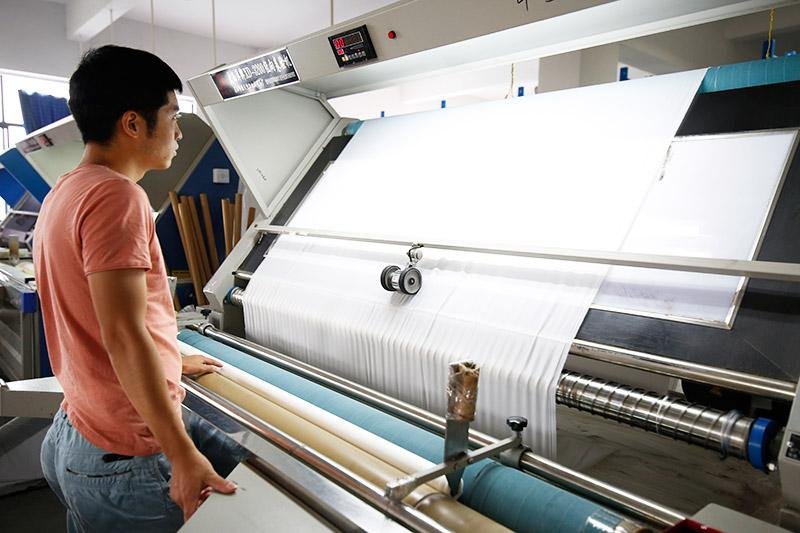
Fabric rolling looks like a simple, final step in textile production, but it has a bigger effect on downstream work than most people expect. A roll that comes off the winding line loose, wrinkled, or misaligned can create problems much later — during inspection, storage, spreading, or cutting — long after anyone remembers what happened on the winding floor. A well-maintained fabric rolling machine is meant to prevent exactly this, yet fabric rolling problems still show up regularly on production floors, from uneven fabric rolls to tension inconsistencies and edge misalignment.
This article looks at why these issues occur, how to trace them back to a root cause, and what operators and quality teams can do to keep roll formation consistent. The goal is practical troubleshooting, not a sales pitch — because a roll that isn’t formed correctly can quietly affect fabric inspection accuracy, transportation, spreading, and eventually garment production.
What Are the Most Common Fabric Rolling Problems?
Most fabric rolling problems fall into a handful of recurring categories. Some are visible immediately after winding; others only become obvious once the roll has been stored for a while or unrolled for cutting.
| Fabric Rolling Problem | Typical Symptom | Possible Cause |
| Uneven fabric rolls | Irregular roll shape | Uneven tension or alignment |
| Fabric roll wrinkles | Creases during winding | Poor fabric guidance or tension |
| Loose fabric rolls | Soft or unstable roll | Insufficient winding tension |
| Excessively tight rolls | Hard or compressed roll | Excessive tension |
| Edge misalignment | Fabric edges do not line up | Incorrect fabric roll alignment |
| Telescoping | Layers shift sideways | Poor edge control or tension |
| Uneven roll hardness | Different firmness across roll | Variable tension or winding conditions |
This table is a starting point, not a diagnostic checklist. The actual cause behind any of these symptoms depends on the specific machine, the fabric being processed, and the conditions on the shop floor at the time. Two mills running the same fabric on different machines can see different results, which is why troubleshooting has to be specific to the situation rather than applied generically.
How Does a Fabric Rolling Machine Work?
At a basic level, a fabric rolling machine takes fabric from a feeding point, guides it through an alignment mechanism, applies controlled tension, and winds it into a roll. Each stage plays a role in the finished result:
- Fabric feeding — the fabric is drawn into the machine at a controlled rate.
- Fabric guidance — guide rollers or edge sensors keep the fabric tracking straight.
- Tension control — a tensioning system determines how tightly the fabric is wound.
- Edge alignment — the machine keeps the fabric edges consistent as layers build up.
- Winding and roll formation — the fabric is wrapped around a core or mandrel, building up the roll.
- Roll completion — the finished roll is released, often with a wrapper or tape to hold its shape.
The relationship between fabric tension, winding speed, fabric width, alignment, and roll formation is what ultimately determines roll quality. If any one of these variables drifts out of range, the effect usually shows up somewhere in the finished roll. It’s also worth noting that machine design and operating procedures vary between manufacturers and models, so settings that work well on one machine may need adjustment on another.
Fabric Rolling Problems Caused by Incorrect Tension
Tension is one of the most common sources of fabric rolling tension problems, and it works in both directions — too little and too much cause different but equally frustrating issues.
Low tension during winding can lead to:
- Loose rolls that lose shape during handling
- Poor roll stability during transport
- Wrinkles forming as layers shift
- Layer shifting or telescoping
- Uneven roll formation overall
Excessive tension, on the other hand, can result in:
- Overly compact, hard rolls
- Fabric distortion or stretching
- Edge damage or curling
- Potential harm to delicate or stretch fabrics
Because different fabrics respond differently to tension, operators should set tension according to the specific material being processed rather than applying one standard setting across every fabric type. A setting that works well for a heavy woven fabric may be too aggressive for a lightweight knit.
Uneven Fabric Rolls and Fabric Roll Alignment Problems
Uneven fabric rolls are one of the most frequently reported fabric rolling machine problems, and they rarely have a single cause. Common contributors include:
- Incorrect fabric roll alignment at the start of winding
- Uneven fabric feeding into the machine
- Edge guide sensors that are misaligned or poorly calibrated
- Inconsistent fabric width along the length of the piece
- Operator handling during loading
- Improper machine setup for the fabric being run
- Unequal tension across the width of the fabric
Fabric roll alignment refers to how consistently the fabric edges line up as the roll builds. Even a small alignment error at the beginning of a roll tends to compound as more layers are added, so accurate edge positioning matters from the very first wrap. Because of this, alignment should be checked periodically throughout a production run, not just when the machine is first set up.
Fabric Roll Wrinkles and Surface Defects
Fabric roll wrinkles are often the easiest defect to spot but not always the easiest to trace. Typical causes include:
- Incorrect tension settings
- Poor fabric guiding through the winding zone
- Fabric entering the winding area at a slight angle
- Uneven feeding speed
- Improper machine settings for the fabric type
- Fabric-specific characteristics, such as a tendency to curl or shift
A practical way to narrow down the cause is to watch the fabric at each stage — feeding, guiding, and winding — rather than only inspecting the finished roll. If a wrinkle appears consistently at the same point in the fabric path, that stage is usually where the correction needs to happen.
Fabric Winding Problems and Roll Defects
Beyond tension and alignment, several other fabric winding problems can affect the finished roll, including loose winding, overly tight winding, telescoping, uneven edges, soft spots, hard spots, layer displacement, and irregular roll shape. These fabric roll defects don’t just affect appearance — they can make later handling more difficult, from how easily a roll can be lifted and stored to how accurately it can be spread and cut.
Fabric Rolling Machine Troubleshooting: A Practical Approach
When a problem shows up, it helps to start with the simplest checks before assuming a major mechanical issue is involved.
| Problem | Possible Cause | Recommended Check |
| Loose roll | Low tension | Check tension setting and fabric feed |
| Tight roll | Excessive tension | Review tension and winding pressure |
| Wrinkles | Poor guiding | Inspect fabric path and alignment |
| Uneven edges | Misalignment | Check edge guide and fabric positioning |
| Telescoping | Side movement | Inspect alignment and tension consistency |
| Uneven roll hardness | Variable tension | Check tension across the winding process |
| Irregular roll shape | Feeding or alignment issue | Inspect machine setup and fabric entry |
Working through simple checks first — tension setting, fabric path, edge guides — usually resolves the issue without needing to adjust deeper machine settings. Jumping straight to major adjustments can sometimes introduce a new problem while trying to fix the original one.
How to Prevent Textile Fabric Rolling Problems
Most textile fabric rolling problems are easier to prevent than to fix after the fact. Useful preventive habits include:
- Setting up the machine correctly for each fabric type
- Applying appropriate, fabric-specific tension
- Cleaning rollers and guides regularly
- Verifying fabric alignment before and during runs
- Carrying out routine inspection of rolls during production
- Training operators on machine settings and fabric handling
- Following a preventive maintenance schedule
- Checking fabric width consistency
- Monitoring roll formation as the roll builds
- Following manufacturer instructions for the specific machine
Preventive maintenance matters because small mechanical issues — a slightly worn roller, a drifting sensor — tend to produce inconsistent results long before they cause a visible breakdown.
How Fabric Type Affects Rolling Performance
Not all fabrics behave the same way on a rolling machine. Factors that influence performance include fabric weight, stretch, surface structure, thickness, slipperiness, width variation, fabric construction, and finishing treatment. A slippery synthetic fabric, for example, may need different edge control than a heavier cotton woven. Rolling conditions should be adjusted to the material being processed rather than assuming a single machine setting works for every fabric that comes through.
Choosing the Right Fabric Rolling Machine
For manufacturers evaluating equipment, useful considerations include fabric width range, compatibility with different fabric types, roll diameter requirements, tension control options, edge alignment features, speed control, ease of operation, maintenance requirements, expected production volume, availability of technical support, and overall machine construction and reliability. These factors matter more than any single specification, since the right machine depends on the fabrics and production volumes a facility actually handles.
Why Proper Fabric Rolling Matters in Textile Quality Control
Fabric rolling connects directly to textile quality control, even though it’s often treated as a packaging step. A properly formed roll supports accurate fabric inspection, consistent material handling, smoother cutting preparation, safer storage, easier transportation, and better production planning. When rolls are uneven, wrinkled, or misaligned, the effects tend to ripple forward — inspection takes longer, spreading becomes less accurate, and cutting teams may need to account for defects that could have been avoided earlier in the process.
Why Choose Amith Garment Services
Amith Garment Services supplies textile and garment testing equipment and related machinery to manufacturers, exporters, and quality-control teams. The company’s product range spans fabric testing and inspection equipment that supports the kind of quality-control workflow described above — from evaluating fabric properties before processing to verifying finished fabric quality before it moves into garment production. For manufacturers looking to address fabric rolling problems as part of a broader quality-control approach, understanding how rolling connects to inspection, testing, and handling is a useful starting point.
If your production process regularly deals with uneven fabric rolls, tension inconsistencies, or other fabric rolling machine problems, working through the fabric path systematically — feeding, guiding, tensioning, and winding — is usually more effective than replacing equipment outright. A well-maintained fabric rolling machine, paired with consistent operator practices, remains one of the most reliable ways to keep roll quality consistent across a production run.
Frequently Asked Questions:
A Fabric Rolling Machine is used to wind finished fabric into neat, stable rolls after processing, inspection, or finishing. It controls fabric tension and alignment to create uniform rolls suitable for storage, transportation, spreading, and cutting.
Uneven fabric rolls are usually caused by inconsistent tension, misaligned fabric edges, or uneven feeding during winding. Variations in fabric width and incorrect machine setup can also contribute to uneven roll formation.
To prevent wrinkles, ensure the fabric enters the winding zone straight, keep guiding rollers properly aligned, and set the correct tension for the fabric type. Regular inspection during production can also help identify wrinkling at an early stage.
Start by checking fabric tension, feeding consistency, and edge alignment. A loose roll may indicate insufficient tension, while telescoping can be related to alignment problems. Checking these basic factors before changing advanced machine settings can help identify the problem efficiently.
An uneven fabric roll is commonly caused by inconsistent tension or misaligned edges during winding. Uneven feeding speed and changes in fabric width can also cause the roll to build unevenly.
Make sure the fabric feeds straight into the winding zone, the guiding rollers are correctly aligned, and the tension is suitable for the fabric. Inspecting the roll during production can help detect wrinkles before they affect the entire roll.
Begin with the three main checks: tension, fabric feeding, and alignment. Identify the type of roll defect and match it to the most likely cause before making major machine adjustments.