
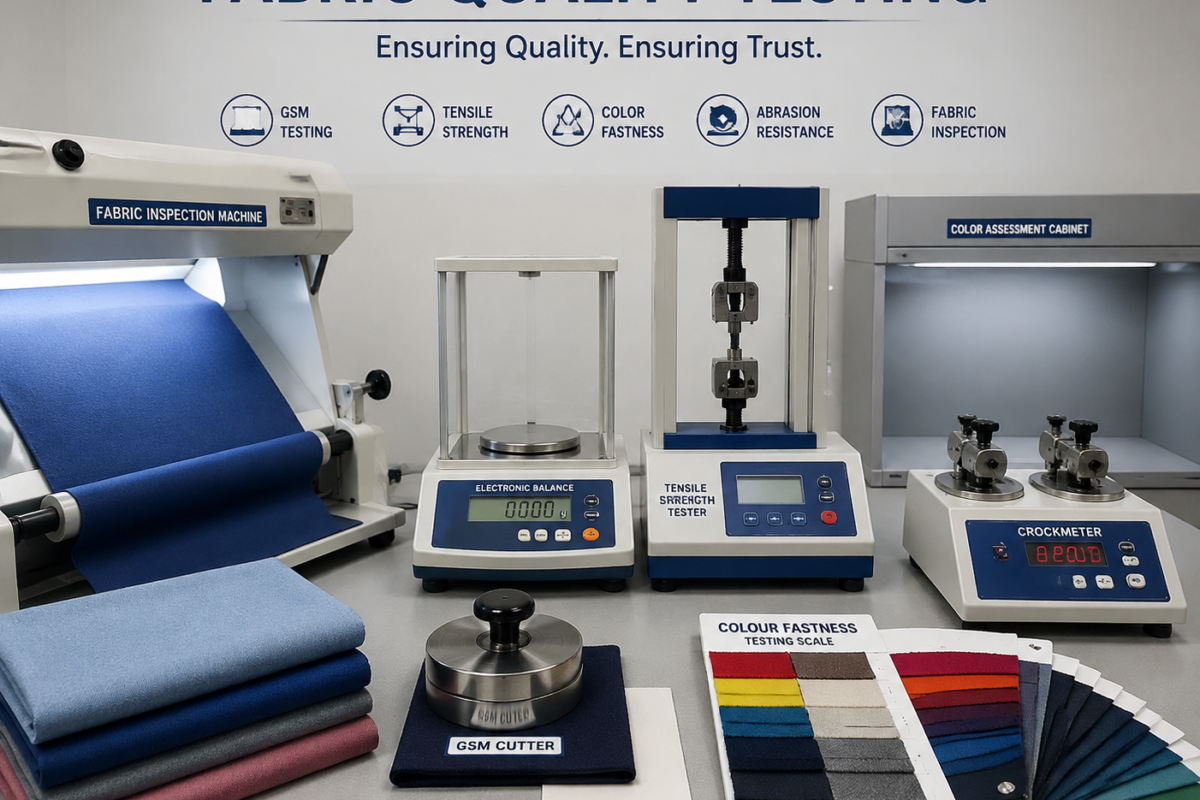
Introduction
The quality of a textile product is determined long before the finished garment reaches the customer. Every stage of textile production, from fibre selection and yarn manufacturing to fabric processing and garment production, can influence the final quality and performance of the material. This is why textile testing methods play an important role in the modern textile and apparel industry.
Textile testing helps manufacturers measure important fabric properties such as weight, strength, colour fastness, shrinkage, abrasion resistance, moisture, dimensional stability and overall appearance. By testing these properties before and during production, manufacturers can identify quality issues early and reduce the risk of product rejection, customer complaints and unnecessary production losses.
For garment manufacturers, textile exporters, buying houses and quality-control laboratories, fabric quality testing is also important for meeting buyer specifications and applicable testing standards.
This complete guide explains the major textile testing methods, the importance of fabric testing and the equipment commonly used in textile quality-control laboratories.
What Is Textile Testing?
Textile testing is the process of evaluating the physical, mechanical and performance characteristics of fibres, yarns, fabrics and finished garments.
The purpose of testing is to determine whether a textile material meets the required quality specifications for its intended application.
For example, a fabric used for sportswear may need to be tested for moisture-related performance and durability, while upholstery fabric may require abrasion and strength testing. Similarly, export garments may need to meet specific buyer requirements related to colour fastness, shrinkage and dimensional stability.
Common textile properties evaluated during testing include:
- Fabric weight
- Tensile strength
- Tear strength
- Bursting strength
- Colour fastness
- Abrasion resistance
- Pilling resistance
- Shrinkage
- Fabric appearance
- Dimensional stability
- Moisture content
- Fibre properties
A systematic testing process helps manufacturers make quality decisions based on measurable results rather than visual judgement alone.
Why Is Fabric Quality Testing Important?
Fabric quality directly affects the performance, appearance and durability of finished garments and textile products.
Without proper testing, defects may remain undetected until after garments have been produced or delivered. At that stage, correcting the problem can become expensive.
The major benefits of textile testing include:
1. Maintaining Consistent Product Quality
Testing helps manufacturers monitor whether fabrics from different production batches meet the same required specifications.
Even small variations in fabric weight, strength or colour can affect the consistency of the final product.
2. Detecting Defects Early
Testing can identify potential problems before bulk production or shipment.
Early defect detection can reduce:
- Material wastage
- Rework
- Production delays
- Customer complaints
- Product returns
3. Meeting Buyer Requirements
Many textile manufacturers and exporters work according to specific buyer specifications. Textile testing provides measurable information that can help verify whether the product meets those requirements.
4. Improving Product Durability
Strength, abrasion and other performance tests help manufacturers understand how a material may perform during use.
5. Supporting Quality-Control Systems
Regular testing creates a more structured quality-control process and helps manufacturers monitor production consistency.
Major Textile Testing Methods
1. Fabric GSM Testing
One of the most common textile testing methods is GSM testing.
GSM stands for Grams per Square Metre. It indicates the weight of a fabric over a defined area.
For example, a fabric with a GSM of 200 weighs approximately 200 grams per square metre.
Fabric GSM can influence several characteristics, including:
- Fabric thickness
- Fabric feel
- Material cost
- Durability
- Suitability for specific applications
A typical GSM testing process involves cutting a fabric sample with a known area and measuring its weight using a precision balance.
Common equipment used includes:
- GSM Cutter
- GSM Testing Machine
- Precision Weighing Balance
Accurate sample preparation is important because an incorrectly sized sample can affect the final calculation.
GSM testing is widely used by textile mills, garment manufacturers, fabric suppliers and quality-control laboratories. Amith Garment Services supplies GSM testing equipment designed for fabric quality-control applications.
2. Tensile Strength Testing
Tensile strength refers to the ability of a textile material to withstand pulling forces before breaking.
A Tensile Strength Tester applies controlled force to a fabric sample and measures how the material responds to the load.
This test can help evaluate:
- Fabric strength
- Breaking force
- Material durability
- Performance under mechanical stress
Tensile testing is particularly important for fabrics used in garments, industrial textiles and applications where mechanical strength is required.
Both woven and knitted fabrics may be tested using appropriate procedures and sample preparation methods.
A Universal Testing Machine or specialised tensile testing equipment may be used for evaluating mechanical properties.
3. Bursting Strength Testing
Bursting strength testing is used to determine how much pressure a fabric can withstand before rupture.
This method is particularly useful for fabrics where strength is applied in multiple directions rather than only in one direction.
Bursting strength testing is commonly used for:
- Knitted fabrics
- Stretch fabrics
- Non-woven textiles
- Technical textiles
During testing, pressure is gradually applied to the fabric sample until the material bursts. The force or pressure required to cause rupture is recorded.
The results can help manufacturers compare fabric performance and identify variations between production batches.
4. Tear Strength Testing
Tear strength testing measures the resistance of a fabric to the propagation of a tear.
A fabric may initially have good tensile strength but still perform poorly if a small cut or tear spreads easily.
Tear strength testing can be useful for evaluating:
- Workwear
- Denim
- Outdoor fabrics
- Industrial textiles
- Upholstery materials
The test helps manufacturers understand how well a fabric may resist damage during handling and use.
5. Colour Fastness Testing
Colour fastness testing evaluates how well a textile retains its colour when exposed to different conditions.
Colour changes or colour transfer can affect the appearance and quality of garments.
Common colour fastness tests include:
- Wash fastness
- Rubbing fastness
- Perspiration fastness
- Light fastness
Why Is Colour Fastness Important?
Poor colour fastness can result in:
- Fading
- Colour bleeding
- Staining of other garments
- Customer complaints
Colour fastness testing helps manufacturers evaluate the performance of dyes and finishing processes.
Testing equipment may include washing fastness testers, crock meters and controlled lighting systems depending on the type of evaluation required.
6. Crocking or Rubbing Fastness Testing
Crocking is the transfer of colour from one textile surface to another due to rubbing.
A Crock Meter is commonly used to evaluate rubbing fastness under controlled conditions.
The test may be performed under:
- Dry rubbing conditions
- Wet rubbing conditions
During testing, a standard rubbing material is brought into contact with the textile sample using controlled pressure and movement.
The amount of colour transferred can then be evaluated according to the applicable testing procedure.
Rubbing fastness testing is particularly important for dyed and printed fabrics.
7. Abrasion Resistance Testing
Textiles are frequently exposed to friction during normal use.
Abrasion resistance testing evaluates how well a fabric withstands repeated rubbing and wear.
A Martindale Abrasion Tester is one commonly used instrument for evaluating fabric resistance to abrasion.
The test can help assess:
- Surface wear
- Fabric durability
- Material suitability
- Resistance to repeated use
Abrasion testing is commonly relevant for upholstery fabrics, workwear, uniforms and frequently used garments.
Repeated rubbing cycles can simulate wear conditions and help compare the durability of different textile materials.
8. Pilling Resistance Testing
Pilling occurs when small balls of tangled fibres develop on the surface of a fabric.
This can negatively affect the appearance of garments, especially after repeated wear and washing.
Pilling resistance testing helps manufacturers evaluate how likely a fabric is to develop pills under controlled conditions.
The results can be useful during:
- Fabric development
- Quality control
- Material comparison
- Supplier evaluation
Testing can help manufacturers select suitable fibres, yarn constructions and finishing processes.
9. Shrinkage and Dimensional Stability Testing
Many fabrics change dimensions after washing or drying.
Shrinkage testing evaluates changes in the length or width of a textile material after exposure to specified conditions.
Dimensional stability is particularly important because excessive shrinkage can affect:
- Garment fit
- Product appearance
- Size consistency
- Customer satisfaction
The testing process generally involves marking or measuring a fabric sample before and after the required treatment.
Specialised shrinkage templates and measuring scales can help improve consistency during the evaluation process.
Amith Garment Services provides shrinkage-related testing accessories as part of its fabric testing equipment range.
10. Fabric Inspection
Not every fabric quality issue requires laboratory testing. Visual inspection is also an important part of textile quality control.
A Fabric Inspection Machine helps manufacturers examine fabric rolls for visible defects.
Common defects may include:
- Holes
- Broken yarns
- Uneven weaving
- Dyeing defects
- Printing defects
- Colour variations
- Streaks
Fabric inspection machines can also help improve the efficiency of fabric handling and inspection.
Early detection of visible defects can prevent unsuitable fabric from entering the cutting or garment production process.
11. Colour Matching and Visual Evaluation
Colour consistency is critical in textile and apparel production.
A colour that appears correct under one lighting condition may look different under another light source.
Colour matching equipment and controlled lighting systems help quality teams evaluate textile colours under defined viewing conditions.
A Colour Matching Cabinet can be used to examine samples under different lighting environments.
This process can help identify differences between:
- Production batches
- Supplier samples
- Approved standards
- Finished materials
Consistent colour evaluation can help reduce disagreements caused by subjective visual assessment.
12. Moisture and Fibre Testing
Textile quality testing can begin even before fabric production.
Fibre properties influence yarn quality and the final performance of the fabric.
Common fibre-related evaluations may include:
- Fibre fineness
- Fibre length
- Moisture content
- Fibre uniformity
Moisture levels can influence textile processing and the accuracy of certain measurements.
Fibre testing helps manufacturers understand the characteristics of raw materials before they enter later production stages.
Essential Equipment for a Textile Testing Laboratory
The exact equipment required depends on the type of textile products being manufactured.
However, a textile quality-control laboratory may include equipment such as:
- GSM Cutter
- GSM Weighing Balance
- Tensile Strength Tester
- Bursting Strength Tester
- Crock Meter
- Colour Matching Cabinet
- Washing Fastness Tester
- Martindale Abrasion Tester
- Fabric Inspection Machine
- Shrinkage Template
- pH Meter
- Moisture Meter
- Universal Testing Machine
The correct combination of instruments should be selected based on the fabric type, production requirements and applicable testing procedures.
Amith Garment Services provides textile, fabric, yarn and garment testing instruments along with laboratory support and calibration-related services.
Textile Testing Standards
Textile testing procedures may be developed according to recognised standards or specific buyer requirements.
Common standards used in the textile industry include:
- ISO
- ASTM
- AATCC
- BS
- Buyer-specific SOPs
The appropriate standard depends on the product, market and testing requirement.
It is important for laboratories to use suitable equipment, sample preparation procedures and test conditions for the method being followed.
How to Choose the Right Textile Testing Equipment
When selecting textile testing equipment, manufacturers should consider more than the initial cost.
Important factors include:
1. Type of Material
The equipment should be suitable for the fabrics or textile materials being tested.
2. Testing Requirements
Identify which properties need to be measured regularly.
3. Applicable Standards
Check whether the testing equipment supports the required testing procedures and specifications.
4. Accuracy and Repeatability
Reliable equipment should provide consistent results when used according to the recommended procedure.
5. Calibration Requirements
Regular verification and calibration can help maintain measurement reliability.
6. Technical Support
Installation assistance, operator training and after-sales support can be important for laboratories using specialised equipment.
Frequently Asked Questions
Textile testing methods are procedures used to evaluate the physical, mechanical, and performance properties of fibres, yarns, fabrics, and garments. These tests help determine textile quality, durability, safety, and compliance with industry requirements.
Fabric quality testing helps manufacturers identify defects, maintain production consistency, evaluate material performance, and ensure fabrics meet required specifications before production or shipment.
GSM testing measures the weight of fabric in grams per square metre. It is commonly used to monitor fabric weight, thickness, consistency, and production quality in textile manufacturing.
Common textile testing equipment includes GSM cutters, weighing balances, tensile strength testers, crock meters, abrasion testers, fabric inspection machines, colour matching cabinets, and other quality control instruments used for fabric and garment testing.
Colour fastness testing evaluates how well a textile retains its colour when exposed to conditions such as washing, rubbing, perspiration, and light. It helps ensure fabrics maintain colour quality during usage and meet buyer requirements.
Fabric inspection helps identify visible defects such as holes, weaving defects, colour variations, and printing problems before materials enter production. This improves quality control, reduces defects, and prevents costly rejections.
Conclusion
Textile testing methods are an essential part of maintaining consistent fabric and garment quality. From GSM measurement and strength testing to colour fastness, abrasion resistance and fabric inspection, each testing method provides valuable information about the performance of a textile material.
A well-planned fabric quality testing process can help manufacturers detect defects earlier, improve production consistency and make informed decisions about materials and processes.
For textile manufacturers, garment exporters and quality-control laboratories, selecting suitable testing equipment and following appropriate testing procedures are important steps towards building a reliable quality-control system.
Amith Garment Services provides a wide range of textile, fabric and garment testing equipment for quality-control laboratories and manufacturers across India, including GSM testing instruments, tensile strength testers, fabric inspection machines, abrasion testing equipment and other laboratory solutions.