
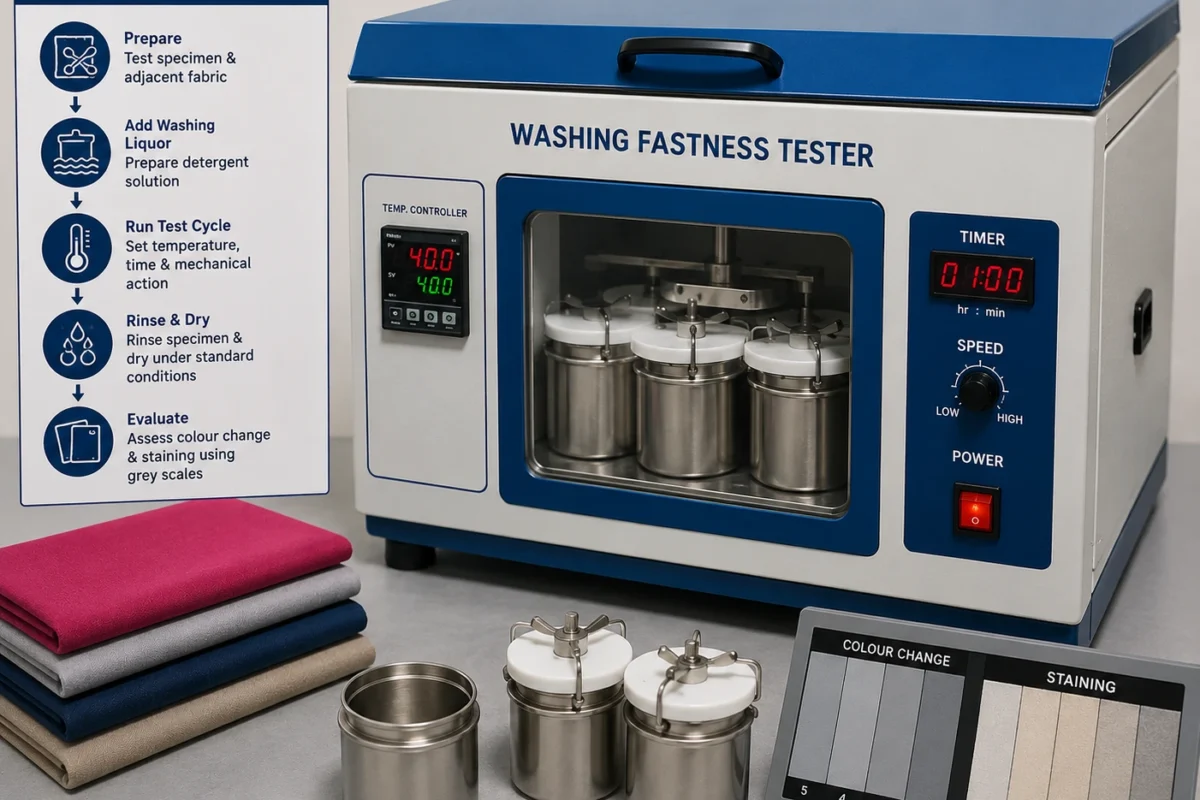
When a customer buys a shirt, a bedsheet, or a school uniform, the last thing they expect is for the colour to bleed or fade after the first few washes. Yet this is one of the most common quality complaints textile manufacturers and garment exporters deal with. Colour durability during laundering is not a minor detail — it directly affects buyer satisfaction, brand reputation, and whether a shipment gets accepted or rejected at inspection.
This is where a washing fastness tester becomes essential. It is a laboratory instrument used to simulate domestic or industrial washing conditions on a small fabric specimen, so that colour change and staining can be assessed before the fabric or garment goes into bulk production. For textile manufacturers, garment exporters, testing laboratories, and quality-control teams, this single test can prevent costly rework, disputes with buyers, and returned shipments.
In this article, we’ll walk through what a washing fastness tester is, how it works, the general testing procedure, the standards commonly referenced, and where this equipment is used across the textile and garment industry.
What Is a Washing Fastness Tester?
A washing fastness tester is a piece of textile testing equipment designed to evaluate how well a dyed or printed fabric holds its colour when subjected to controlled washing conditions. It’s used across textile testing laboratories, garment factories, and buying-house inspection units to check Colour Fastness to Washing — essentially, how resistant a fabric’s colour is to laundering.
The instrument typically works by placing fabric specimens, along with an adjacent (multi-fibre) fabric, inside sealed containers along with a washing liquor. These containers are then rotated at a controlled temperature for a specified duration, replicating the mechanical and chemical stress of an actual wash cycle.
Two main properties are evaluated after the test:
- Colour change in the original specimen
- Staining on the adjacent fabric
Because even small variations in temperature, time, or agitation can change the outcome, controlled laboratory conditions are critical. A washing fastness tester allows this consistency, which is something a normal washing machine simply cannot guarantee.
What is a washing fastness tester?
A washing fastness tester is a laboratory instrument that evaluates how well a dyed fabric retains its colour when washed under controlled conditions. It measures colour change in the specimen and staining on an adjacent fabric, helping textile and garment manufacturers assess Colour Fastness to Washing before production.
Why Is Washing Fastness Testing Important?
Washing fastness testing matters across almost every category of textile product — garments, dyed fabrics, home textiles, apparel, uniforms, children’s clothing, workwear, and export-bound products. Each of these goes through repeated washing during its usable life, and the colour is expected to hold up reasonably well throughout.
Poor washing fastness can lead to several downstream issues:
- Noticeable colour fading after a few wash cycles
- Colour transfer onto skin or other garments
- Staining of adjacent fabrics in a mixed laundry load
- Customer complaints and returns
- Rejection of bulk shipments during buyer inspection
- Repeated quality-control failures that slow down production timelines
For garment exporters in particular, many international buyers specify a minimum fastness rating as part of their technical package. Failing to meet that rating, even by a small margin, can result in an entire consignment being put on hold.
Why is washing fastness important?
Washing fastness testing is important because it predicts how a fabric’s colour will behave after repeated laundering. Without it, manufacturers risk colour fading, staining of other garments, buyer rejection, and customer complaints — issues that are far more expensive to fix after production than before it.
How Does a Washing Fastness Tester Work?
The working principle behind a washing fastness tester is based on simulating a wash cycle under repeatable, measurable conditions. While exact parameters vary by standard, the general sequence looks like this:
- Preparation of the textile specimen — a fabric sample is cut to the required size.
- Selection of adjacent fabric — a multi-fibre or single-fibre fabric is chosen based on the applicable test method.
- Preparation of washing liquor — water is prepared at the specified concentration and, where required, combined with detergent or soap.
- Addition of detergent or soap — added only where the applicable standard calls for it.
- Loading the specimen — the specimen and adjacent fabric are sewn together and placed into the test container along with steel balls, if specified.
- Controlled washing conditions — the container is sealed and placed into the instrument.
- Temperature control — the water bath or heating system maintains the required test temperature.
- Time and agitation — the container rotates for a fixed duration to reproduce mechanical washing action.
- Rinsing — the specimen is rinsed to remove residual washing liquor.
- Drying — specimens are dried under controlled conditions, away from direct heat that could distort results.
- Assessment — colour change and staining are evaluated, typically using grey scales.
Every one of these steps needs to be repeatable. If temperature drifts, agitation is inconsistent, or drying conditions vary, the same fabric could produce different fastness ratings in two separate tests. This is exactly why relying on manual or improvised washing setups is not considered reliable for formal testing.
Washing Fastness Tester Procedure
While the exact test conditions always depend on the applicable standard, customer specification, fibre type, dye class, and the laboratory’s own SOPs, a typical procedure follows this general flow:
- Cut the fabric specimen to the required dimensions.
- Attach the adjacent fabric as specified by the chosen test method.
- Prepare the washing liquor with the correct water-to-detergent ratio.
- Place the specimen and steel balls (if required) into the test container.
- Set the required temperature and time on the instrument.
- Run the test cycle.
- Remove, rinse, and dry the specimen under controlled conditions.
- Evaluate colour change and staining using grey scales or the method specified.
| Testing Stage | What Is Controlled | Purpose |
| Specimen Preparation | Fabric size and construction | Ensures consistency |
| Washing | Temperature and liquor conditions | Simulates specified laundering |
| Agitation | Mechanical action | Reproduces washing stress |
| Rinsing | Water and procedure | Removes residual washing liquor |
| Drying | Controlled drying conditions | Prepares specimen for evaluation |
| Assessment | Colour change and staining | Determines fastness rating |
Laboratories should always cross-check the exact parameters against the current version of the standard being applied, since conditions can differ meaningfully between methods.
Washing Fastness Standards
There isn’t a single universal condition that applies to every washing fastness test. The applicable method — including temperature, detergent, time, and mechanical action — depends entirely on the standard requested by the buyer or specified for the product category. Some of the commonly referenced standards in the textile industry include:
- ISO 105-C06 — widely used for domestic and commercial laundering evaluation of textiles.
- ISO 105-C08 — used for assessing colour fastness with reference detergents containing an optical brightening agent.
- AATCC TM61 — commonly used in markets that follow American testing conventions, covering various wash conditions depending on the test option selected.
We’re not reproducing the exact clauses or numerical parameters of these standards here — laboratories should always refer to the current, official edition of the relevant standard and follow the specific conditions it prescribes, along with any buyer requirements.
Which standard is used for washing fastness testing?
Common standards for washing fastness testing include ISO 105-C06, ISO 105-C08, and AATCC TM61. The exact standard used depends on the buyer’s specification, market requirement, and fabric type, since each method defines different temperature, detergent, and time conditions.
What Does a Washing Fastness Test Measure?
A washing fastness test primarily measures two distinct outcomes:
Colour Change — This refers to the change in the original colour of the tested specimen itself, comparing its appearance before and after the wash cycle.
Staining — This refers to the transfer of colour from the tested specimen onto the adjacent fabric during washing.
Both are typically assessed using grey scales — one for colour change and one for staining — or other evaluation methods prescribed by the applicable standard. The resulting rating gives manufacturers and buyers a comparable, standardised way to judge how the dye is likely to behave in real-world laundering.
Types of Washing Fastness Tests
Not every washing fastness test looks the same. Depending on the applicable standard and the intended end use of the textile, laboratories may run:
- Standard washing fastness testing at moderate, domestic-style conditions
- Accelerated laundering evaluation designed to simulate multiple wash cycles in a shorter time
- Tests at different temperature settings, depending on the product category
- Tests using different detergent formulations or reference detergents
- Tests involving different levels of mechanical action or agitation
No single washing fastness tester or test method covers every possible washing condition a fabric might encounter in real life. The choice of method should always match the buyer’s requirement or the intended market.
Applications of Washing Fastness Tester
A washing fastness tester is used across a wide range of settings in the textile and garment industry:
- Garment manufacturing — checking finished garments before shipment
- Textile dyeing units — validating dye recipes and fixation quality
- Fabric processing houses — quality checks after finishing treatments
- Apparel production — verifying fastness before cutting large fabric lots
- Home textiles — testing bedsheets, curtains, and upholstery fabrics
- Textile export — meeting buyer and country-specific compliance requirements
- Buying-house inspection — pre-shipment quality verification
- Third-party textile laboratories — independent testing for multiple clients
- Research and development — evaluating new dyes, finishes, or fibre blends
- Textile quality control departments — routine, ongoing production checks
In India, this kind of testing is particularly relevant given the scale of the textile industry — from dyeing units to garment manufacturing hubs. Clusters like Tiruppur and cities such as Bangalore house a large concentration of garment manufacturing and textile exporters, many of whom supply to international buyers with strict fastness requirements. A reliable washing fastness tester is a practical necessity for labs and factories operating in this environment.
Factors Affecting Washing Fastness
Several variables influence how a fabric performs in a washing fastness test:
- Type of dye used
- Quality of dye fixation
- Fibre composition of the fabric
- Dye concentration
- Finishing treatments applied
- Washing temperature
- Detergent chemistry
- Washing time and cycle length
- Mechanical action during washing
- pH of the washing liquor
- Fabric construction (weave or knit density)
- Quality of pretreatment before dyeing
Any one of these factors, if not properly controlled during production, can shift the colour change or staining result — sometimes significantly.
How to Improve Fabric Colour Fastness to Washing
While no single step guarantees a particular fastness rating, several practical measures consistently help:
- Choose dyes that are well-suited to the specific fibre type
- Ensure proper dye fixation before moving to finishing
- Optimise dyeing time, temperature, and liquor ratio
- Control soaping and washing-off steps carefully during dyeing
- Follow recommended finishing procedures for the fabric type
- Run laboratory testing before committing to bulk production
- Compare in-house test results against the buyer’s technical specification
- Maintain consistent parameters across production batches
These steps reduce the likelihood of fastness-related rejections later in the supply chain, though results should always be verified through actual testing rather than assumed.
How to Choose the Right Washing Fastness Tester
Selecting the right washing fastness tester depends on your lab’s testing volume, applicable standards, and budget. Key considerations include:
- Which testing standards the instrument supports
- Accuracy and range of temperature control
- Number and size of test containers
- Type of agitation mechanism
- Timer accuracy and programmability
- Heating system reliability
- Build quality and construction material
- Safety features, such as lid locking and overheat protection
- Ease of cleaning between tests
- Ongoing maintenance requirements
- Expected daily or monthly testing workload
- Calibration and verification support
- Availability of technical support and spare parts
A small textile laboratory running occasional tests has different needs compared to a garment factory running daily quality checks, or a large third-party testing laboratory handling high volumes across multiple standards. Research facilities may also need more flexible parameter control for experimental work. Matching the equipment to actual testing needs — rather than buying based on capacity alone — tends to give better long-term value.
Why Use Textile Testing Equipment for Quality Control?
Reliable textile testing equipment, including washing fastness testers, crock meters, and light booths, plays a central role in quality assurance. Controlled testing supports:
- Consistency across production batches
- Repeatable results that can be compared over time
- Stronger quality assurance before shipment
- Better alignment with buyer compliance requirements
- Ongoing monitoring during production
- Faster troubleshooting when a fastness issue is identified
- More informed decisions during product development
Without standardised testing equipment, quality decisions end up relying on visual judgement alone, which is far less reliable and harder to defend during a buyer audit.
Why Choose Amith Garment Services
Amith Garment Services supplies textile testing equipment, including washing fastness testers, to textile manufacturers, garment units, and testing laboratories. The focus is on providing equipment that supports accurate, repeatable testing aligned with commonly referenced industry standards.
For labs and factories evaluating a washing fastness tester or related textile laboratory equipment, it’s worth comparing instruments based on the testing standards they support, build quality, ease of use, and after-sales technical support — rather than price alone. Amith Garment Services also offers related garment testing instruments, such as crock meters and light booths, for teams looking to build a more complete in-house testing setup.
Whether you’re setting up a new textile testing laboratory or upgrading existing fabric testing equipment, it’s advisable to assess your specific testing requirements, applicable standards, and expected workload before finalising a purchase. You can explore the available range of testing instruments on the Amith Garment Services website to find equipment suited to your lab’s needs.
Ultimately, a dependable washing fastness tester is not just a compliance tool — it’s a practical safeguard that helps textile manufacturers and garment exporters catch colour fastness issues before they become expensive problems down the line.
Frequently Asked Questions
A washing fastness tester is used to check how well a fabric's colour withstands laundering. It simulates a wash cycle under controlled temperature, time, and mechanical action, allowing evaluation of colour change in the specimen and staining on an adjacent fabric. This helps textile manufacturers and garment exporters identify fastness issues before bulk production or shipment.
A washing fastness test typically involves preparing a fabric specimen with an adjacent fabric, placing them in a sealed container with a prepared washing liquor, and running the cycle at the temperature and duration specified by the applicable standard. The specimen is then rinsed, dried, and assessed using grey scales for colour change and staining.
Commonly referenced standards for colour fastness to washing include ISO 105-C06, ISO 105-C08, and AATCC TM61. The appropriate method depends on the buyer specification, target market, fabric category, and applicable testing requirements. Laboratories should follow the current official edition of the selected standard.
Factors affecting washing fastness include dye type, dye fixation, fibre composition, dye concentration, finishing treatments, washing temperature, detergent chemistry, mechanical agitation, fabric construction, and pretreatment quality. Changes in dyeing or finishing processes can affect colour change and staining results.
A washing fastness tester is used to test how well a fabric's colour holds up after washing. It helps identify colour fading and staining under controlled test conditions before fabric enters production or is shipped to buyers.
A small fabric specimen is tested with an adjacent fabric in a controlled washing machine or tester at a specified temperature and time. After washing, the specimen is rinsed and dried before colour change and staining are evaluated using appropriate grey scales.
Colour fastness to washing describes how well a textile retains its original colour and resists staining other materials when subjected to washing under specified test conditions.
Common standards include ISO 105-C06, ISO 105-C08, and AATCC TM61. The correct washing fastness test method depends on the textile product, buyer requirements, target market, and testing specification.