
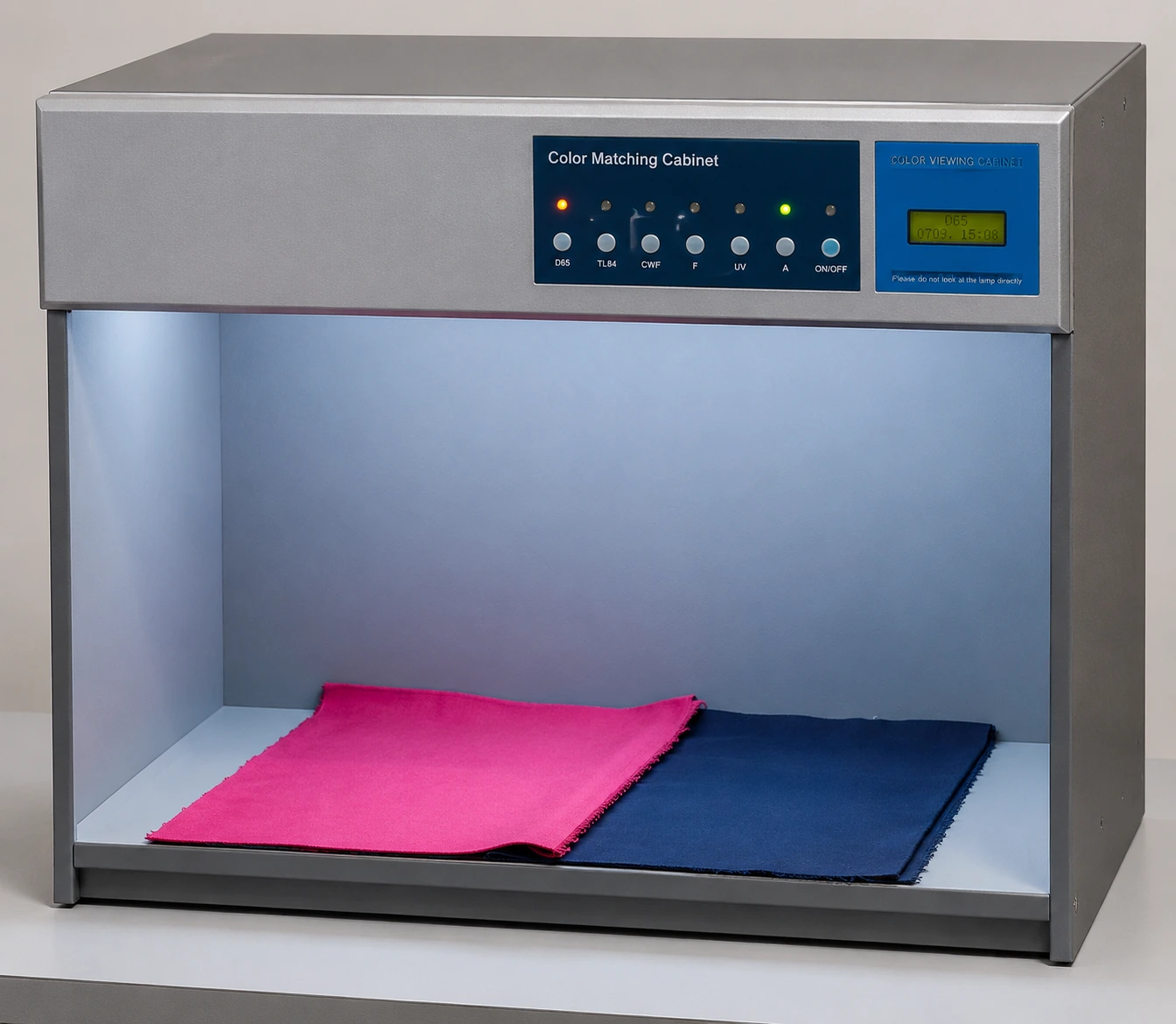
Color consistency is one of the first things buyers notice when they inspect a fabric or finished garment. A shade that looks correct under one lighting condition can appear noticeably different under another. This is why professional textile laboratories and quality-control teams use a Color Matching Cabinet for controlled visual color evaluation.
A Color Matching Cabinet provides a standardized viewing environment in which fabric, yarn, trims, garments, plastics, paints, and other colored materials can be compared under different light sources. It helps reduce subjective judgment and makes color approval more consistent between suppliers, manufacturers, buyers, and testing teams.
For textile manufacturers and exporters in India, particularly production centers such as Bangalore and Tiruppur, controlled color evaluation can be an important part of maintaining product consistency.
What Is a Color Matching Cabinet?
A Color Matching Cabinet is a laboratory instrument designed to provide controlled and standardized illumination for visual comparison of colors. Instead of examining a fabric under changing room lights or natural daylight, the operator evaluates samples inside a dedicated viewing environment.
The cabinet contains selected light sources that simulate different lighting conditions. This allows a quality-control professional to determine whether two samples genuinely match or whether their appearance changes when the illumination changes.
Why Is a Color Matching Cabinet Important?
Color approval is rarely as simple as placing two fabric samples next to each other. The surrounding environment, type of illumination, viewing angle, surface characteristics, and even the observer can influence how a color is perceived.
A controlled cabinet reduces some of these variables. Instead of relying on ordinary office lighting or inconsistent daylight, the operator can compare samples under defined illumination conditions.
A Color Matching Cabinet is particularly useful during:
- Lab-dip approval
- Bulk fabric inspection
- Shade matching
- Yarn color comparison
- Garment panel checking
- Trim and accessory approval
- Buyer sample comparison
- Production quality control
- Final inspection
For textile exporters, consistent color evaluation can also make communication easier between a dyeing unit, garment manufacturer, buying house, and overseas customer.
How Does a Color Matching Cabinet Work?
The basic principle is straightforward. The operator places the test specimens and reference standard inside the viewing area and selects the required light source.
The samples are then visually compared under controlled illumination. If required, the operator changes to another light source and repeats the comparison.
This process is particularly useful for identifying metamerism. Metamerism occurs when two samples appear to have a similar color under one light source but show a noticeable difference under another.
Typical operating sequence
- Clean the viewing area and make sure the light sources are functioning correctly.
- Place the reference sample and production sample in the viewing area.
- Position the samples consistently for comparison.
- Select the required standard light source.
- Compare shade, hue, depth, and visible color difference.
- Change to another relevant light source.
- Record the observation according to the laboratory’s quality-control procedure.
- Take corrective action if the samples do not meet the approved shade requirement.
Important: A viewing cabinet supports visual assessment; it does not replace instrumental color measurement when a specification requires numerical color data.
Different Light Sources Used for Color Evaluation
Different light sources represent different viewing environments. The exact configuration varies between instruments and laboratory requirements.
Common sources used in color evaluation include:
| Light Source | Typical Application |
|---|---|
| D65 | Artificial daylight simulation |
| TL84 | Common commercial/store lighting simulation |
| CWF | Cool white fluorescent environment |
| UV | Examination of fluorescent or optical brightening effects |
| Tungsten / Incandescent | Warm indoor lighting conditions |
D65 is especially relevant when daylight-like evaluation is required. Other sources can reveal differences that may remain unnoticed under a single illumination condition.
This is one reason color approval should not depend on only one type of lighting.
Color Matching Cabinet and Metamerism
Metamerism is a common concern in textile color evaluation. Two materials may appear to match under one light source but separate visually when viewed under another.
For example, a dyed fabric may appear acceptable under daylight simulation but show a reddish or bluish difference under a store-light simulation.
This does not necessarily mean that one sample has been incorrectly dyed. It may indicate that the spectral characteristics of the two materials are different even though their colors appear similar under a particular illumination.
A Color Matching Cabinet allows the laboratory team to investigate these changes in a controlled environment.
Industries That Use Color Matching Cabinets
Although textile laboratories are a major application area, controlled color evaluation is useful across several manufacturing sectors.
Common users include:
- Textile and yarn manufacturers
- Garment manufacturing units
- Dyeing and finishing facilities
- Buying houses
- Fabric testing laboratories
- Printing companies
- Paint and coating manufacturers
- Plastic manufacturers
- Paper manufacturers
- Product quality-control departments
Within India’s textile sector, facilities in Tiruppur, Bangalore, Gujarat, Tamil Nadu, and other manufacturing regions can use controlled visual assessment as part of their broader quality-control procedures.
The actual testing requirement depends on the product, customer specification, and applicable quality standard.
Factors That Can Affect Color Evaluation
A laboratory may have a good instrument, but the testing procedure still needs to be controlled. Several factors can influence visual color assessment.
Important factors include:
Light source: Different illumination can change the perceived appearance of a sample.
Sample positioning: Samples should be positioned consistently so that one is not viewed at a substantially different angle.
Viewing angle: Textile surfaces can reflect or scatter light differently depending on their structure and finish.
Sample condition: Moisture, finishing treatments, surface contamination, and fabric construction may influence appearance.
Surrounding environment: Strong external light entering the viewing area can affect the comparison.
Observer: Human color perception varies, so standardized procedures help improve consistency.
Light-source age: Lamps have operating lives and their performance can change over time. Laboratory maintenance and replacement schedules should therefore be followed.
How to Improve Color Quality Control in Textile Production
A Color Matching Cabinet works best when it is integrated into a wider quality-control system rather than used as an isolated inspection step.
Manufacturers can establish color checks at multiple stages, including sample development, dyeing, fabric inspection, garment assembly, and final inspection.
A practical workflow may include:
- Approving a physical or instrumental color standard
- Checking lab dips before bulk production
- Comparing bulk production against the approved standard
- Inspecting fabric lots consistently
- Checking trims against the garment fabric
- Evaluating samples under more than one relevant light source
- Recording shade observations
- Maintaining equipment and light-source performance
- Using instrumental color measurement where required by the specification
Good color control starts before final inspection. Detecting a shade issue during laboratory approval is generally more manageable than discovering it after garments have been manufactured.
Choosing the Right Color Matching Cabinet
The right instrument should be selected according to the laboratory’s actual testing requirements rather than simply choosing the model with the largest number of features.
Consider the following before purchasing:
1. Required light sources
Determine which illuminants are relevant to your customers and products.
2. Viewing area
The cabinet should provide enough space to compare the sample sizes normally handled by your laboratory.
3. Viewing geometry
Consistent viewing geometry helps improve repeatability between observations.
4. Controls and operation
The light-source selection system should be practical for regular laboratory use.
5. Maintenance
Check how lamps, controls, and other consumable components are maintained or replaced.
6. Applicable standards
Confirm which standards and customer-specific requirements apply to your testing procedure.
7. Laboratory workload
A production laboratory handling frequent shade approvals may require a more robust setup than a small unit performing occasional checks.
A Color Matching Cabinet should be treated as part of the laboratory’s color-management process, not simply as a lighting box.
Color Matching Cabinet vs Ordinary Lighting
The difference is mainly control and consistency.
| Factor | Ordinary Room Lighting | Color Matching Cabinet |
|---|---|---|
| Lighting | Variable | Controlled |
| Light source selection | Limited | Multiple options |
| External light influence | Possible | Reduced |
| Sample comparison | Less standardized | More controlled |
| Metamerism evaluation | Difficult | More practical |
| Laboratory use | Limited | Designed for testing |
| Repeatability | Can vary | Better controlled |
This does not mean every visual color decision requires a cabinet. However, when consistent color approval is important, a controlled viewing environment offers a more reliable approach than ordinary workplace lighting.
Why Choose Amith Garment Services?
Amith Garment Services focuses on textile and garment testing requirements, providing equipment intended for practical quality-control and laboratory applications.
For textile manufacturers, exporters, testing laboratories, and garment units, the equipment selection should match the actual testing procedure, material, production volume, and customer requirements.
Along with color evaluation equipment, a textile laboratory may require instruments for different aspects of fabric and garment performance, including strength, dimensional stability, inspection, GSM, and washing-related testing.
When selecting equipment, buyers should consider not only the machine itself but also technical specifications, operating requirements, calibration or verification needs, after-sales support, and suitability for the intended testing method.
Conclusion
Consistent color is an important part of textile and garment quality. A controlled viewing environment makes it easier for quality teams to compare approved standards with production samples and investigate color differences under different illumination conditions.
A Color Matching Cabinet is therefore a useful part of a professional textile laboratory, particularly where shade approval, buyer requirements, and metamerism control are important. When combined with appropriate testing procedures and other Textile Testing Equipment, it can support more consistent quality decisions from fabric development through final garment inspection.
For textile manufacturers and testing laboratories looking to strengthen their Fabric Color Testing and quality-control process, choosing the right Color Matching Cabinet should be based on the required light sources, testing practices, standards, workload, and laboratory conditions.
Frequently Asked Questions
A Color Matching Cabinet is used to evaluate and compare textile colors under controlled lighting conditions. It allows laboratory personnel to compare a fabric, yarn, trim, or garment against an approved reference sample. Different illuminants can also be used to identify metamerism, where two samples appear similar under one light but different under another. This makes controlled visual color assessment useful during shade approval, production inspection, and garment quality control.
D65 represents a standardized daylight illuminant and is commonly used when a daylight-like viewing condition is required for color assessment. Using a controlled D65 source provides a more consistent environment than relying on changing natural daylight. However, D65 is only one possible viewing condition. Depending on the product and customer requirement, laboratories may also evaluate samples under other relevant illuminants.
A Color Matching Cabinet allows two samples to be compared under different controlled light sources. If the samples match under one illuminant but show a noticeable difference when the light source changes, the materials may exhibit metamerism. Identifying this effect before production approval can help textile manufacturers investigate shade combinations and avoid unexpected differences during customer inspection.
Not every laboratory will have the same testing requirements, but a controlled color-viewing instrument can be valuable where shade approval and visual color consistency are important. Textile dyeing units, garment manufacturers, exporters, buying houses, and quality-control laboratories may benefit from it. The appropriate configuration depends on the materials tested, customer specifications, relevant standards, production volume, and other color-measurement methods used by the laboratory.
A Color Matching Cabinet is used to compare colors under controlled lighting. In textile testing, it helps inspectors evaluate fabric and garment shades consistently and identify differences that may appear when the samples are viewed under different types of illumination.
Samples are placed inside the cabinet and viewed under selected standardized light sources. The operator compares the production sample with a reference sample and observes whether the colors remain consistent when the illumination changes.
Metamerism occurs when two colors look similar under one light source but appear different under another. A Color Matching Cabinet helps identify this effect by allowing samples to be compared under multiple controlled illumination conditions.
Color matching helps maintain consistent shades between fabric lots, garments, trims, and approved samples. It can reduce shade-related quality problems and support more reliable inspection before finished garments are supplied to buyers.