
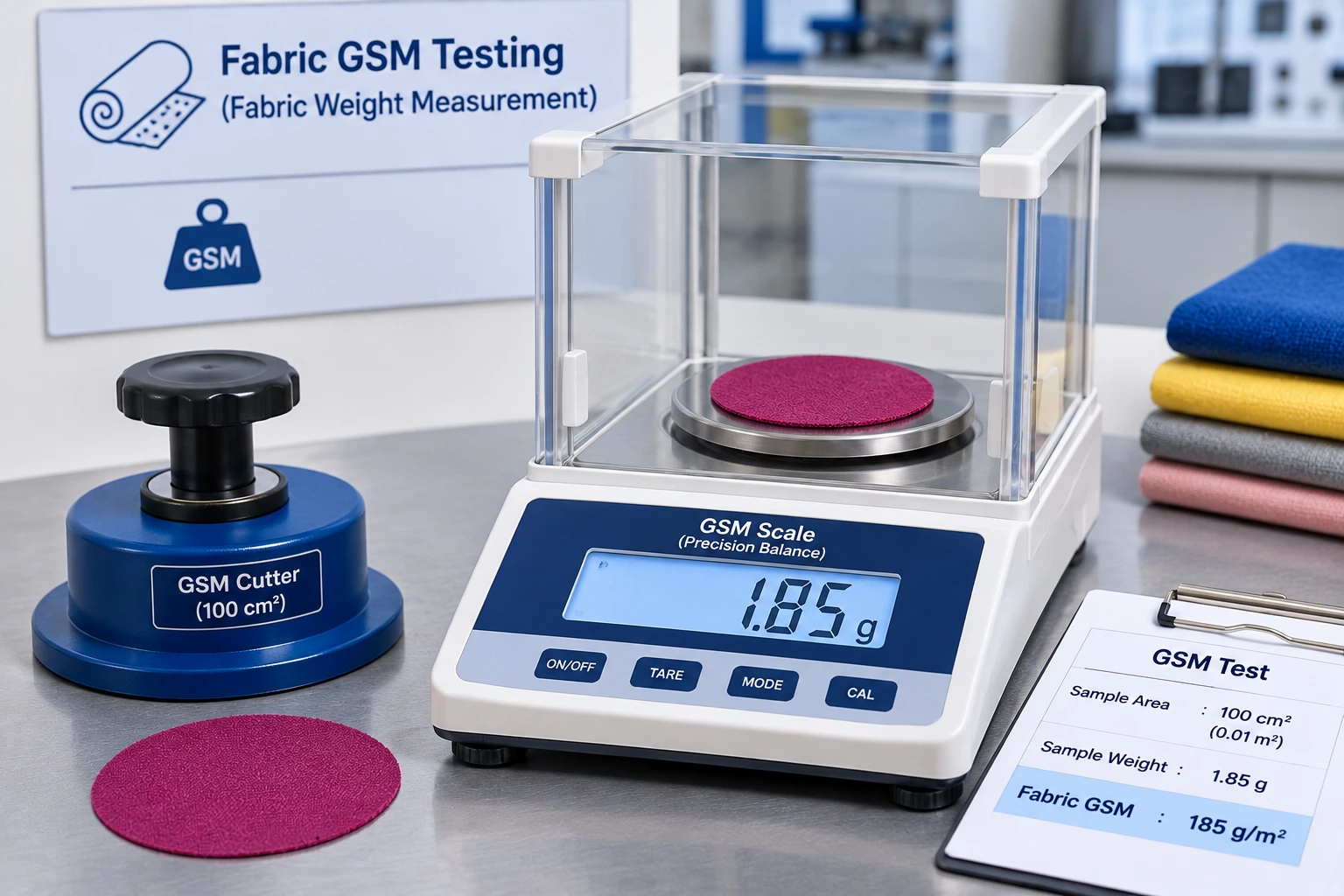
GSM is usually the first number a buyer checks on a fabric specification. Fabric GSM, or grams per square metre, shows how heavy a fabric is, and it shapes handfeel, drape, durability and cost. A GSM Scale, used with a GSM cutter, gives mills, garment units and testing labs a practical way to carry out fabric weight measurement before bulk cutting begins. Careful fabric GSM testing keeps specifications consistent from lot to lot. Careless testing produces numbers that look precise but mislead. This guide explains the method, equipment, common errors and standards the way an experienced lab technician would explain them on the bench.
What Is a GSM Scale in Textile Testing?
A GSM Scale is a precision weighing balance used to weigh a fabric sample of known area so its weight can be expressed in grams per square metre. It measures mass only; the sample area comes from a GSM cutter, and the GSM figure follows from the calculation.
GSM stands for grams per square metre, so it expresses fabric weight per unit area, not the weight of a roll or garment. It is not fabric thickness, which is the distance through the fabric in millimetres; two fabrics can share a GSM yet differ in thickness. Because GSM reflects yarn, construction and finishing, it underpins textile quality control from grey fabric to finished garment.
Why Is GSM Scale Testing Important in the Textile Industry?
GSM Scale testing confirms that fabric weight matches the specification before production starts. It helps teams catch batch-to-batch variation, check supplier lots, avoid garment performance problems and support purchasing decisions. Without it, a fabric that is slightly too light or heavy can pass unnoticed until the garment fails a buyer’s inspection.
Picture a knit mill supplying 200 GSM single jersey. If one dye lot arrives noticeably lighter, the garments may feel thin and behave differently in washing. A check at goods inward catches this early. Buying houses also use GSM results to confirm that bulk fabric matches the approved sample.
How to Measure Fabric GSM Accurately Using a GSM Scale
To measure fabric GSM accurately, take a representative sample, condition it, cut a specimen of known area with a GSM cutter, and weigh it on a calibrated GSM Scale. Divide the weight in grams by the area in square metres, then repeat on several specimens and record the average.
- Prepare a representative sample, avoiding roll ends, creases and selvedge.
- Condition the sample as the applicable test method requires, since moisture changes weight.
- Cut a specimen of known area with a suitable GSM cutter.
- Check the specimen is clean, flat and free from loose fibres.
- Place it on a calibrated scale.
- Record the weight in grams.
- Calculate GSM with the formula below.
- Repeat on several specimens to judge consistency.
GSM = Fabric sample weight (g) ÷ Sample area (m²)
For a 100 cm² sample, this simplifies to GSM = weight (g) × 100.
Example: a specimen cut with a 100 cm² cutter weighs 1.85 g, so GSM = 1.85 × 100 = 185 g/m².
Use the ×100 shortcut only when the area really is 100 cm². A 38 mm round cutter, for instance, covers roughly 11.3 cm², so you divide by its actual area in square metres. This is a worked example, not an official test result. Cutting accuracy and weighing precision matter because errors carry straight through: a 2% error in area or weight becomes roughly a 2% error in GSM.
What Equipment Is Required for GSM Scale Testing?
Fabric GSM testing needs a GSM cutter to prepare a known-area sample, a cutting pad, a calibrated precision balance and a clean, draught-free workspace. Some labs add a conditioning area. Together these form a GSM testing setup, often called a GSM testing machine.
The GSM cutter prepares the sample; the scale only weighs it. The cutting pad protects the blades and gives clean edges. Laboratories that condition samples often use a conditioning chamber or rack. A well-organised GSM testing equipment setup helps a lab repeat measurements consistently.
Different Methods of Fabric GSM Measurement
GSM Measurement Using a GSM Cutter and Weighing Scale
This is the standard known-area method. A GSM cutter produces a circular specimen, commonly 100 cm², and a balance weighs it. It is quick, repeatable and widely used in textile laboratories.
GSM Measurement Using a Fabric Sample of Known Dimensions
When the exact dimensions are known, area equals length times width. A 15 cm × 10 cm piece covers 150 cm², or 0.015 m². If it weighs 2.70 g, GSM = 2.70 ÷ 0.015 = 180 g/m². Hand-cut edges are less precise than cutter edges, so measure carefully.
GSM Testing for Knitted and Woven Fabrics
Knitted fabrics stretch and curl, so lay them relaxed and cut without pulling. Woven fabrics can vary across the width, so sample from several positions. Conditioning matters for both. No single method suits every fabric; follow the method your buyer or laboratory specifies.
Common Factors That Affect GSM Testing Accuracy
Most GSM errors begin before the fabric reaches the scale.
- Incorrect sample dimensions: a worn blade or wrong cutter shifts the area, and every result with it.
- Improper GSM cutter use: uneven pressure leaves ragged edges and partial cuts.
- Uncalibrated weighing scale: drift biases every reading in the same direction.
- Moisture, temperature and humidity: fabric that has absorbed moisture weighs more.
- Surface irregularities: slubs, coatings or loose pile add local weight.
- Non-representative samples: one piece rarely speaks for a whole roll.
- Inconsistent handling: dust, oils and loose fibres add mass.
- Stretching during cutting: it distorts the specimen area, especially in knits.
GSM Testing Standards and Laboratory Practices
Two references come up most often. ISO 3801 covers mass per unit length and mass per unit area of woven fabrics. ASTM D3776/D3776M covers mass per unit area (weight) of fabric and offers several options, including a small-swatch method. Both rely on conditioned specimens, so follow recognised conditioning practice in the laboratory.
Which method applies depends on fabric type, customer requirements and the testing specification, and no single procedure is mandatory for every fabric. Consult the current official text before compliance testing. These standards address fabric mass only; colour fastness and strength tests follow separate methods.
What Is the Difference Between GSM Scale and GSM Testing Machine?
A GSM cutter cuts a fabric sample of fixed, known area. A GSM scale weighs that sample. Neither gives GSM alone: the cutter supplies the area, the scale supplies the mass, and the calculation or a direct-reading digital display turns them into grams per square metre.
| Parameter | GSM Scale | GSM Testing Setup |
| Purpose | Measures sample weight | Supports complete GSM testing |
| Main function | Weighing | Sample cutting and weighing |
| Equipment | Precision weighing balance | GSM cutter, cutting pad and balance |
| Result | Sample mass | Calculated fabric GSM |
Terminology varies between suppliers, so confirm what a listing actually includes. For a deeper look at how the setup works, see this guide to the GSM testing machine.
How to Improve Fabric GSM Testing Accuracy
- Use a suitable GSM cutter and check its stated dimensions.
- Keep the weighing scale calibrated and the pan clean.
- Condition samples consistently before weighing.
- Select representative samples from different positions.
- Avoid stretching or compressing the fabric.
- Take repeat measurements where required and average them.
- Maintain testing records with date, method and operator.
- Follow the specified testing standard.
Industries That Use GSM Testing
GSM testing runs through the whole chain: textile manufacturing, garment manufacturing, knitted and woven fabric production, home textiles, sportswear, textile dyeing and processing, exporters and fabric inspection laboratories. In India’s textile industry, hubs such as Tiruppur and Bangalore rely on GSM checks to confirm fabric before bulk garment manufacturing and export. Teams often pair them with a fabric inspection process on a fabric inspection machine, so weight and visible defects are checked together.
Choosing the Right GSM Scale and GSM Testing Equipment
Match the equipment to your fabrics and test method, not to a headline accuracy figure. Ask suppliers for written specifications covering:
- Weighing capacity suited to your specimen weights
- Readability and measurement precision
- Compatibility with your GSM cutter’s specimen area
- Calibration and maintenance support
- Ease of operation for your team
- Your laboratory testing requirements
- Manufacturer specifications and after-sales support
Why Choose Amith Garment Services?
Amith Garment Services is a Bangalore-based supplier of textile testing instruments and garment testing instruments; its website states it was established in 1999. For GSM work, the website lists a GSM Testing Machine setup built from a GSM cutter and a GSM weighing scale, including round and hydraulic cutters, a 38 mm cutter for small samples and digital GSM balances.
Labs that run GSM checks often add related tests, and the site also lists a Crock Meter for rubbing fastness; see the guide to colour fastness testing for context. Confirm specifications and availability with the company directly.
Conclusion
Reliable fabric GSM measurement comes down to four habits: representative sampling, a suitable GSM cutter, a calibrated weighing scale and a consistent procedure. Skip one and the number can drift without anyone noticing. Follow the specified standard, keep records, and treat a worked example like 185 g/m² as an illustration, not an official result. Used with care, a GSM Scale turns a routine check into dependable evidence for textile quality control.
GSM Scale & Fabric GSM Testing – FAQs
Find answers to common questions about GSM scales, fabric weight measurement, GSM cutters, calculations and textile quality control.
1. What is a GSM Scale used for in the textile industry?
A GSM Scale is used to weigh a fabric sample of known area so its weight per square metre can be worked out. Mills, garment manufacturers and testing laboratories use it to confirm fabric weight against the specification, compare supplier lots and spot variation before cutting. Used with a GSM cutter, it turns a small round specimen into a fabric GSM figure. The scale measures mass only, so the cutter and the calculation are equally important.
2. How do you calculate the GSM of fabric?
Weigh the specimen on a GSM Scale, then divide the weight in grams by its area in square metres. For a 100 cm² specimen, the area is 0.01 m², so you can multiply the weight by 100. A 100 cm² piece weighing 1.85 g gives 185 g/m². The shortcut works only for a 100 cm² sample; for any other size, convert the actual area to square metres first. This is a worked example, not an official test result.
3. What is the difference between a GSM cutter and a GSM weighing scale?
A GSM cutter prepares the sample by cutting a fabric specimen of fixed, known area, commonly 100 cm². A GSM weighing scale then measures that specimen’s mass. Neither one gives GSM alone. The cutter supplies the area, the scale supplies the weight, and the calculation, or a direct-reading digital display, produces the result. Accurate cutting and accurate weighing both matter, because an error in either flows straight into the final fabric GSM.
4. Why is Fabric GSM Testing important in garment manufacturing?
Fabric GSM testing confirms that the fabric matches the specification before garments are cut. GSM affects handfeel, drape, warmth, durability and cost, so a lot that is too light or too heavy can change how the finished garment looks and performs. Testing at goods inward helps teams catch lot-to-lot variation early, support purchasing decisions and reduce disputes with suppliers or buyers. It works best alongside other checks such as inspection and colour fastness.
5. How do I measure fabric GSM at home or in a textile laboratory?
In a lab, cut a known-area sample with a GSM cutter, weigh it on a calibrated scale and divide the weight by the area in square metres. At home you can do the same with a ruler and a precise kitchen scale, but treat the result as an estimate.
6. What does 180 GSM mean in fabric?
180 GSM means one square metre of the fabric weighs 180 grams. It is often seen in T-shirt knits, though the exact feel depends on fibre, yarn and construction. A 100 cm² piece of it would weigh about 1.8 grams.
7. Which equipment is used to measure fabric GSM?
Most labs use a GSM cutter to cut a known-area sample and a precision balance, often called a GSM scale, to weigh it. Together they form a GSM testing setup. Some digital balances can display GSM directly.
8. How often should fabric GSM be tested during production?
There’s no single rule. It depends on your buyer’s requirements, fabric type and quality plan. Common practice is to test incoming lots and whenever results look off. Follow your documented procedure.