
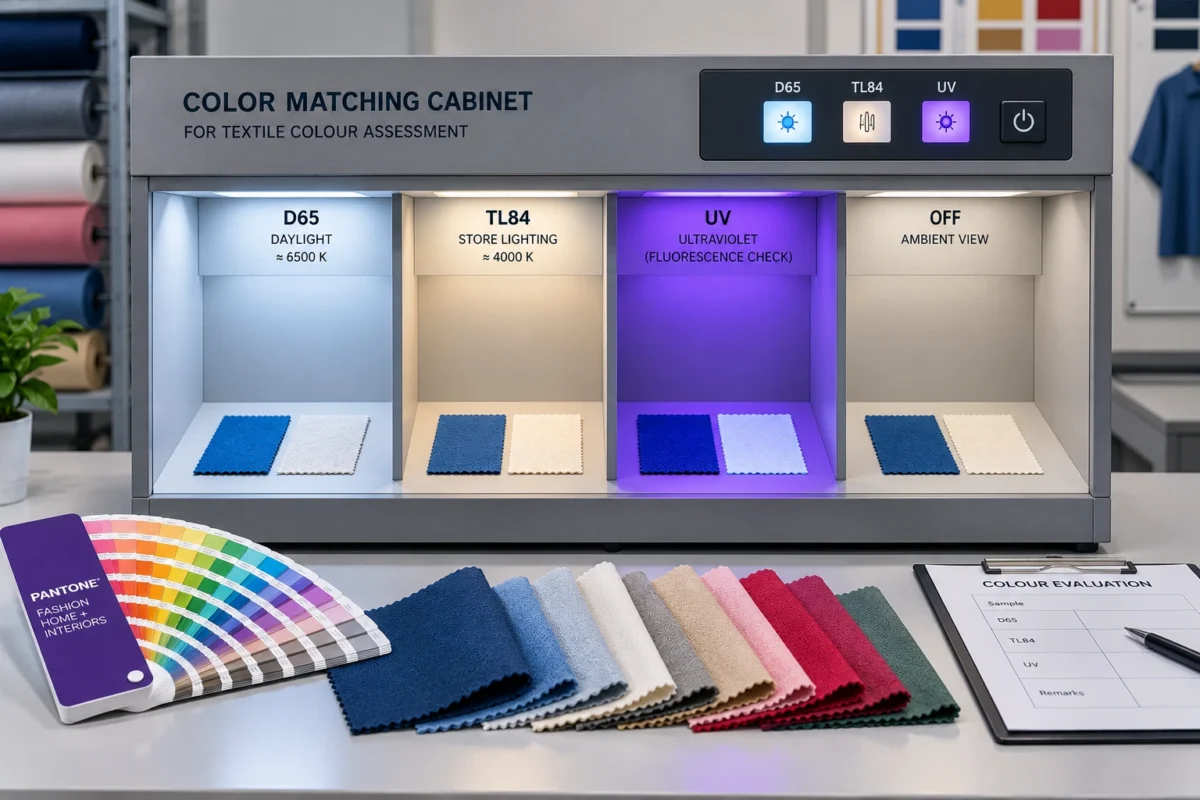
A fabric is approved in the lab, shipped to the buyer, and suddenly looks different under shop lighting. Anyone in garment manufacturing has seen this. A navy that looks right near a window can turn greyer under office tubes, and a white shirt can glow under UV in ways nobody expected. Often the cause is the light, not the fabric. That is why textile exporters, garment factories and testing laboratories across India, from Bangalore to Tiruppur, assess colour inside a Color Matching Cabinet, where illumination is controlled and repeatable.
What Is a Color Matching Cabinet?
Also called a colour matching light booth, it is an enclosed viewing cabinet fitted with standardised light sources and a neutral interior. It lets technicians compare fabric, trims and garments against an approved standard under controlled illumination instead of whatever room lighting happens to be available.
Room light changes with the time of day, window position and lamp age. Those shifts affect visual judgement. A colour matching cabinet fixes the lighting, and its neutral interior reduces the influence of surrounding colours.
It is a viewing tool, not a guarantee. Results still depend on the observer, the material and the procedure followed.
Why Are Different Light Sources Used for Colour Matching?
No single light represents every viewing condition. Textiles are seen in daylight, shops, offices and sometimes under UV, and colours can shift between them. Laboratories check samples under several light sources to catch differences that one illuminant alone would hide.
Every source spreads its energy across wavelengths differently. Fabric reflects that energy in its own way, so appearance changes with the light. This is the root of metamerism. Checking daylight simulation, retail lighting and UV illumination gives a fuller picture than any one source.
What Is D65 Light Source?
D65 is a CIE standard illuminant that represents average daylight, with a correlated colour temperature of about 6500 K. In textile colour assessment, a D65 light source simulates daylight so technicians can compare fabric and garment colour against approved standards under controlled conditions.
D65 is not identical to natural sunlight, which varies with hour, season and sky. It is a defined reference, and cabinet lamps approximate it as artificial daylight. How closely they match depends on the lamp and system, so check the manufacturer’s specifications.
Colour temperature also describes only the overall tone of the light. Two lamps can both be rated near 6500 K and still render the same fabric differently, because their spectral characteristics differ.
What Is TL84 Light Source?
TL84 is a commonly used reference for commercial store lighting, based on a narrow-band fluorescent lamp with a colour temperature near 4000 K. Buyers use TL84 lighting to see how fabrics and garments may look under typical retail conditions.
TL84 began as a commercial lamp designation, so it is not a CIE standard illuminant like D65. It is often compared with the CIE F11 fluorescent series. Exact specifications vary by lamp and cabinet, so treat 4000 K as approximate. If a buyer names TL84 in their requirements, confirm which lamp they mean.
What Is a UV Light Source?
UV illumination in a colour matching cabinet reveals fluorescence. It mainly shows whether fabrics contain optical brightening agents, which absorb ultraviolet radiation and emit visible blue light. That is why white and pastel fabrics can look different under UV-containing light.
Many white and pastel textiles are treated with optical brighteners. Under a source with UV content they glow, and without it they look duller. UV assessment is therefore a fluorescence check, not ordinary visible-light colour matching. Some D65 simulators include UV content and others do not, so know what your cabinet provides.
D65 vs TL84 vs UV Light Source
D65 simulates daylight at about 6500 K, while TL84 represents retail fluorescent lighting at about 4000 K. Colours look cooler under D65 and warmer under TL84. UV is different: it is not a viewing condition but a way to detect fluorescence.
| Feature | D65 | TL84 | UV |
| Main purpose | Daylight assessment | Retail-light assessment | Fluorescence check |
| Typical application | Shade approval | Buyer store-light check | Whites, pastels |
| Approx. colour temperature | ~6500 K | ~4000 K | Not applicable |
| Represents | Standard daylight illuminant | Commercial store lighting | Ultraviolet radiation |
| Useful for | Matching to standards | Spotting retail shifts | Detecting brighteners |
| UV component | Varies by cabinet | Usually minimal | Primary feature |
| Common textile use | Colour approval | Garment and buyer checks | Optical brightener checks |
Values are approximate and vary by lamp and system.
Why Metamerism Matters in Textile Colour Matching
Metamerism is when two samples appear to match under one light but differ under another. It happens because their spectral reflectance curves differ, even though they look alike under the first illuminant. In textiles, it often arises when different dye combinations are used.
Imagine a bulk fabric that matches its standard under D65 but shows a visible difference under TL84. That can mean a rejected shipment. Exporters, garment manufacturers, buying houses, quality teams and merchandisers all share that risk. Checking multiple illuminants helps flag potential metameric pairs early, and instrumental measurement can support the visual check.
How a Color Matching Cabinet Helps Textile Laboratories
In a textile laboratory, a Color Matching Cabinet gives technicians controlled lighting and a consistent place to compare fabric against standards. It suits garments and trims as well, and it allows evaluation under multiple illuminants. That supports quality-control decisions and reduces dependence on changing room light.
Visual assessment should always follow the relevant laboratory or customer procedure, including ISO and AATCC practices where they apply.
D65, TL84 and UV: Which Light Should You Use?
There is no single best light. The choice depends on customer requirements, product application, export market, retail environment, material, the colour standard, laboratory procedure and the presence of optical brighteners.
A shirt for a European retailer may need D65 and TL84 checks. White sportswear may also need a UV check. Always start with the buyer’s written requirements.
Industries That Use Color Matching Cabinets
Beyond textile manufacturing, garment manufacturing and dyeing and finishing, they are common in export houses, buying houses, fabric testing laboratories and home textiles. Fashion and apparel teams use them, and printing and packaging sometimes do too. In India, Tiruppur’s knitwear exporters and Bangalore’s garment manufacturers regularly work to buyer-specified lighting. Quality-control departments use the cabinet daily for colour evaluation and textile inspection.
How to Choose the Right Color Matching Cabinet
Consider these points before buying:
- Light sources: which of D65, TL84 and UV you actually need
- Number of illuminants: match it to buyer requirements
- Light uniformity across the viewing area
- Interior surface and viewing environment
- Lamp replacement availability, and a timer or hour meter
- Colour evaluation needs and available laboratory space
- Manufacturer specifications: ask for lamp data
- Calibration and maintenance expectations
- Compliance with customer or laboratory procedures
Why Choose Amith Garment Services for Textile Testing Equipment?
Amith Garment Services supplies textile testing equipment for garment and fabric laboratories. The range includes the colour matching cabinet, crock meter for colour fastness testing, washing fastness tester, GSM cutter, fabric inspection machine, bursting strength tester and fabric rolling machine.
These instruments cover practical quality-control needs in garment manufacturing and textile laboratories. The team can discuss your testing requirements and help you select suitable equipment. Confirm specifications against your own procedures before purchase.
Conclusion
D65 simulates daylight, TL84 represents common store lighting, and UV reveals fluorescence from optical brighteners. Each shows a different side of colour appearance, which is why they are not interchangeable. Used with the right procedure, a Color Matching Cabinet gives textile teams consistent, controlled conditions for colour evaluation, though it works best alongside trained observers and, where needed, instrumental measurement.
Frequently Asked Questions
A Color Matching Cabinet is used to assess fabric, trim and garment colour under controlled, repeatable lighting. Technicians compare a production sample with an approved standard under sources such as D65, TL84 and sometimes UV, away from changing room light. This helps textile laboratories, garment factories and buying houses make more consistent visual decisions. It does not replace instrumental measurement, and results still depend on the observer, material and the relevant customer or laboratory procedure.
D65 is a CIE standard illuminant that represents average daylight at roughly 6500 K, so it is used to judge colour under daylight-like conditions. TL84 is a commercial fluorescent reference associated with store lighting, with a colour temperature near 4000 K. D65 shows how a colour behaves in daylight, while TL84 shows how it may look in a shop. Exact specifications vary by lamp and cabinet, so always check the manufacturer's data.
UV light is used to reveal fluorescence, mainly in fabrics treated with optical brightening agents. These agents absorb ultraviolet radiation and re-emit it as visible blue light, making whites and pastels look brighter. Checking under UV helps technicians see whether two samples contain different levels of brightener, which could cause a visible mismatch under certain lighting. It is a fluorescence check rather than a replacement for visible-light colour matching.
Yes. This is called metamerism. Two samples can have different spectral reflectance, such as when different dye combinations are used, yet look identical under one illuminant. Under another light with a different spectral distribution, such as TL84, the difference may become visible. That is why laboratories check important shades under more than one light source before approving a lot or shipping to a buyer.
It's a viewing cabinet with standard lights that lets you compare fabric colours under controlled lighting. Textile labs and garment factories use it to check a sample against an approved standard without room lighting changing the result.
D65 is a standard daylight reference at about 6500 Kelvin. In a colour matching cabinet, it simulates daylight so you can judge how a fabric colour compares with its approved standard.
TL84 is a commonly used store-lighting reference at around 4000 Kelvin. Buyers and garment makers use it to see how a fabric or garment colour will look under typical shop lighting.
They use UV light to spot fluorescence, especially from optical brighteners in white and pastel fabrics. It shows whether a fabric glows under ultraviolet, which can change how it looks under some lighting.