
Introduction
Colour plays an important role in textile and garment manufacturing. Customers expect fabrics, garments and accessories to maintain the approved shade and appearance throughout production and regular use. Even a small colour difference between fabric batches can affect the final appearance of a garment collection.
Textile manufacturers, garment exporters, dyeing units and quality control laboratories use specialised instruments and colour references to evaluate colour consistency and fabric performance.
Colour Fastness Testing, colour matching and shade evaluation are important processes used to understand how textile materials respond to washing, rubbing, perspiration, light and other conditions.
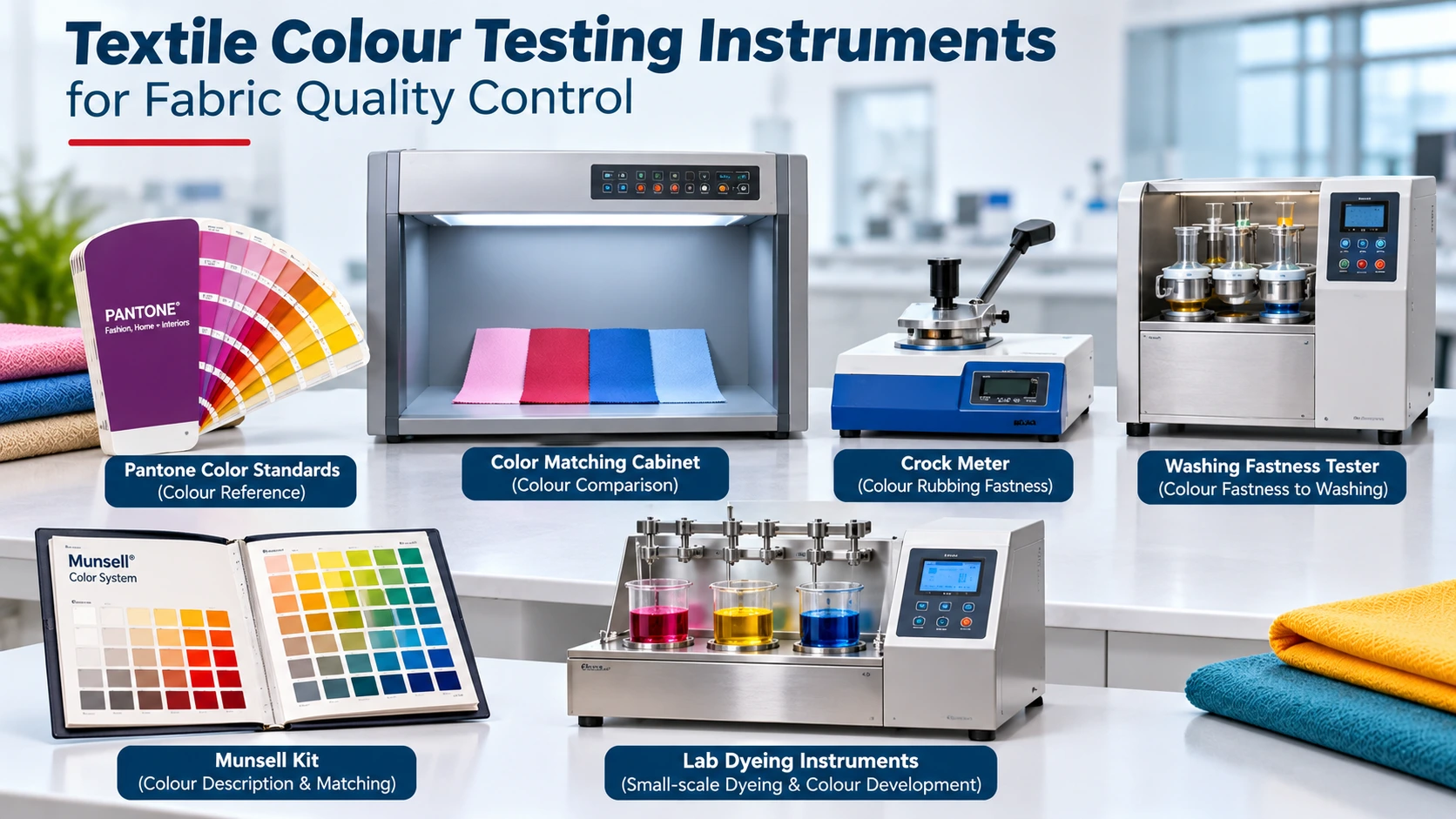
Equipment such as a Color Matching Cabinet, Crock Meter, Washing Fastness Tester and laboratory dyeing instruments supports different stages of colour development and quality assessment. Pantone Color Standards, Pantone Swatches and Munsell Kit references are also used for colour communication and evaluation.
Amith Garment Services supplies textile testing instruments, colour matching products, Pantone references and laboratory equipment for textile and garment applications.
This guide explains the important colour testing instruments, their uses and how to select suitable solutions for textile laboratories.
1. What Is Textile Colour Testing?
Textile colour testing involves evaluating the appearance, consistency and performance of colours applied to textile materials.
It helps manufacturers determine whether a fabric or garment meets the required colour specifications.
Colour testing may involve:
- Comparing fabric shades against approved references
- Evaluating colour differences under controlled lighting
- Testing resistance to washing
- Checking colour transfer during rubbing
- Assessing colour changes due to perspiration
- Evaluating colour response to light exposure
- Comparing laboratory dyeing samples
The exact test depends on the fabric, dyeing process, customer specification and applicable test method.
2. Color Matching Cabinet: Importance in Textile Shade Evaluation
A Color Matching Cabinet is used to visually compare colours under controlled lighting conditions.
The appearance of a fabric colour can change depending on the light source. A fabric may appear similar to a reference under one lighting condition but different under another. This phenomenon is commonly associated with metamerism.
A colour matching cabinet provides different specified light sources to help assess colour appearance under controlled conditions.
Common light sources
Depending on the cabinet configuration, available light sources may include:
- D65 daylight
- TL84
- CWF
- Incandescent or INCA lighting
- UV lighting
Each light source represents a particular viewing condition. The exact configuration depends on the instrument model.
Applications of a Color Matching Cabinet
- Comparing fabric shades
- Evaluating yarn colours
- Checking garment accessories
- Comparing approved and production samples
- Assessing colour differences between batches
- Supporting colour approval processes
How to select a Color Matching Cabinet
Consider the available light sources, viewing area, operating controls, maintenance requirements and suitability for your testing procedures.
A controlled viewing environment helps improve consistency in visual shade assessment.
3. Pantone Color Standards in Textile Manufacturing
Pantone Color Standards are widely used colour references that help textile and apparel businesses communicate specific colours.
During product development, designers, manufacturers, buyers and suppliers need a common colour reference to reduce confusion when discussing shades.
Pantone references are available in different formats and product families. Some references are specifically designed for fashion, textiles, home and interiors applications.
Why are Pantone Color Standards important?
- They support colour communication.
- They help identify specified shades.
- They assist fabric and garment development.
- They support communication between buyers and manufacturers.
- They help maintain consistency during production.
Pantone references should be selected according to the intended material, application and required colour system.
4. Pantone Swatches for Fabric Colour Selection
Pantone Swatches provide physical colour references that can be used during textile development and shade approval.
A Pantone Swatch Library or suitable cotton reference product can help users compare colours in a format relevant to textile and apparel applications.
Applications of Pantone Swatches
- Selecting fabric colours
- Comparing textile shades
- Preparing seasonal colour collections
- Communicating colour requirements to suppliers
- Reviewing product development samples
- Supporting buyer and manufacturer discussions
When selecting Pantone Swatches, consider the product format, colour system, reference edition and intended application.
It is also important to use current and suitable references because colour libraries may be updated.
5. Pantone Color Products for Textile and Apparel Businesses
Pantone Color Products include colour guides, cotton references, swatch libraries and other colour communication tools.
These products are useful for businesses involved in fashion, garment manufacturing, textile development, home furnishings and product design.
Common applications
Fashion design: Designers use colour references while planning seasonal collections.
Fabric development: Manufacturers compare sample fabrics with approved colour references.
Garment production: Production teams use specified colour references to communicate shade requirements.
Quality control: Quality teams compare production materials with the approved colour reference.
Choosing the correct Pantone product requires checking the intended colour system, material type and product format.
6. Munsell Kit for Colour Evaluation
A Munsell Kit is a colour reference system used to describe and compare colours through organised colour attributes.
The Munsell system commonly describes colours using three dimensions:
- Hue
- Value
- Chroma
Hue describes the colour family, value indicates lightness or darkness, and chroma represents colour intensity.
Applications of a Munsell Kit
- Colour evaluation
- Comparing colour samples
- Research and educational applications
- Visual colour communication
- Material and product assessment
A Munsell Kit and Pantone references serve different purposes. They should not be treated as interchangeable systems without checking the required colour specification.
7. Textile Marker Pen for Fabric Identification
A Textile Marker Pen is used for marking textile materials during production, inspection and sample preparation.
Depending on the marker type, it may be designed for temporary or more permanent marking.
Applications
- Identifying fabric samples
- Marking cutting and stitching positions
- Labelling inspection specimens
- Organising fabric swatches
- Identifying production batches
- Marking measurement points
How to select a Textile Marker Pen
Consider the fabric composition, colour, marking permanence, visibility and whether the mark needs to be removed.
Always test the marker on a sample before applying it to finished material. The marking method should not damage the fabric or affect its appearance.
8. What Is Colour Fastness Testing?
Colour Fastness Testing evaluates the resistance of a textile material’s colour to different external conditions.
During washing, rubbing, perspiration or exposure to light, dyes and pigments may change colour or transfer to another material.
Testing helps assess these characteristics under defined procedures.
Important types of Colour Fastness Testing
- Colour fastness to washing
This test evaluates how textile colours respond to specified washing conditions.
- Colour fastness to rubbing
This test evaluates the transfer of colour when a fabric surface is rubbed against another material.
- Colour fastness to perspiration
This evaluates colour behaviour when textile materials are exposed to specified artificial perspiration conditions.
- Colour fastness to light
This evaluates resistance to colour change following controlled light exposure.
- Colour fastness to hot pressing and dry heat
These methods assess colour behaviour under specified temperature and pressing conditions.
The appropriate test method should be selected according to the material and customer requirements.
9. Crock Meter for Colour Fastness to Rubbing
A Crock Meter is used to evaluate colour fastness to rubbing.
The test involves rubbing a textile specimen against a specified adjacent fabric under defined conditions.
Both dry and wet rubbing procedures may be conducted, depending on the required method.
How a Crock Meter works
- Prepare and condition the textile specimen as required by the test method.
- Attach the specimen to the instrument.
- Prepare the rubbing cloth.
- Conduct the rubbing movement using the specified test conditions.
- Remove the rubbing cloth.
- Assess colour transfer using the applicable evaluation scale.
Applications
- Testing dyed fabrics
- Evaluating printed textiles
- Checking garment colour transfer
- Assessing textile accessories
- Supporting buyer quality requirements
A Crock Meter should be selected according to the required test method, finger dimensions, operating mechanism and relevant accessories.
10. Washing Fastness Tester for Textile Quality Control
A Washing Fastness Tester is used to evaluate the resistance of textile colours to washing.
The test generally involves treating a fabric specimen with a specified washing solution under controlled conditions.
Depending on the method, the procedure may involve specified temperatures, durations, detergents, mechanical action and adjacent fabrics.
Importance of washing fastness testing
- Evaluating colour retention
- Identifying colour transfer
- Comparing dyeing performance
- Assessing fabric suitability
- Supporting garment quality control
After testing, colour change and staining are evaluated using appropriate grey scales or other specified assessment systems.
The washing procedure should follow the selected ISO, AATCC or buyer-specific method rather than using one universal test condition.
11. Imported Washing Machine for Textile Testing
An Imported Washing Machine may be used in textile laboratories when the equipment is designed for controlled washing and testing procedures.
It is important to distinguish a laboratory washing tester from a regular commercial or domestic washing machine.
Laboratory testing requires control over the parameters specified by the relevant method. These may include temperature, time, mechanical action, loading conditions and washing solution.
What to check before purchasing
- Intended testing application
- Applicable test methods
- Temperature control
- Timer and operating controls
- Capacity and specimen arrangement
- Availability of accessories
- Installation and maintenance support
The machine should be selected according to the actual laboratory testing requirement.
12. Lab Dyeing Instruments for Colour Development
Lab Dyeing Instruments are used to conduct small-scale dyeing trials before moving to larger production batches.
They help textile developers evaluate dye combinations, colour recipes and processing conditions.
Common laboratory dyeing equipment
Depending on the laboratory setup, equipment may include:
- Laboratory beaker dyeing machines
- Infrared dyeing machines
- Laboratory jiggers
- Padding mangles
- Sample preparation equipment
Benefits of laboratory dyeing
Sample development: Small fabric or yarn samples can be dyed before bulk production.
Colour recipe evaluation: Different dyeing combinations can be assessed.
Process comparison: Laboratory trials help evaluate processing conditions.
Production planning: Sample testing can support decisions before larger production runs.
The equipment should match the type of textile material, dyeing process, sample quantity and temperature requirements.
13. How to Choose the Right Colour Testing Instruments
Selecting colour testing instruments requires understanding the purpose of each product.
Consider the following factors:
- Testing requirement: Determine whether the requirement is visual colour matching, washing fastness, rubbing fastness or laboratory dyeing.
- Material type: Check whether you are testing cotton, polyester, blended fabric, yarn or finished garments.
- Test method: Identify the applicable ISO, AATCC or buyer-specific procedure.
- Light source: For colour matching cabinets, check the available lighting options.
- Accessories: Verify whether rubbing cloths, adjacent fabrics, grey scales and other accessories are required.
- Calibration and maintenance: Check the instrument’s maintenance and calibration requirements.
- Operator training: Ensure that laboratory personnel understand the correct procedure.
- Documentation: Maintain records of samples, testing conditions and results.
14. Why Choose Amith Garment Services?
Amith Garment Services has been supplying textile and garment testing instruments since 1999.
Based in Bangalore, the company provides a range of products for colour testing, fabric testing, garment quality control and textile laboratory applications.
Its product categories include Color Matching Cabinets, Pantone Color Standards, garment testing instruments, laboratory dyeing machines and textile consumables.
Customers can also enquire about equipment selection, installation assistance, demonstration, operator training and relevant technical support.
For textile manufacturers and garment exporters, choosing the correct colour evaluation and testing equipment is an important part of maintaining product consistency.
Frequently Asked Questions:
1. What is a Color Matching Cabinet used for?
A Color Matching Cabinet is used to compare fabric, yarn and other material colours under controlled lighting conditions.
2. What are Pantone Color Standards?
Pantone Color Standards are organised colour references used to communicate and identify specified colours in design, textiles and product development.
3. What is the difference between Pantone Swatches and a Color Matching Cabinet?
Pantone Swatches provide physical colour references, while a Color Matching Cabinet provides controlled lighting conditions for visual colour comparison.
4. What does a Crock Meter test?
A Crock Meter evaluates the colour transfer of a textile material during rubbing, including dry and wet rubbing procedures.
5. What is the purpose of a Washing Fastness Tester?
A Washing Fastness Tester evaluates the resistance of textile colours to washing under specified test conditions.
6. What is a Munsell Kit used for?
A Munsell Kit is used to describe and compare colours based on hue, value and chroma.
7. Why is Colour Fastness Testing important?
Colour Fastness Testing helps assess whether textile colours resist fading or transferring under conditions such as washing, rubbing, perspiration and light exposure.
8. What are Lab Dyeing Instruments?
Lab Dyeing Instruments are used to conduct small-scale textile dyeing trials and evaluate colour development before production.
Conclusion
Textile colour evaluation requires suitable reference systems and testing equipment. A Color Matching Cabinet, Pantone Swatches, Munsell Kit, Crock Meter and Washing Fastness Tester each serve a different purpose in textile quality control.
Selecting the right equipment according to the fabric, colour system and testing method can help laboratories maintain organised and consistent evaluation procedures.
Looking for Textile Colour Testing and Pantone Products?
Contact Amith Garment Services to discuss your requirements for colour matching cabinets, Pantone references, crock meters, washing fastness testers and laboratory dyeing instruments.
Website: https://www.amithgarmentservices.com/
Email: textiletesting@amithgarmentservices.com
Phone: +91 98450 53517