
Introduction
Quality control is an essential part of textile and garment manufacturing. From raw yarn and fabric production to garment stitching and final inspection, every stage requires proper testing to maintain product quality, consistency and buyer requirements. Textile manufacturers, garment exporters and testing laboratories use specialised instruments to evaluate fabric weight, strength, dimensions, appearance and construction.
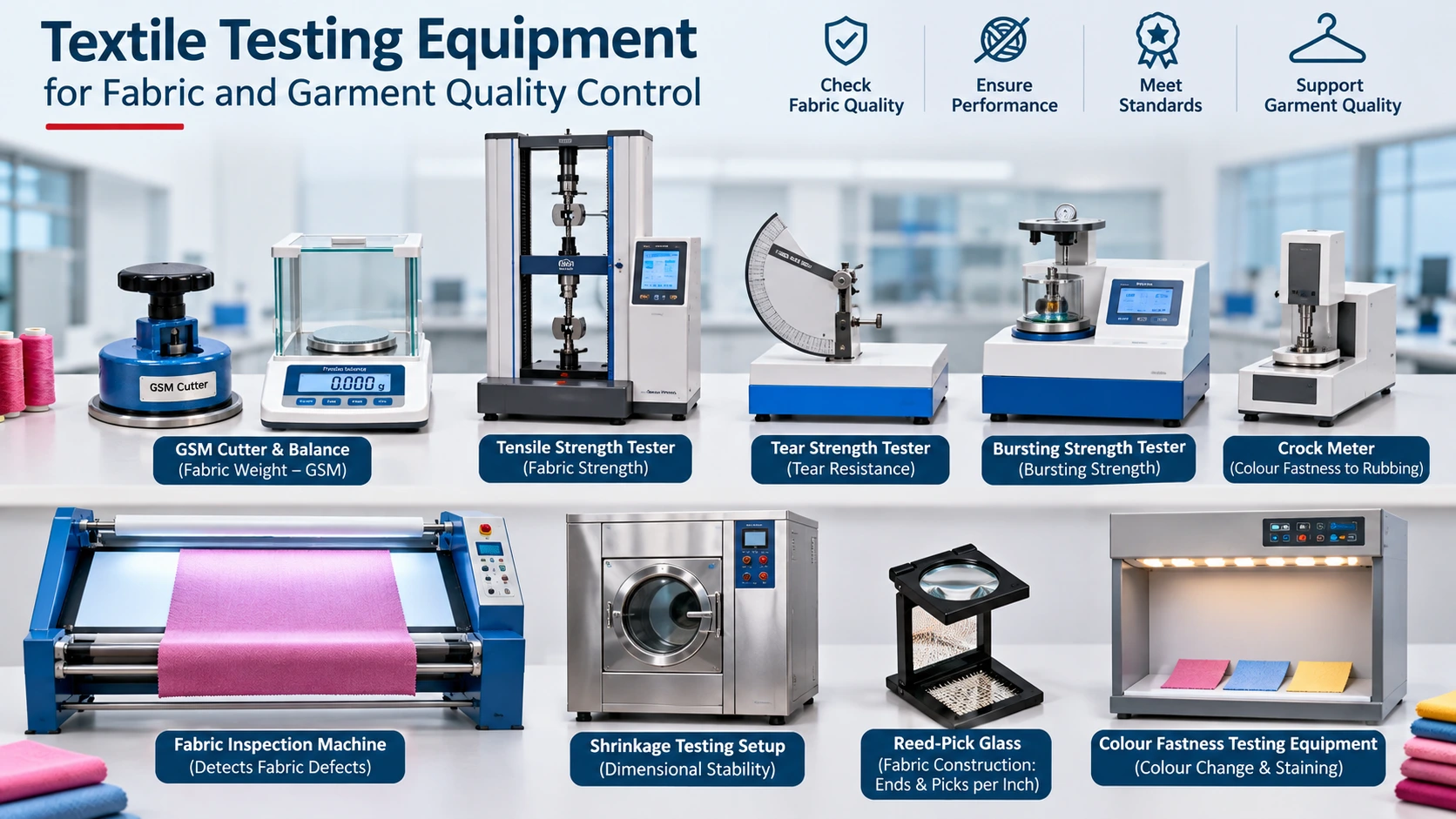
Choosing the right Fabric Testing Equipments helps manufacturers identify defects, reduce material wastage and maintain consistent production quality. Equipment such as a Fabric Inspection Machine, GSM Testing Machine, Fabric Strength Testing Machine, Shrinkage Template and Scale, and Yarn Testing Equipments supports different stages of textile quality control.
Amith Garment Services, established in 1999, supplies textile testing and quality control instruments for garment manufacturers, exporters and laboratories across India. Its product range includes fabric testing, garment testing, yarn testing, laboratory instruments, swatch cutting machines and related accessories.
This guide explains the important textile testing instruments, their applications and how businesses can select suitable equipment for their laboratories.
1. What Are Fabric Testing Equipments?
Fabric Testing Equipments are instruments used to examine the physical and performance properties of textile materials. They help determine whether fabric meets the required specifications before it is used for garment production or supplied to customers.
Common testing parameters include:
- Fabric weight and GSM
- Tensile and tearing strength
- Fabric shrinkage
- Fabric construction
- Surface defects
- Dimensional stability
- Fabric appearance and consistency
- Yarn properties
Different instruments are required for different tests. A GSM cutter cannot replace a tensile strength tester, and a fabric inspection machine cannot provide the same measurements as a shrinkage testing instrument.
A properly planned textile laboratory should select instruments according to the fabric types, production processes, customer specifications and applicable test methods.
2. Fabric Inspection Machine: Identifying Fabric Defects
A Fabric Inspection Machine is used to examine woven and knitted fabrics for visible defects before cutting and garment manufacturing.
Fabric rolls are passed through the inspection system, allowing operators to observe the material under suitable lighting. The machine helps identify weaving defects, dyeing variations, printing defects, stains, holes and other visible irregularities.
Common applications
- Inspecting incoming fabric rolls
- Identifying weaving and knitting defects
- Checking dyeing and printing irregularities
- Examining fabric appearance
- Measuring inspected fabric length
- Preparing rolls for further processing
A suitable fabric inspection system may include inspection lighting, adjustable fabric movement, measuring counters and roll winding arrangements.
The required working width, operating speed, lighting arrangement and roll-handling capacity should be considered before purchasing.
3. GSM Testing Machine and GSM Machine
Fabric GSM means grams per square metre. It indicates the weight of a fabric per unit area and is an important parameter in textile quality control.
A GSM Testing Machine helps determine whether the fabric weight is consistent with the specified requirement.
A typical GSM testing process involves cutting a fabric specimen of a known area using a GSM cutter and measuring its weight using a suitable balance.
How GSM is measured
- Place the fabric flat without stretching it.
- Use an appropriate GSM cutter to prepare a specimen.
- Check that the specimen has the required cutting area.
- Weigh the specimen using a suitable GSM balance.
- Calculate or read the GSM value according to the equipment arrangement.
- Compare the result with the required specification.
For a circular specimen with an area of 100 square centimetres, the measured weight in grams is multiplied by 100 to obtain GSM.
GSM Scale
A GSM Scale or digital GSM balance is used to measure the weight of prepared fabric specimens. Depending on the model, it may provide direct GSM readings or display the specimen weight for calculation.
When selecting a GSM Machine, consider weighing capacity, sensitivity, calibration, display type and compatibility with the GSM cutter.
4. Small GSM Cutter for Fabric Sample Preparation
A Small GSM Cutter is used to cut fabric specimens for weight measurement. Accurate sample preparation is important because incorrect dimensions can affect the final GSM result.
The instrument should have a sharp cutting mechanism, a suitable cutting pad and a secure arrangement for handling the fabric.
It is useful in textile laboratories, garment quality departments and fabric inspection facilities where regular fabric weight testing is performed.
5. Fabric Swatch Cutters and Swatch Making Machine
Fabric Swatch Cutters are used to prepare fabric samples of consistent dimensions. These samples are useful for shade approval, product development, buyer presentations and laboratory testing.
A Swatch Making Machine can support the preparation of organised fabric samples for textile and apparel applications.
Applications
- Preparing fabric samples for buyer approval
- Creating fabric sample collections
- Comparing different colours and materials
- Organising textile development samples
- Preparing swatches for laboratory evaluation
Before purchasing fabric swatch cutters or a swatch making machine, consider cutting dimensions, material compatibility, operating method and the number of samples required.
6. Fabric Rolling Machine for Textile Production
A Fabric Rolling Machine is used to inspect, handle and roll fabric into organised bundles or rolls.
It can support fabric handling activities during inspection, storage and preparation for garment production.
Depending on the configuration, a machine may provide forward and reverse movement, adjustable speed, inspection lighting and fabric-length measurement.
Why fabric rolling is important
Proper fabric rolling helps maintain organised material handling, makes inspection easier and supports convenient transportation and storage.
Manufacturers should evaluate working width, roll diameter, operating speed and fabric compatibility before selecting a machine.
7. Fabric Strength Testing Machine
Fabric strength is an important quality parameter because textile materials must withstand different forces during manufacturing and regular use.
A Fabric Strength Testing Machine is used to evaluate the mechanical properties of textile materials.
Common testing methods include:
Tensile strength testing
Tensile testing evaluates the force required to pull a fabric specimen until it breaks or reaches a defined endpoint.
Tear strength testing
Tear testing evaluates the force required to continue a tear in a prepared fabric specimen.
Bursting strength testing
Bursting tests are commonly used to assess the resistance of knitted and other suitable fabrics to pressure applied over a defined area.
The correct method depends on the material and applicable test standard.
A fabric strength testing setup may include tensile testers, tear strength testers and bursting strength testers.
8. Shrinkage Template and Scale
Fabric shrinkage refers to dimensional reduction after processes such as washing, drying or other treatments.
A Shrinkage Template and Scale helps measure changes in fabric dimensions.
The process generally involves marking a defined measurement area, subjecting the specimen to the required treatment and measuring the dimensions again.
How shrinkage is calculated
Shrinkage percentage can be calculated using:
Shrinkage (%) = [(Original dimension − Final dimension) / Original dimension] × 100
For example, if a marked fabric length changes from 50 cm to 48 cm, the shrinkage is 4%.
A Shrinkage Template and Scale can help measure dimensional changes in length and width.
Why shrinkage testing is important
- Evaluating dimensional stability
- Checking fabric behaviour after washing
- Supporting garment size consistency
- Comparing fabric batches
- Assessing material suitability for production
The template dimensions and procedure should match the applicable test method and customer requirements.
9. Yarn Testing Equipments
Yarn quality affects fabric appearance, strength and manufacturing performance. Yarn Testing Equipments help laboratories evaluate different yarn properties.
Depending on the testing requirement, instruments may be used for yarn count, tensile strength, twist and other characteristics.
Important yarn testing parameters
- Yarn count
- Yarn strength
- Elongation
- Twist
- Uniformity
- Appearance
Yarn testing helps manufacturers assess raw material consistency before fabric production.
10. Reed-Pick Glass for Fabric Construction Analysis
A Reed-Pick Glass is a compact inspection tool used to examine fabric construction.
It helps determine:
- Ends per inch (EPI)
- Picks per inch (PPI)
- Weave structure
- Fabric construction details
- Local fabric irregularities
Some models include a pointer or lighting arrangement to improve visibility during inspection.
This instrument is useful for fabric inspection teams, textile laboratories and quality control departments.
11. Garment Quality Testing Instruments
Garment quality testing involves examining the finished product and its components to identify possible quality issues.
Garment Quality Testing Instruments may include:
- Button snap pull testers
- Fabric strength testing machines
- Shrinkage testing accessories
- GSM testing instruments
- Colour fastness testing equipment
- Fabric inspection systems
The selection depends on garment type, buyer specifications, product category and required testing procedures.
Testing should be conducted using appropriate equipment and documented methods.
12. How to Choose the Right Textile Testing Equipment
Selecting textile laboratory equipment requires understanding the actual testing requirements.
Consider the following factors:
- Testing requirements: Identify whether you need to test fabric weight, strength, shrinkage, construction or appearance.
- Material type: Consider woven fabrics, knitted fabrics, non-woven materials, yarn and finished garments.
- Applicable standards: Check the relevant ISO, ASTM, AATCC or buyer-specific method before selecting an instrument.
- Measurement capacity: Verify the working range, sample dimensions, load capacity and measurement sensitivity.
- Calibration: Check calibration arrangements and documentation requirements.
- Installation and training: Consider operator training and installation support.
- Technical assistance: Check whether maintenance, calibration and repair support are available.
- Laboratory space: Plan the equipment layout, power requirements and working area.
13. Importance of Textile Testing in Quality Control
Textile testing supports informed decisions at different stages of production.
It helps manufacturers identify material variations, evaluate fabric performance and compare production batches against defined specifications.
Regular testing can also help reduce avoidable production problems, improve inspection processes and support documentation for customer audits.
However, the usefulness of a test depends on proper sampling, suitable equipment, trained operators and correct test procedures.
14. Why Choose Amith Garment Services for Textile Testing Equipment?
Amith Garment Services has been serving the textile and garment industry since 1999. Based in Bangalore, the company supplies a range of textile testing and quality control instruments for manufacturers, exporters and laboratories.
Its product categories include fabric testing equipment, garment testing equipment, yarn testing equipment, swatch cutting machines, laboratory instruments and calibration and repair services.
Customers can seek assistance with equipment selection, installation, demonstration, operator training and laboratory planning, depending on the product and service requirement.
For businesses planning a new textile laboratory or upgrading an existing quality control facility, selecting instruments according to actual testing requirements is an important first step.
Frequently Asked Questions:
1. What are the most commonly used Fabric Testing Equipments?
Common instruments include GSM cutters and balances, fabric inspection machines, tensile strength testers, tear strength testers, bursting strength testers, shrinkage templates, crock meters and colour fastness testing equipment.
2. What is the purpose of a GSM Testing Machine?
A GSM Testing Machine is used to determine the weight of fabric in grams per square metre. It helps assess fabric weight consistency.
3. What is the difference between a GSM cutter and a GSM scale?
A GSM cutter prepares a fabric specimen of a defined area, while a GSM scale or balance measures its weight or displays the calculated GSM value.
4. Why is a Fabric Inspection Machine required?
It helps operators examine fabric rolls and identify visible weaving, knitting, dyeing, printing and surface defects.
5. What does a Shrinkage Template and Scale measure?
It helps measure dimensional changes in fabric after a specified treatment, such as washing and drying.
6. Which equipment is used for fabric strength testing?
Tensile strength testers, tear strength testers and bursting strength testers are used for different fabric strength evaluation methods.
7. What is the use of Reed-Pick Glass?
It is used to examine fabric construction and determine ends per inch and picks per inch.
8. Where can I find textile testing equipment in India?
Amith Garment Services, based in Bangalore, supplies textile testing and quality control instruments to manufacturers, exporters and laboratories across India.
Conclusion
Textile testing is an important part of manufacturing quality control. From Fabric Inspection Machines and GSM Testing Machines to Fabric Strength Testing Machines, Shrinkage Templates and Yarn Testing Equipments, each instrument supports a specific evaluation requirement.
Choosing suitable equipment based on fabric type, testing method, measurement range and applicable standards can help establish an organised textile laboratory.
Looking for Fabric Testing Equipments in India?
Contact Amith Garment Services to discuss your textile testing requirements and find suitable instruments for your laboratory.
Website: https://www.amithgarmentservices.com/
Email: textiletesting@amithgarmentservices.com
Phone: +91 98450 53517