
Introduction
A textile testing laboratory plays an important role in maintaining the quality of fabrics, yarns, garments and textile accessories. Manufacturers and garment exporters need reliable testing procedures to evaluate material properties, identify production variations and meet customer specifications.
A well-equipped laboratory requires more than testing machines. It also needs suitable consumables, chemicals, measuring instruments, sample preparation tools and regular equipment maintenance.
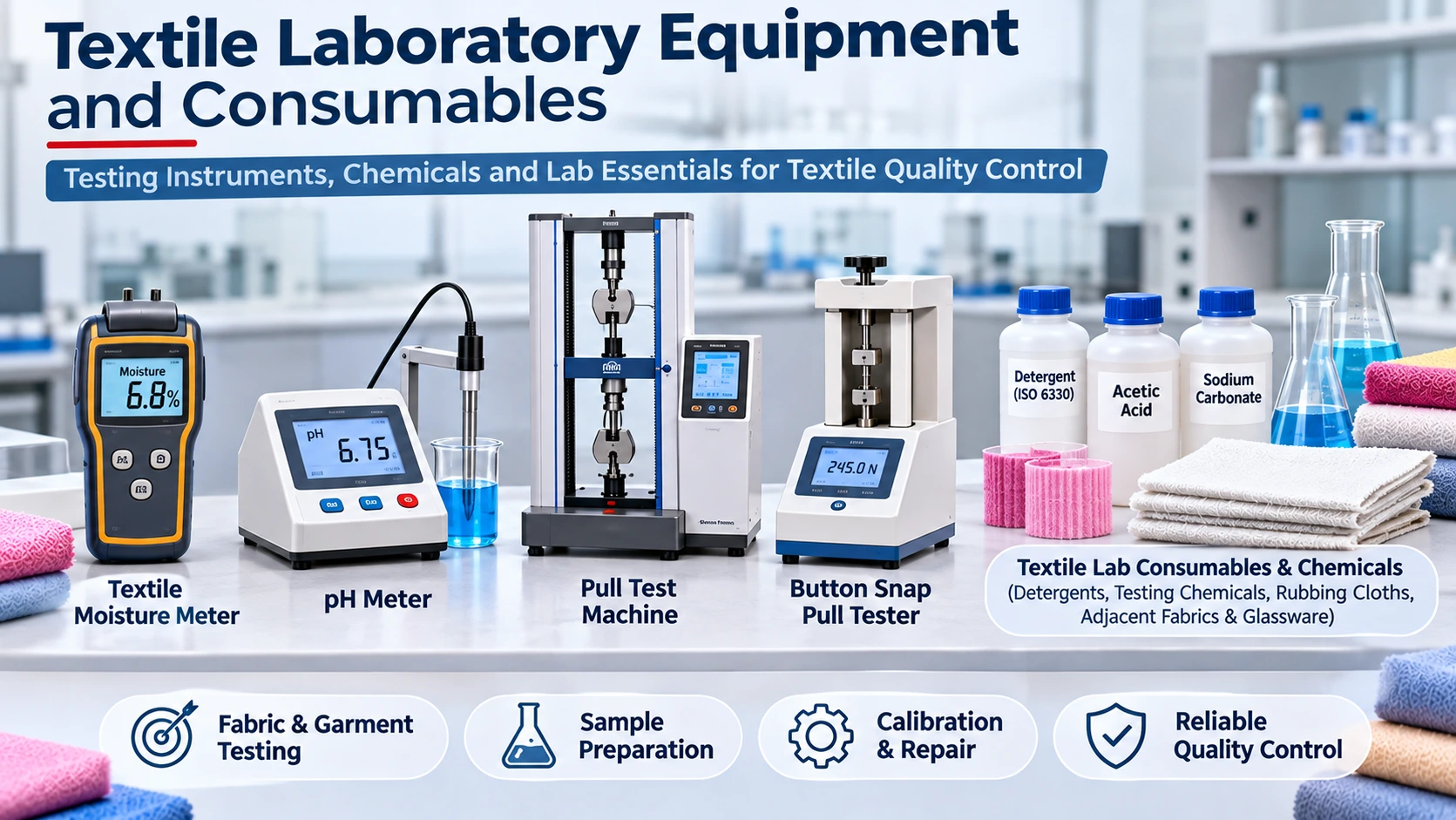
Products such as Textile Moisture Meter, pH Meter, Pull Test Machine and Button Snap Pull Testers are used for different quality control applications. In addition, Textile Lab Consumables and Chemicals support the preparation and execution of laboratory testing procedures.
Regular Calibrations / Repair of Testing Instruments also help laboratories maintain equipment performance and measurement reliability.
Amith Garment Services, established in 1999 and based in Bangalore, supplies textile testing instruments, laboratory consumables, garment testing equipment and related technical services for the textile and apparel industry.
This guide explains the important textile laboratory products, their applications and the factors to consider when selecting testing equipment.
1. What Is Textile Laboratory Equipment?
Textile laboratory equipment includes instruments and accessories used to examine the physical, chemical and performance properties of textile materials.
These instruments help laboratories assess different parameters throughout the textile manufacturing process.
Common testing areas include:
- Fabric strength
- Fabric weight
- Moisture content
- pH measurement
- Garment component strength
- Yarn properties
- Colour performance
- Fabric dimensional stability
- Textile material quality
Different instruments are required for different applications. Therefore, laboratories should select equipment based on the tests they perform, the materials they handle and the specifications they need to meet.
2. Textile Lab Consumables and Chemicals
Textile Lab Consumables and Chemicals are materials used during laboratory testing, sample preparation, dyeing trials and quality evaluation.
Unlike testing instruments, consumables are generally used during the testing process and may need regular replacement.
Common categories of textile laboratory consumables
Depending on the testing application, laboratory consumables may include:
- Washing and testing chemicals
Specified detergents and chemical reagents may be required for washing fastness, pH and other laboratory procedures.
- Colour testing accessories
Rubbing cloths, adjacent fabrics and evaluation materials may be required for particular colour fastness tests.
- Sample preparation materials
Cutting accessories, templates, containers and other laboratory tools help prepare samples for testing.
- Dyeing laboratory materials
Laboratory dyeing trials may require suitable chemicals, containers and supporting accessories according to the dyeing process.
- General laboratory consumables
Beakers, conical flasks, test tubes, wash bottles and related laboratory items support routine testing activities.
How to choose textile laboratory consumables
Consider the following:
- Intended test method
- Chemical compatibility
- Required specifications
- Supplier documentation
- Storage conditions
- Shelf life, where applicable
- Safety data and handling requirements
Always use the correct consumables specified by the relevant testing procedure. Substituting materials without checking compatibility may affect test results.
3. Textile Moisture Meter for Fabric and Yarn Testing
A Textile Moisture Meter is used to determine the moisture content of textile materials.
Moisture content can affect material handling, storage, processing and product quality. Measuring moisture is particularly useful when working with materials such as cotton, polyester, viscose, silk and yarn.
How a Textile Moisture Meter works
Depending on the instrument design, moisture measurement may involve suitable sensing technology and calibrated measurement settings.
The operator places or connects the appropriate sensor to the material and obtains a reading according to the instrument’s instructions.
Some digital models provide moisture readings as percentages and may support different electrodes or probes for specific material forms.
Applications of a Textile Moisture Meter
- Measuring moisture in cotton
- Checking moisture in textile fibres
- Evaluating yarn moisture
- Monitoring textile material during storage
- Supporting raw material quality control
- Comparing moisture readings across batches
How to select a Textile Moisture Meter
Before purchasing, consider:
- Material compatibility
- Measurement range
- Display and reading format
- Probe or electrode availability
- Calibration arrangements
- Portability
- Battery life
- Operating instructions
A moisture meter should be used according to the material-specific procedure and the instrument’s operating guidelines.
4. pH Meter for Textile Industry Applications
A pH Meter is used to measure the acidity or alkalinity of a liquid solution.
In textile manufacturing, pH measurement is relevant to processes such as dyeing, finishing, washing and chemical treatment.
The pH of a textile extract or processing solution can influence process consistency and material evaluation.
Applications of a pH Meter
- Measuring textile extract pH
- Checking processing solutions
- Evaluating washing solutions
- Monitoring laboratory dyeing conditions
- Supporting chemical quality control
A textile pH measurement may require preparing a fabric extract using the procedure specified by the relevant method.
The instrument measures the pH of the prepared liquid rather than directly measuring the pH of a dry fabric surface.
How to choose a pH Meter
Consider:
- Portable or benchtop configuration
- Measurement range
- Display resolution
- Electrode compatibility
- Temperature compensation
- Calibration options
- Buffer solution requirements
- Maintenance requirements
Proper electrode care and regular calibration checks are important for reliable measurements.
Understanding pH Meter Manufacturers
When comparing pH Meter Manufacturers, laboratories should look beyond the product price.
Evaluate the instrument’s technical specifications, electrode availability, calibration support, replacement parts, documentation and suitability for textile applications.
A suitable pH meter should meet the laboratory’s measurement requirements and provide practical operating support.
5. Pull Test Machine for Garment Quality Testing
A Pull Test Machine is used to evaluate the force required to pull or separate a component from a textile product.
In garment manufacturing, pull testing is particularly relevant for evaluating attachments and components that must remain securely fixed during normal use.
The exact testing arrangement depends on the component, fixture and applicable test procedure.
Applications of a Pull Test Machine
- Testing garment attachments
- Evaluating component holding strength
- Assessing fastening systems
- Supporting garment accessory inspection
- Checking specified quality requirements
Important selection factors
- Force measurement capacity
- Measurement sensitivity
- Grip and fixture arrangements
- Digital or analogue display
- Operating method
- Calibration documentation
- Compatibility with the intended test
A Pull Test Machine should be selected according to the actual component and force range being evaluated.
6. Button Snap Pull Testers
Button Snap Pull Testers are specialised instruments used to determine the force required to remove buttons, snaps and similar attachments from garments.
These instruments are relevant to apparel quality control because loosely attached components can create product safety and quality concerns.
How button snap pull testing works
The garment component is secured using suitable fixtures or jaws. The instrument applies a controlled pulling force according to the selected procedure.
The force required to detach or reach the defined test endpoint is measured and recorded.
Components that may be evaluated
- Buttons
- Press studs
- Snaps
- Eyelets
- Rivets
- Zippers and selected attachments using suitable fixtures
- Other garment accessories
Why button snap testing is important
It helps manufacturers assess attachment strength, identify weak fastening arrangements and evaluate whether garment components meet specified requirements.
What to check before purchasing
- Available force range
- Measurement sensitivity
- Fixture and jaw arrangements
- Compatibility with different attachments
- Calibration weights or verification arrangements
- Relevant buyer requirements
Amith Garment Services lists button snap pull testing equipment with different fixture options. The required configuration should be confirmed before ordering.
7. Calibration of Textile Testing Instruments
Calibration is an important part of textile laboratory management.
Over time, instruments may experience measurement deviations due to usage, environmental conditions, wear and other factors.
Calibration involves comparing an instrument’s measurement performance with suitable reference standards under defined conditions.
Why instrument calibration matters
Measurement reliability: Calibration helps assess whether the instrument provides measurements within the required limits.
Quality documentation: Laboratories may need calibration records for internal quality systems and customer audits.
Equipment monitoring: Calibration results can help identify changes in instrument performance.
Process consistency: Reliable measurement supports comparison between samples and production batches.
Common textile instruments requiring calibration or verification
Depending on the instrument and applicable requirements, calibration or verification may be relevant to:
- GSM balances
- Tensile testing machines
- Pull test machines
- pH meters
- Moisture meters
- Temperature measuring devices
- Dimensional measuring instruments
- Other laboratory equipment
The calibration frequency should be determined based on instrument usage, manufacturer guidance, measurement risk and laboratory quality procedures.
Not every instrument requires the same calibration interval.
8. Repair of Textile Testing Instruments
Laboratory equipment may develop problems due to regular use, mechanical wear, electrical faults, sensor issues or improper handling.
Timely repair can help laboratories restore equipment functionality and reduce interruptions to testing activities.
Common reasons for instrument repair
- Display or electronic problems
- Sensor malfunction
- Mechanical wear
- Damaged cables or connections
- Inconsistent readings
- Timer or control issues
- Problems with moving components
- Worn-out accessories
What should be checked before arranging repair?
- Identify the instrument model and serial number.
- Describe the issue clearly.
- Record any error messages.
- Explain when the problem started.
- Check the operating and maintenance manual.
- Ask about spare parts and service availability.
- Confirm whether calibration or performance verification is required after repair.
Repairs should be performed by suitably qualified personnel. An instrument should not be returned to routine testing solely because it powers on after repair; its performance should be checked according to the applicable procedure.
9. Calibrations / Repair of Testing Instruments: Choosing a Service Provider
Selecting a service provider for Calibrations / Repair of Testing Instruments is important for maintaining laboratory operations.
A suitable provider should understand the instrument’s application and the measurement requirements of the laboratory.
Factors to consider
Technical knowledge: The service provider should understand the equipment type and its operation.
Calibration documentation: Confirm the type of calibration service and documentation provided.
Traceability: Where required, check whether the calibration is traceable to suitable reference standards.
Equipment compatibility: Confirm that the service provider supports the specific instrument model.
Spare parts: Check the availability of compatible replacement components.
Post-service verification: Understand the performance checks required after repair or maintenance.
Service records: Maintain documentation of repairs, calibration and equipment history.
Laboratories should also distinguish between a general calibration service and calibration performed by a laboratory accredited for the relevant scope. Accreditation should never be assumed without verification.
10. Textile Laboratory Maintenance Best Practices
Regular equipment maintenance supports laboratory organisation and helps reduce avoidable operational issues.
Recommended practices
- Follow manufacturer instructions
Use each instrument according to its operating manual.
- Keep equipment clean
Remove dust, fabric fibres and chemical residue using suitable cleaning procedures.
- Maintain consumables
Store chemicals, reagents and testing materials according to their labels and safety documentation.
- Monitor calibration status
Maintain an equipment register showing calibration dates and upcoming requirements.
- Train laboratory operators
Ensure operators understand sample preparation, equipment handling and testing procedures.
- Maintain service records
Document repairs, replacement parts, calibration results and maintenance activities.
- Protect equipment during storage
Use suitable storage arrangements to protect instruments from moisture, dust and accidental damage.
11. How to Set Up a Textile Testing Laboratory
Setting up a textile testing laboratory requires planning based on the products and testing procedures involved.
A small garment quality laboratory may require different instruments from a large textile manufacturing laboratory.
Step 1: Identify testing requirements
Prepare a list of the tests required for fabrics, yarns, garments and accessories.
Step 2: Select instruments
Choose suitable testing instruments based on measurement requirements and applicable methods.
Step 3: Plan laboratory space
Consider equipment dimensions, working areas, electrical requirements and sample storage.
Step 4: Arrange consumables
Identify the chemicals, accessories and reference materials needed for routine testing.
Step 5: Plan calibration
Establish a schedule for calibration and equipment verification.
Step 6: Train operators
Provide suitable training in sample preparation, equipment operation and documentation.
Step 7: Maintain records
Create records for test results, calibration, maintenance and equipment usage.
12. Why Choose Amith Garment Services?
Amith Garment Services has been serving the textile and garment industry since 1999.
Based in Bangalore, the company supplies testing instruments and laboratory products for textile manufacturers, garment exporters, buying houses and testing laboratories across India.
Its product range includes:
- Fabric testing equipment
- Garment testing equipment
- Yarn testing equipment
- Textile moisture meters
- pH meters
- Pull testing instruments
- Button snap pull testers
- Textile laboratory consumables
- Laboratory instruments
- Calibration and repair services
The company also offers support for instrument selection, installation, demonstration, operator training and laboratory planning, depending on the requirement.
Businesses planning a new textile laboratory or maintaining an existing testing facility can enquire about suitable instruments and available technical services.
Frequently Asked Quetsions:
1. What are Textile Lab Consumables and Chemicals?
Textile lab consumables and chemicals are materials used for textile testing, sample preparation, washing procedures, dyeing trials and other laboratory activities. Examples include specified detergents, testing chemicals, rubbing cloths, adjacent fabrics and laboratory glassware.
2. What is a Textile Moisture Meter used for?
A Textile Moisture Meter measures moisture content in materials such as cotton, polyester, viscose, silk and yarn, depending on the instrument's compatibility.
3. Why is a pH Meter required in the textile industry?
A pH Meter measures the acidity or alkalinity of processing solutions and prepared textile extracts, supporting dyeing, finishing and quality control processes.
4. What is a Pull Test Machine used for?
A Pull Test Machine measures the force applied during a pulling test to evaluate the strength of components or materials according to a specified testing procedure.
5. What is the difference between a Pull Test Machine and a Button Snap Pull Tester?
A Pull Test Machine can be configured for different pulling applications, while a Button Snap Pull Tester is designed specifically for evaluating the attachment strength of buttons, snaps and related garment components.
6. Why is calibration necessary for textile testing instruments?
Calibration helps assess measurement accuracy against suitable reference standards and supports reliable laboratory records.
7. How often should textile testing instruments be calibrated?
The frequency depends on instrument usage, manufacturer recommendations, measurement requirements, laboratory procedures and applicable quality systems.
8. Can textile testing instruments be repaired?
Yes, textile testing instruments can be repaired depending on the instrument model and fault. Repair requirements should be assessed by qualified service personnel, followed by suitable performance verification.
9. Where can I find textile testing equipment and laboratory consumables in India?
Amith Garment Services, based in Bangalore, supplies textile testing instruments, laboratory consumables and related products to businesses across India.